
Looking to store your solar energy and cut electricity bills in Northern Ireland? Here’s a quick guide to the top 5 solar batteries for homes.
- Dyness 10kWh: Affordable and modular, handles most evening needs. Costs £5,500–£8,000 installed.
- Soluna 10kWh: Budget-friendly with compact design. Installed cost: £6,000–£8,000.
- Duracell 10kWh: Smart app, fast charging, stackable. Installed cost: £6,500–£8,500.
- Tesla Powerwall 2: High capacity (13.5kWh), whole-home backup. Installed cost: £8,000–£11,000.
- LG Chem RESU 10: Slim, wall-mounted, reliable. Installed cost: £5,000–£7,000.
Key takeaways:
- Batteries can save £20,000–£30,000 over their lifetime.
- Most systems last 10–15 years with warranties covering 10 years.
- Choose based on your energy needs, budget, and compatibility with your solar setup.
For tailored advice, consult a professional installer like EECO Energy.
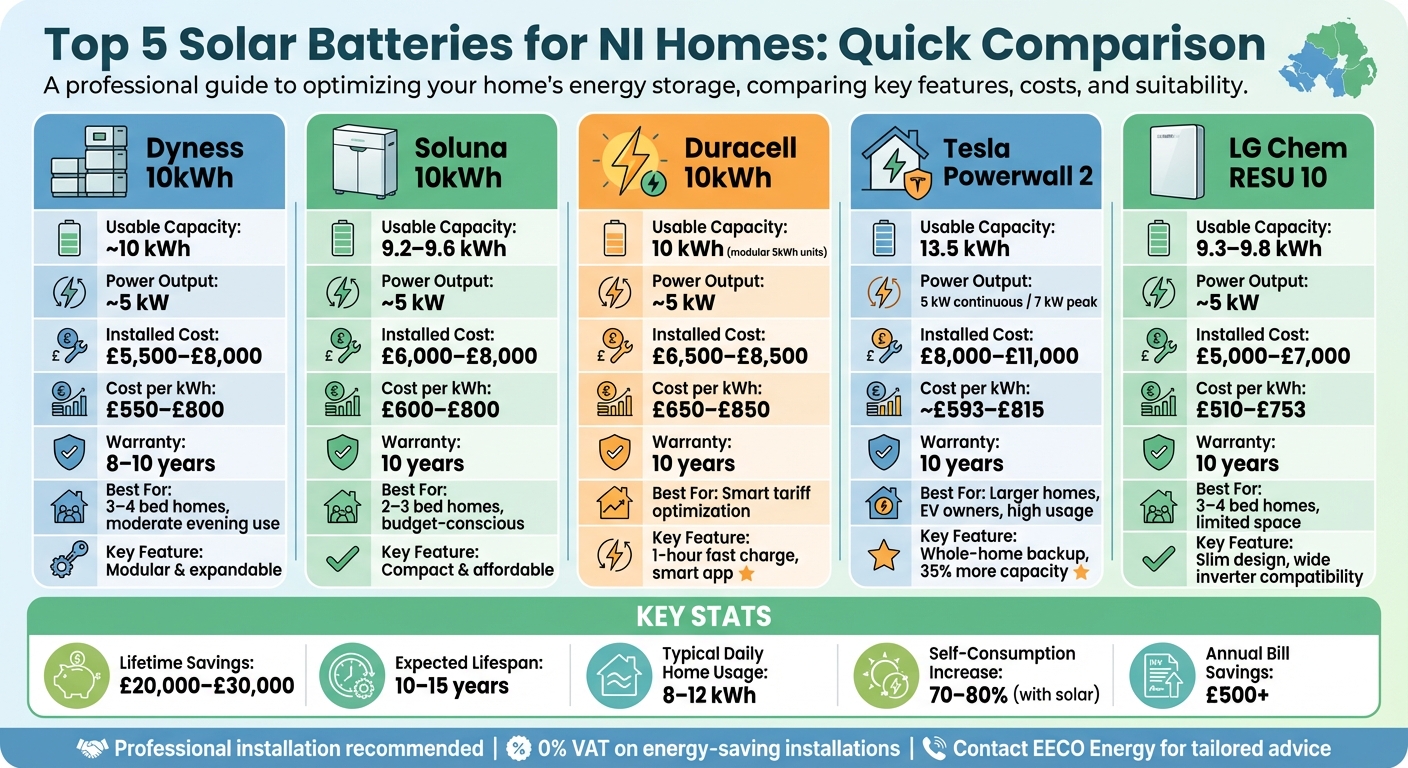
Solar Battery Comparison for Northern Ireland Homes: Capacity, Price & Features
1. Dyness 10kWh Battery

The Dyness 10kWh battery stands out with its modular lithium iron phosphate (LiFePO₄) units, offering a nominal storage capacity of 10kWh (with 9–9.5kWh usable). Common choices for homes in Northern Ireland include the Dyness BX6.3 and Tower T10.24 models, which work seamlessly with popular hybrid inverters from brands like Solis, Growatt, and LuxPower. Thanks to LiFePO₄ chemistry, this battery provides improved thermal stability and safety compared to older lithium-ion technologies. Here’s a closer look at what makes it a practical choice for Northern Ireland households.
Capacity
For an average three-bedroom home in Northern Ireland, which typically consumes 8–12kWh daily, this battery can handle most evening and night-time energy needs. When paired with solar panels, it can supply 50–80% of a household’s daily energy demand, depending on the level of daytime solar generation.
Price
The Dyness 10kWh battery is known for its competitive pricing. The installed cost usually falls between £5,500 and £8,000, depending on the inverter and location. This translates to approximately £550–£800 per kWh of capacity, making it a more economical option compared to smaller batteries, thanks to economies of scale. If you’re only purchasing the battery modules, expect prices around £2,600–£3,400, with the remaining cost coming from the inverter and installation.
Warranty Period
The battery comes with warranties lasting 8–10 years, covering more than 6,000 cycles. By the end of the warranty period, the remaining capacity is guaranteed to be around 60–70%. It’s worth checking whether the warranty includes on-site labour and replacement, as this can significantly impact the long-term value.
Main Features
This battery offers a combination of efficiency and adaptability. With a round-trip efficiency of 90–95% and support for up to 95% depth-of-discharge, you can use roughly 9–9.5kWh of stored energy for every 10kWh. Designed for single-phase homes, which are common in Northern Ireland, it also allows for future expansion by adding extra modules if your energy needs increase. Its design is well-suited for Northern Ireland’s cooler climate, contributing to an expected lifespan of 10–15 years. The modular approach means you can start with 10kWh and easily scale up later, especially if you plan to add an EV charger or heat pump to your home system.
2. Soluna 10kWh Battery

The Soluna 10kWh battery is a modular lithium iron phosphate (LiFePO₄) energy storage system that has gained popularity among homeowners in Northern Ireland. It’s housed in a single cabinet made up of two 5kWh modules, offering a nominal capacity of 10.24kWh, with around 9.2–9.6kWh of usable energy. Compatible with well-known hybrid inverters like Solis, Deye, Sunsynk, and Growatt, this battery is a versatile option for both new solar installations and retrofits. Thanks to its LiFePO₄ chemistry, it offers excellent thermal stability, making it particularly suited for indoor setups. Similar to the Dyness range, the Soluna battery provides a dependable, modular solution tailored to the needs of homes in Northern Ireland.
Capacity
For a typical three-bedroom home in Northern Ireland, which uses about 8–12kWh of electricity daily, the Soluna 10kWh battery, when fully charged, can handle most evening and night-time energy demands. When paired with a 4–6kWp solar array, it can increase on-site energy usage from 30–40% to an impressive 70–80%, significantly cutting down reliance on the grid. With a depth-of-discharge of around 90%, nearly all the stored energy can be utilised without affecting the battery’s longevity.
Price
The Soluna 10kWh battery falls into the affordable category of energy storage systems. The hardware alone costs between £3,000 and £4,000 (including VAT), while a complete installation typically ranges from £6,000 to £8,000. This translates to roughly £600–£800 per kWh of storage, making it a cost-effective choice compared to premium options. Additionally, domestic installations may benefit from a 0% VAT rate for energy-saving projects, further enhancing its affordability.
Warranty Period
The Soluna battery comes with a 10-year product warranty, covering about 6,000 cycles. By the end of the warranty period, it’s expected to retain approximately 60–70% of its original usable capacity. With one full charge and discharge cycle per day, the battery has an expected lifespan of 10–15 years, making it a long-term investment for most households.
Main Features
The Soluna 10kWh battery boasts an impressive 90–95% round-trip efficiency and operates effectively in temperatures ranging from –10°C to +50°C, making it ideal for indoor use. It can be charged via solar panels or directly from the grid, allowing homeowners to take advantage of cheaper off-peak electricity rates and use stored energy during expensive peak times. With a maximum continuous charge and discharge power of approximately 5kW, it’s well-suited for the energy needs of most single-phase homes. Additionally, when paired with the right inverter and transfer switch, the battery can supply backup power to essential circuits during outages – a particularly useful feature for those living in rural areas prone to power cuts.
3. Duracell 10kWh Battery
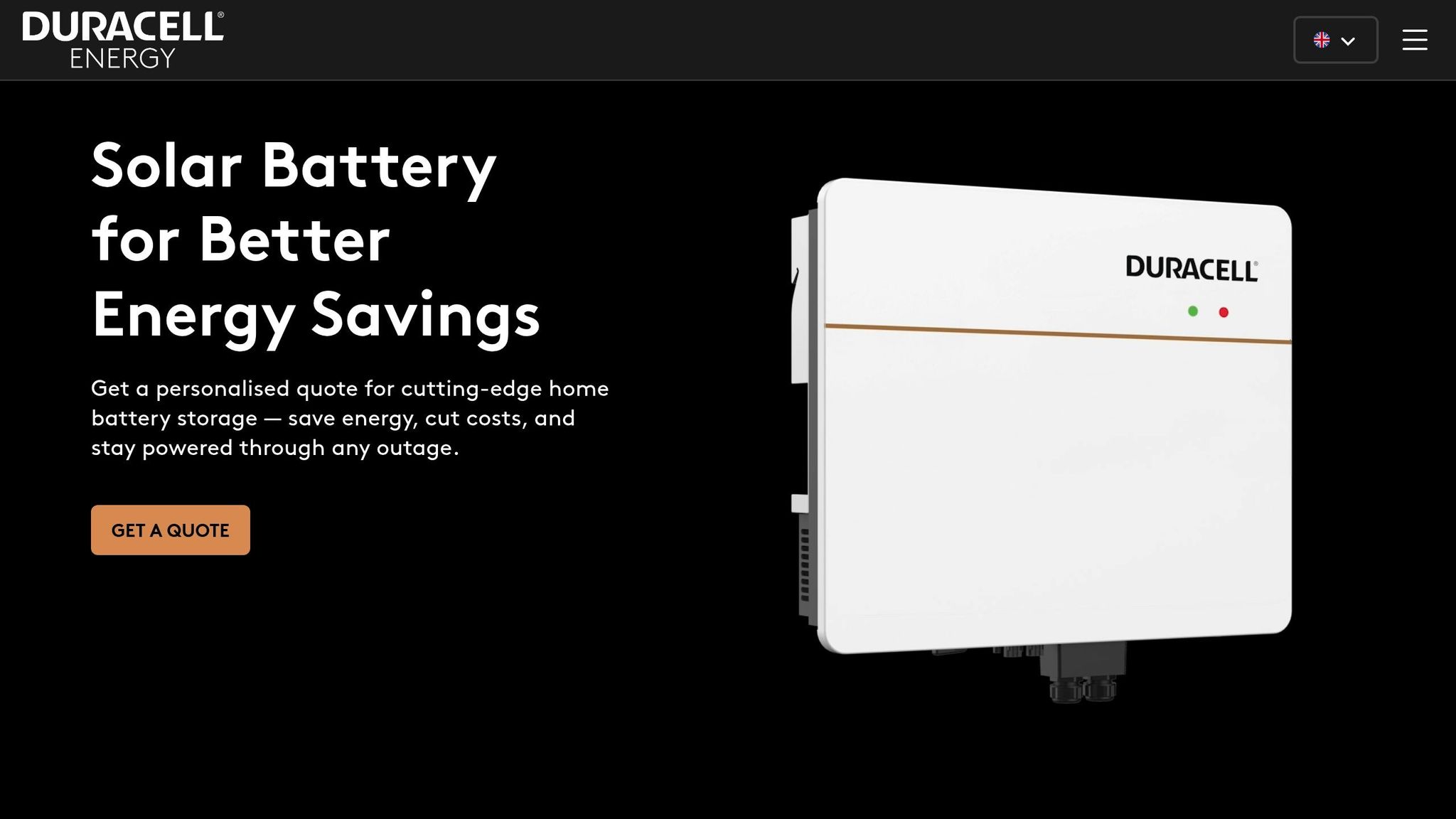
The Duracell 10kWh battery stands out as a reliable option with its fast charging capabilities and smart energy management features. Built with two 5kWh Dura5 units in a modular design, it can fully charge in just one hour – an ideal feature for Northern Ireland’s unpredictable weather. Plus, its smart companion app uses weather forecasts to optimise charging and discharging, making it a forward-thinking choice for energy-conscious households.
Capacity
With a total capacity of 10kWh, this battery comfortably meets the energy needs of most Northern Ireland homes. Its modular design offers flexibility, allowing users to start with 5kWh and expand to 10kWh – or even scale up to an impressive 160kWh if required. When paired with a well-sized solar panel system, the Duracell battery can significantly cut down on grid dependency, making it a practical choice for homes looking to embrace renewable energy.
Price
The Duracell 10kWh battery is competitively priced at £3,650 for the hardware alone. After factoring in professional installation, the total cost ranges from approximately £6,500 to £8,500, translating to about £650–£850 per kWh. Thanks to the 0% VAT rate on energy-saving installations, this investment becomes even more cost-effective. EECO Energy offers installation services across Northern Ireland, backed by their standard 25-year warranty.
Warranty Period
Duracell provides a 10-year warranty with this system, guaranteeing 70–80% capacity retention over that period. The warranty typically covers manufacturing defects and performance issues. With proper care and maintenance, the battery is expected to last 10–15 years, or around 10,000–15,000 charge cycles, offering long-term reliability.
Main Features
One of the standout features is the smart app, which tracks performance and uses weather forecasts to optimise energy usage. This ensures the battery is fully charged before periods of low sunlight. Coupled with its rapid one-hour charging time, the Duracell system is a responsive and efficient solution for managing your home’s energy needs effectively.
4. Tesla Powerwall 2
The Tesla Powerwall 2 is a high-capacity energy storage solution tailored to meet the needs of households in Northern Ireland. With 13.5 kWh of usable capacity, it’s designed to handle high evening energy demands and provide reliable backup during power outages, which are often more common in rural areas. This capacity not only aligns with the typical daily energy usage of 8–12 kWh but also enhances the use of surplus solar energy, significantly increasing self-consumption rates.
Capacity
The Powerwall 2’s 13.5 kWh capacity offers approximately 35% more storage than the 10 kWh systems discussed earlier. This extra capacity becomes particularly useful during the darker winter months in Northern Ireland, where solar energy production is lower, allowing households to make the most of stored energy. The system is compatible with solar arrays ranging from 3–6 kWp, and thanks to its AC-coupled design, it can be retrofitted to existing solar setups without the need to replace the current inverter.
Now, let’s take a closer look at the investment required.
Price
The installed cost of a Tesla Powerwall 2 typically falls between £8,000 and £11,000, depending on the specifics of the installation. While this is more expensive than the £6,000–£8,000 range for 10 kWh systems, the higher cost reflects its larger capacity, integrated backup functionality, and the added assurance of Tesla’s established brand. EECO Energy can provide a customised quote based on your home’s requirements and energy profile.
Warranty Period
Tesla provides a 10-year warranty for the Powerwall 2, ensuring around 70% of its original usable capacity at the end of that period under normal residential usage. To maintain the warranty, the system must be installed by an approved installer, remain connected for firmware updates and monitoring, and operate within the recommended temperature range. With proper care, the battery is expected to deliver reliable service for 10–15 years.
Let’s explore some of its standout operational features.
Main Features
The Powerwall 2 offers 90% round-trip efficiency, meaning only 10% of the energy is lost during the charge and discharge process. This efficiency is particularly valuable in Northern Ireland’s often cloudy conditions, ensuring you get the most out of every kilowatt-hour. The system also includes smart app monitoring, which helps optimise energy self-consumption and provides automatic backup during outages. This feature is especially beneficial for remote areas, keeping essential circuits like lighting, internet, and refrigeration running during power cuts.
sbb-itb-d2d975a
5. LG Chem RESU 10
The LG Chem RESU 10 is a product from one of the top lithium-ion battery manufacturers, offering a nominal capacity of 9.8–10 kWh and a usable capacity of 9.3–9.8 kWh. Its sleek, wall-mounted design makes it a practical choice for homes with limited space, a common scenario in Northern Ireland.
Capacity
The RESU 10’s usable capacity is designed to meet a significant portion of evening and night-time energy needs, especially when paired with a 4–6 kWp solar PV system. It can comfortably handle essential household appliances like lights, fridges, and electronic devices, reducing reliance on grid electricity. Plus, it allows homeowners to make the most of day and night tariffs. With a depth of discharge of 90–95%, nearly all of the battery’s capacity can be used daily without affecting its lifespan. This makes it a great option for households with moderate to high evening energy use, or those incorporating electric vehicle charging or heat pumps into their energy setup.
Price
In Northern Ireland, installing an LG Chem RESU 10 typically costs between £5,000 and £7,000. The final price depends on factors like the choice of inverter, monitoring options, and whether it’s a brand-new installation or an upgrade to an existing solar system. This price reflects LG’s reputation for reliability, compatibility with a wide range of inverters, and consistent performance in the UK. EECO Energy can provide a customised quote tailored to your home’s energy needs and tariff plan.
Warranty Period
The RESU 10 comes with a 10-year warranty, which covers both time and energy throughput. The battery is expected to provide 10–15 years of dependable service, retaining around 60–70% of its capacity during that time.
Main Features
The LG Chem RESU 10 boasts a round-trip efficiency of over 90% in DC-coupled setups, ensuring minimal energy loss during charging and discharging. This efficiency is especially useful in Northern Ireland, where overcast weather is common. Its slim and lightweight design makes installation easier compared to bulkier alternatives. Additionally, its compatibility with major hybrid inverter brands like SolarEdge, SMA, and Fronius reduces potential integration issues and lowers the costs of future upgrades. The battery is designed to store solar energy generated during the day for use in the evening and can also charge from the grid during cheaper off-peak hours. This makes it an excellent choice for households seeking a dependable, long-term energy storage solution with proven results.
Comparison Table
Here’s a handy table that highlights the key features of each battery option discussed earlier.
| Battery Model | Usable Capacity | Power Output | Warranty | Best for NI Households | Key Features |
|---|---|---|---|---|---|
| Dyness 10kWh | Approximately 10 kWh | Around 5 kW | Around 10 years | Perfect for 3–4 bed homes with moderate evening energy needs | Lithium-based modular design for flexible configurations |
| Soluna 10kWh | Approximately 10 kWh | Around 5 kW | Around 10 years | Ideal for smaller, 2–3 bed homes looking for affordability | Compact build, optimised for day/night tariff compatibility |
| Duracell 10kWh | Built from 5 kWh modules (stacked to 10 kWh) | Around 5 kW | Around 10 years | Great for households aiming to maximise smart tariff benefits | Smart app integration, fast charging (about one hour), stackable up to 160 kWh with additional units |
| Tesla Powerwall 2 | 13.5 kWh | 5 kW continuous / 7 kW peak | 10 years | Best suited for larger homes, EV owners, or high evening usage | Whole-home backup, sleek design, proven reliability, and integrated gateway |
| LG Chem RESU 10 | Approximately 9.3–9.8 kWh | Around 5 kW | 10 years | Fits standard 3–4 bed homes with moderate to high evening demand | Slim wall-mounted design, compatible with inverters like SolarEdge, SMA, Fronius, and expandable to 32 kWh |
Note: These figures are estimates. For precise, site-specific information, visit EECO Energy.
This table provides a quick overview to help you decide which battery might suit your needs before diving into installation specifics.
How to Choose a Solar Battery in Northern Ireland
Selecting the right solar battery for your home starts with understanding your energy consumption. For smaller households, a capacity of around 11–12kWh is often sufficient, while larger families might need up to 32kWh. Focus on your evening energy usage, as this is when you’ll rely most on stored solar power. By matching the battery size to your actual needs, you can avoid overspending on unnecessary capacity.
Once you’ve determined your energy requirements, it’s time to consider your budget. Take into account not just the battery’s price but also installation costs and VAT, which can vary, especially for retrofit projects. EECO Energy offers a range of competitively priced models, making it easier to find an option that aligns with your financial plan. Adding a solar battery can lead to monthly savings of 20–50%, with potential lifetime savings reaching £20,000–£30,000 or more.
Next, ensure the battery is compatible with your existing inverter and system setup. Many AC-coupled systems are designed to work with most solar installations without needing an inverter upgrade, saving you up to £1,000. EECO Energy’s MCS-registered installers can evaluate your current system and recommend solutions that integrate seamlessly.
Consider Northern Ireland’s climate and the battery’s warranty terms to ensure long-term reliability. In the region’s cooler and damp conditions, choose a battery with strong low-temperature performance and a weather-resistant enclosure. Pay close attention to warranty details, including performance guarantees and capacity retention, which typically cover 10 to 12 years.
Lastly, professional installation is key to getting the most out of your solar battery. EECO Energy’s experienced installers ensure your system is properly sized, safely integrated, and compliant with local regulations. They also offer fast installation and extended warranties for added peace of mind. For tailored advice, request a free survey to learn which options best suit your property and energy habits.
Conclusion
The five batteries – Dyness 10kWh, Soluna 10kWh, Duracell 10kWh, Tesla Powerwall 2, and LG Chem RESU 10 – offer practical solutions for storing surplus solar energy and reducing reliance on the grid for homes in Northern Ireland. The Dyness and Soluna models stand out as budget-friendly, modular options perfect for typical households, while Duracell provides dependable warranty support. Tesla Powerwall 2 continues to be a premium all-in-one smart battery, offering excellent app features and whole-home backup capabilities. Meanwhile, LG Chem RESU 10 is a compact choice, ideal for homes where space is limited. All these options enable homeowners to make the most of their solar power during peak evening hours, helping to lower energy bills and support a more reliable local grid.
Beyond their features, solar batteries come with broader benefits. While the upfront costs can be significant, the long-term savings and increased energy independence often justify the investment. A properly sized battery system can cut electricity bills by over £500 annually, with potential lifetime savings of £20,000–£30,000 or more. Batteries also offer greater energy security, particularly in rural areas prone to power outages, and play a role in smoothly integrating more renewable energy into Northern Ireland’s grid.
To turn these benefits into reality, it’s essential to choose the right battery for your needs. Factors like daily electricity usage, available space, and budget will guide your decision. For most households in Northern Ireland, a 10kWh system strikes a good balance between cost and capacity. Larger homes or those planning to charge an electric vehicle may need more storage. Professional installation is crucial to ensure the system is correctly sized, safely integrated, and compliant with local regulations. EECO Energy provides solar panel and battery installations across Northern Ireland, with MCS-registered installers who can assess your home and recommend the best solution.
To take the next step, start by reviewing your electricity bills from the past year to estimate your evening energy usage. Then, arrange a free survey to get tailored projections for self-consumption, annual savings, and the payback period for each battery option. By choosing the right system and relying on EECO Energy’s expertise, homeowners in Northern Ireland can enjoy both financial savings and environmental benefits. Every battery installed not only reduces your own costs and emissions but also strengthens the region’s transition to a flexible, low-carbon energy system – bringing Northern Ireland closer to its net-zero goals.
FAQs
How can I choose the right solar battery capacity for my home?
Choosing the right solar battery capacity hinges on a few important factors: your household’s energy usage, the size of your solar panel system, and how you typically consume electricity. A well-sized battery lets you store extra solar energy generated during the day, so you can tap into it later. This not only reduces your dependence on the grid but can also help cut down your energy bills.
To figure out the ideal capacity, think about how much electricity your home uses in the evening or at night – times when your solar panels aren’t producing power. This approach helps you maximise self-consumption, ensuring you get the most out of your solar setup. For a more precise recommendation tailored to your needs and property, it’s a good idea to consult an expert.
What are the financial advantages of installing a solar battery over time?
Installing a solar battery lets you save the extra energy your solar panels produce, cutting down on your dependence on the grid and helping to lower your electricity bills. Over the years, this could translate into impressive savings, potentially adding up to £20,000 to £30,000 or even more.
By tapping into your stored energy during peak usage times or cloudy days, you can make the most of your solar system’s potential and reduce costs even further. This makes it a practical and cost-effective choice for homeowners in Northern Ireland looking to invest in the future.
Can these solar batteries work with my current solar panel system?
Yes, these solar batteries are built to integrate smoothly with the majority of existing solar panel systems. They allow you to store any extra energy your panels produce during the day, so you can use it at night or on cloudy days when sunlight is limited.
If you’re uncertain whether your system is compatible, a professional installer can evaluate your setup and suggest the most suitable option for your home.