

Solar water heating systems are a smart way to save money on energy bills while reducing your carbon footprint. Using panels to collect solar energy, these systems can cover up to 60% of your annual hot water needs. They’re low-maintenance, work well even in cloudy UK weather, and integrate easily with your current boiler. Here’s a quick breakdown of the key benefits:
- Lower energy bills: Save around £75 per year, or over £1,350 across 20 years.
- Reduced emissions: Cut approximately 6.6 tonnes of CO₂ over the system’s lifetime.
- Hot water efficiency: Provides 50–70% of your yearly hot water needs.
- Minimal maintenance: Requires servicing only every 3–5 years.
- Works with your existing setup: Complements your current boiler or immersion heater.
With installation grants like the ECO4 scheme offering up to £10,000, solar water heating is an affordable and effective way to make your home more energy-efficient. Ready to lower your bills and make a positive change? Keep reading for all the details.
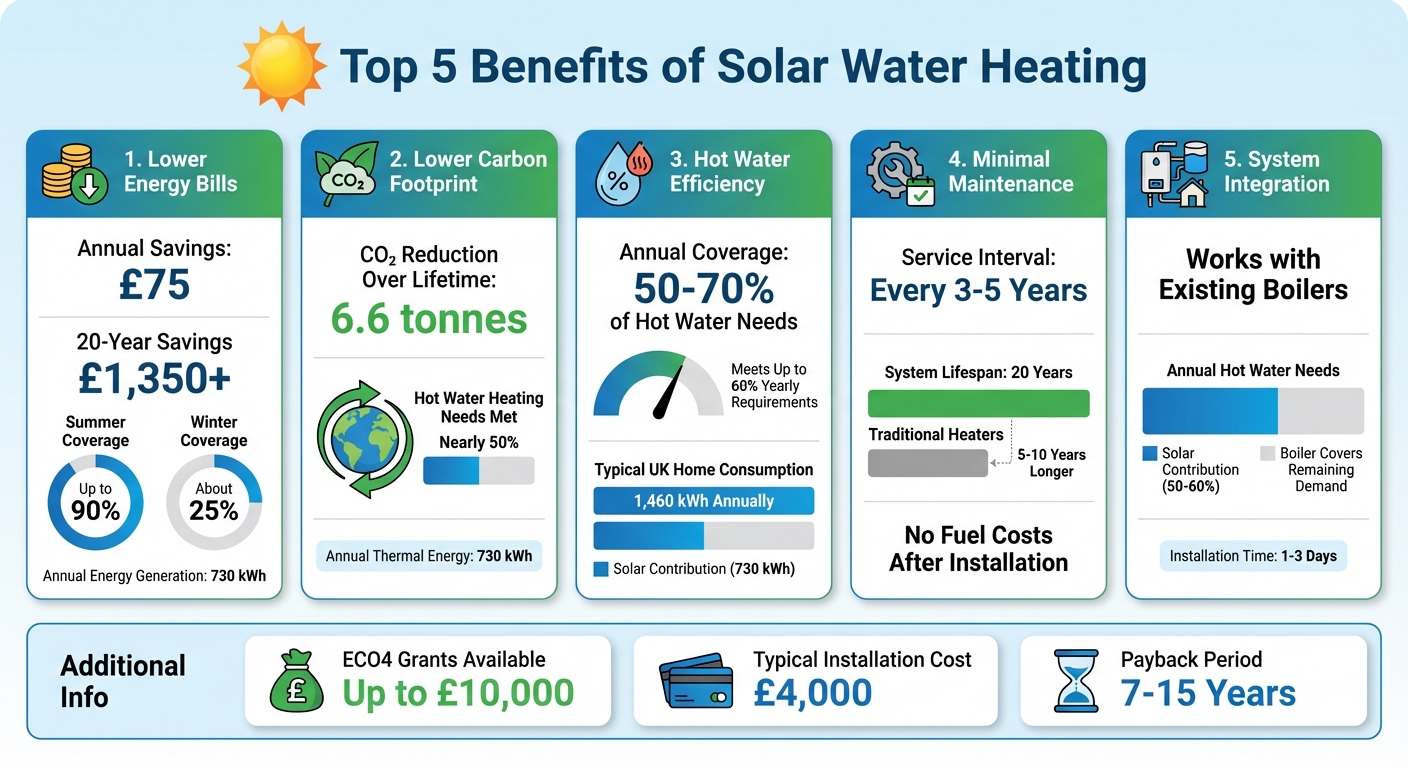
Solar Water Heating Benefits: Key Statistics and Savings
1. Lower Energy Bills
Solar water heating can help you cut down on your monthly energy expenses. By harnessing sunlight to heat your water, you rely less on gas and electricity from the grid. A well-designed solar thermal system can generate around 730 kWh annually, cutting your hot water bills in half. With gas currently priced at 10.3p per kWh, this translates to savings of about £75 per year – or more than £1,350 over a 20-year lifespan.
The system’s efficiency does vary throughout the year. In the summer months, it can cover up to 90% of your hot water needs, while in winter, it manages about 25%. During colder months, your boiler or immersion heater steps in to make up the difference. Over the course of a year, this setup still significantly reduces your reliance on conventional heating methods.
Additionally, solar water heating aligns well with government support schemes. For instance, off-grid households can access ECO4 grants of up to £10,000, which help offset installation costs – typically around £4,000 – and reduce the payback period to between 7 and 15 years.
One of the best parts? Once installed, the system requires minimal upkeep. It quietly works in the background, using free solar energy to keep your costs down year after year.
2. Lower Carbon Footprint
Using solar water heating taps into clean, renewable energy, cutting out the need for fossil fuels. Every time you rely on solar power, you’re avoiding emissions that come with traditional heating methods. In the UK, a typical solar thermal system can reduce a household’s carbon footprint by around 6.6 tonnes of CO₂ over its lifetime. It achieves this by generating approximately 730 kWh of thermal energy annually, covering nearly half of your usual hot water heating needs. This makes it an effective way to reduce your environmental impact without overhauling your existing heating system.
And don’t worry about the famously cloudy British weather – solar thermal panels are designed to work even on overcast days, capturing enough solar radiation to provide energy throughout the year.
3. Provides Up to 60% of Annual Hot Water
A properly installed solar water heating system can meet up to 60% of your household’s yearly hot water needs. For instance, in a typical UK home consuming around 1,460 kWh of hot water annually, this type of system could handle the majority of that demand. This not only saves energy but also contributes to lowering your carbon footprint.
In the summer months, with longer days and stronger sunlight, the system can often meet nearly all your hot water needs. However, during the winter, when daylight hours are shorter, a backup heating system is necessary to ensure a steady supply.
On average, these systems provide between 50% and 70% of a household’s hot water each year. The actual performance depends on factors like the system’s design, installation quality, and how well it’s oriented to capture sunlight. This combination of solar panels and conventional heating ensures you have a dependable and energy-efficient source of hot water throughout the year.
sbb-itb-d2d975a
4. Minimal Maintenance and Durability
One of the standout benefits of solar water heating systems is how little upkeep they require after installation. Unlike traditional boilers or combustion-based systems, there are no flues to clean, no burners to service, and the controls are refreshingly simple. The setup typically includes collectors, a pump, a cylinder, and a straightforward controller. With fewer moving parts and no reliance on fuel combustion, there’s less to go wrong overall.
For most households in the UK, a professional service every 3–5 years is usually sufficient. During these check-ups, technicians inspect antifreeze levels, test the pump and controller, look for leaks, and ensure that sensors and safety valves are functioning properly. Between these visits, homeowners can perform basic visual checks – monitoring pressure gauges, watching for error messages, and ensuring the pipes remain well insulated.
A properly installed solar water heating system can last around 20 years, which is five to ten years longer than many traditional water heaters. In fact, high-quality collectors and cylinders often outlive the system itself, and components like pumps and controllers are relatively affordable to replace. As of August 2023, approximately 43,667 homes in the UK had solar water heating systems registered with the Microgeneration Certification Scheme, underscoring the reliability of this technology.
The durability of these systems largely depends on factors such as the quality of components, installation standards, and environmental exposure. MCS-certified installations, corrosion-resistant collectors, well-insulated pipework, and secure mounting all contribute to preventing early failures. Systems designed for UK conditions are equipped with frost protection, weather-resistant frames, and toughened glass, ensuring they can handle rain, wind, and coastal climates. When installed correctly, these features help the system perform dependably for decades.
Beyond their longevity, solar water heating systems are incredibly economical to run. Once installed, there are no fuel costs, as they rely on free solar energy. The only ongoing expenses are for the small amount of electricity needed to power the pump and occasional servicing. This combination of durability and low running costs makes solar water heating a "set it and forget it" solution, ideal for households wanting to cut energy bills and minimise maintenance over the long haul.
5. Works with Current Heating Systems
Solar water heating systems integrate seamlessly with your existing boiler and hot water setup by pre-heating water before it reaches the boiler or immersion heater. The boiler only kicks in when the solar system can’t achieve the desired temperature, making the transition simple and efficient.
In most cases, the collectors are installed on the roof and connected to a solar-ready cylinder in the airing cupboard through insulated pipes. The solar coil inside the cylinder heats the stored water using energy collected from the panels. Meanwhile, your existing boiler stays on standby for cloudy days or when hot water demand is unusually high. A solar controller ensures that free solar energy is prioritised, which reduces how often the boiler operates and could even help extend its lifespan.
This setup works best with conventional boilers that use a dedicated hot water cylinder, as the system is designed to enhance such configurations. Homes with combi boilers, however, may require the addition of a solar cylinder or thermal store, which can make the installation process slightly more complex. By working alongside your current heating system, solar water heating improves efficiency while offering a more sustainable solution.
For a typical semi-detached house with an existing cylinder, installation usually takes between one and three days. During this time, the hot water supply is briefly interrupted while the cylinder is replaced and the new pipework is connected. Since the radiators and boiler circuits remain untouched, the disruption is generally limited to the roof, loft, and airing cupboard, keeping the process relatively straightforward.
A well-designed solar water heating system can typically meet 50–60% of a household’s annual hot water needs, with the boiler covering the rest. An automatic controller ensures solar heating is used first, switching to the boiler only when necessary, providing an efficient and dependable hot water supply.
Conclusion
Solar water heating provides households in Northern Ireland with a practical way to cut energy bills and reduce carbon emissions. This technology is well-suited to the UK climate and can typically cover 50–60% of a home’s annual hot water needs. Over its 20-year lifespan, it offers significant savings and environmental advantages, all while requiring minimal upkeep and integrating easily with existing heating systems.
These systems work in tandem with boilers or immersion heaters, ensuring a consistent supply of hot water throughout the year without adding to daily operating costs. Many homeowners find that they recoup their initial investment relatively quickly and then enjoy nearly cost-free hot water for years to come.
On a broader scale, increased adoption of solar water heating reduces dependence on imported fuels, strengthens local energy security, and helps stabilise energy costs. These benefits – ranging from financial savings to eco-conscious operation – make solar water heating a valuable addition for modern homes in Northern Ireland.
To maximise the benefits, it’s crucial to work with an experienced installer. EECO Energy, an MCS Registered Installer with over 25 years of experience, specialises in solar panels and battery systems for homes and businesses across Northern Ireland. They provide professional surveys, tailored system designs, and expert installations to ensure your solar water heating system is perfectly suited to your home.
Taking the next step involves arranging a home assessment to evaluate factors like roof orientation, shading, and cylinder compatibility. This will give you a clear idea of potential savings, along with information on available grants to help offset initial costs. The sooner you make the switch, the sooner you can enjoy long-term savings and a smaller carbon footprint.
FAQs
Can solar water heating work on cloudy days?
Yes, solar water heating systems can function even on cloudy days. Thanks to modern thermal collectors, they can harness and store heat from diffuse sunlight, even when the sun isn’t shining brightly. Although their performance might dip compared to clear, sunny conditions, they’re still capable of effectively heating water.
To ensure consistent hot water supply, many systems are equipped with a backup energy source, so you’re covered no matter the weather.
What kind of maintenance does a solar water heating system need?
Keeping your solar water heating system in good shape requires regular maintenance. Key tasks include flushing the system to avoid mineral deposits, cleaning the collectors to maximise sunlight absorption, and inspecting pipes and fittings for leaks or corrosion. Additionally, make sure the controller and pump are functioning as they should.
For optimal performance and reliability, consider scheduling a professional service annually.
Can a solar water heating system work with a combi boiler?
Yes, you can pair solar water heating systems with combi boilers to improve energy efficiency and cut down on traditional heating usage. Combi boilers are designed to deliver hot water instantly, but when combined with a solar water heating system, the water is preheated. This means the boiler uses less energy to bring the water up to the right temperature.
This setup not only helps reduce your energy bills but also lowers your home’s carbon emissions. It’s a smart way to make your heating system more eco-friendly while ensuring you always have hot water on demand.