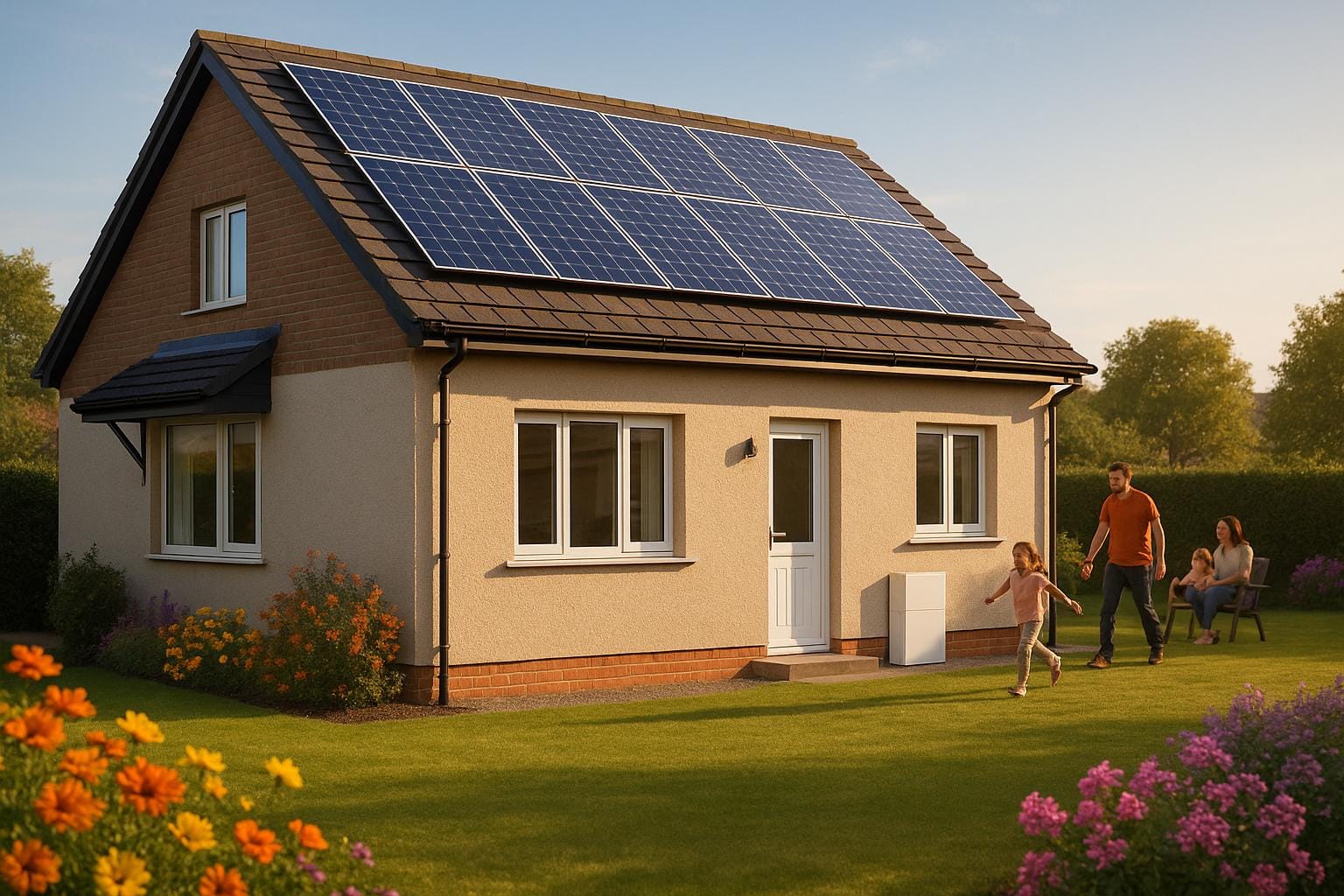
Energy independence is about producing and managing your own electricity to rely less on the grid. For homes and businesses in Northern Ireland, this typically involves solar panels, battery storage, and smart energy management systems. The benefits include lower energy bills, reduced reliance on external suppliers, and better control over energy use.
Key points:
- Solar power is cost-effective: Grid electricity costs ~30p per unit, compared to 14p per unit for exported solar energy.
- A typical 4kW solar system with a 10kWh battery can provide up to 80% self-sufficiency in summer, dropping to 30–40% in winter.
- Financial incentives: Solar installations are VAT-exempt, and grants are available for businesses.
- Savings: A three-bedroom home with a 4.5kW system can save ~£883 annually, with systems paying for themselves in 10–13 years.
- Businesses and farms benefit too, with some achieving up to 80% savings on daytime energy costs.
To start, assess your energy needs, check your roof’s suitability, and choose a system size that fits your property and budget. Battery storage and additional technologies like energy management systems or EV chargers can further enhance savings and efficiency. Regular maintenance ensures your system stays effective for 25–30 years.
Solar Energy Potential and Northern Ireland Policies
Tapping into Northern Ireland’s solar energy resources, supported by forward-thinking policies, plays a crucial role in moving towards energy independence.
Northern Ireland’s Solar Resource
Northern Ireland has seen a notable rise in solar energy adoption. From just 2MW of total solar capacity in 2011, it surged to 352MW by 2022, showcasing the growing feasibility of solar power in the region.
Solar panels work by converting daylight into electricity, even on cloudy days. However, factors like sunlight exposure, shading, and wind patterns can influence their efficiency. To get the most out of your solar system, it’s important to have a certified installer conduct a detailed site assessment. This ensures the best placement for the panels. If your property has areas of persistent shade, microinverter systems can optimise energy output by managing each panel individually.
For instance, a typical three-bedroom home with a 4.5kW solar system and a 3kWh battery can save around £883 annually on energy bills. Most domestic systems pay for themselves within 10 to 13 years. On top of this, the Northern Irish government aims to generate 80% of electricity from renewable sources by 2030, further highlighting the economic and environmental advantages of solar energy.
Energy Policies and Incentives
From 1st May 2023, solar panel installations in Northern Ireland have been exempt from VAT, reducing installation costs by approximately £1,000. This incentive applies to both residential and commercial properties.
For businesses, the Northern Ireland Sustainable Energy Programme (NISEP) offers grants covering up to 20% of solar system installation costs for the 2024/2025 period. While there are no specific grants for residential solar systems, NISEP provides support for broader energy efficiency measures like boiler upgrades and better insulation.
A Renewable Electricity Price Guarantee (REPG) scheme, finalised on 19th September 2025, is set to support renewable energy projects and help meet the 80% renewable electricity target by 2030. Additionally, the Department for the Economy is considering discounted electricity bills for households near REPG-supported projects.
Most residential solar installations fall under permitted development, so planning permission is usually unnecessary. However, exceptions exist for properties in conservation areas, Areas of Outstanding Natural Beauty, or listed buildings, where planning permission or listed building consent may be required. For roof-mounted systems, the panels shouldn’t extend more than 200mm from the roof’s surface or exceed the highest part of the roof. To avoid complications, it’s wise to consult your local council’s planning office before proceeding, as retroactive permissions can be costly.
Grid Connection and Export Tariffs
Most homes in Northern Ireland remain connected to the grid while generating their own electricity. This connection allows you to export surplus power when your solar panels produce more energy than your household needs. Smart meters track both the energy you use and the energy you send back to the grid, ensuring accurate billing.
Export tariffs determine how much you’re paid for the electricity you supply to the grid. However, the financial return from exporting is often less than the savings from using stored energy. This is why adding a battery to store excess power can significantly boost your energy independence.
Staying connected to the grid also provides a safety net, ensuring a reliable power source during times when solar production is lower.
Assessing Your Property and Energy Needs

Solar System Costs and Specifications for Northern Ireland Homes
Taking a close look at your property and energy needs is a crucial first step towards achieving energy independence. By understanding how much energy your household uses and determining if your property is suitable for solar power, you can lay the groundwork for a system that provides more control over your energy consumption.
Evaluating Energy Consumption
Start by reviewing your electricity bills from the past year to identify your energy usage patterns in kilowatt-hours (kWh). Notice any seasonal fluctuations – like higher energy use in winter for heating or in summer for cooling. These insights will help you size your solar system appropriately.
Next, pinpoint the appliances and devices that consume the most power. Items like electric showers, immersion heaters, washing machines, tumble dryers, and electric vehicle (EV) chargers are often the biggest energy users. Adding battery storage to your system allows you to store excess energy for use later, maximising the benefits of your solar panels.
When it comes to battery storage, size matters. This is measured in kWh, and the usable capacity depends on the Depth of Discharge (DoD). For instance, a 10kWh battery may provide around 9kWh of usable energy. Knowing how much energy you typically use in the evening and overnight will help you decide whether a smaller 3kWh battery or a larger 10kWh system is the better fit.
Once you’ve got a clear picture of your energy consumption, the next step is to assess whether your roof is suitable for solar panels.
Roof Suitability for Solar Panels
Your roof’s characteristics play a significant role in how efficiently solar panels will perform.
Orientation and pitch: South-facing roofs are ideal for capturing the most sunlight, but east- and west-facing roofs can also work well. East-facing panels generate more energy in the morning, while west-facing panels peak in the afternoon. Even north-facing roofs can be an option with modern technology, though they’re about 54% as efficient as south-facing systems. Roofs with a pitch between 30° and 40° are optimal for sunlight capture, and most UK roofs naturally fall within this range.
Flat roofs pose unique challenges. Installers often use ballasts – weights that hold the panels in place without drilling – which can significantly increase the system’s total weight. For example, a 240kg solar array might end up weighing 1,200kg with ballasts included. This could exceed your roof’s structural capacity, so it’s important to check beforehand.
Shading from nearby trees, buildings, chimneys, or dormer windows can reduce your system’s efficiency. However, professional installers can use devices like optimisers or microinverters to minimise these losses.
Structural integrity is another key factor. A typical solar array weighs around 200kg, so it’s vital to ensure your roof is in good condition. Address any issues like broken tiles, moss build-up, water damage, or sagging before installation. If your home has a loft, it can be helpful for inspecting the underside of the roof.
Roof size determines how many panels you can install. Each solar panel takes up about 2m². For example, a 4.5kW system usually requires around 23m² (roughly 10 panels), while a 7.2kW system may need about 38m² (around 16 panels). Be sure to account for obstacles like chimneys and skylights when calculating available space.
System Sizing and Budgeting
Once you’ve assessed your energy needs and roof suitability, you can match your system size to your household requirements and available roof space. For instance, a typical three-bedroom home with moderate electricity use might opt for a 4.5kW system with 10 panels, which can generate approximately 3,380kWh annually on a south-facing roof. Larger households or those with an EV may benefit from systems in the 7.2kW to 9kW range.
Here’s a breakdown of estimated costs for different system sizes in Northern Ireland:
| System Size | Number of Panels | Annual Output (kWh) | Price |
|---|---|---|---|
| 4.5kW | 10 | 3,380 | £3,950 |
| 5.4kW | 12 | 4,400 | £4,350 |
| 7.2kW | 16 | 6,189 | £4,850 |
| 8.1kW | 18 | 6,685 | £5,700 |
| 9kW | 20 | 7,099 | £5,900 |
Adding battery storage can further enhance your energy independence. A 10kWh battery typically costs between £2,400 and £3,650, depending on the brand and specifications.
Building an Energy Independent System
Once you’ve assessed your energy needs and planned accordingly, the next step is creating a system that maximises your ability to generate and store your own energy. A well-designed solar and battery setup can significantly cut your reliance on the grid and reduce your energy bills.
Designing a Solar PV Array
The success of your solar installation depends on matching the system’s size to your household’s energy consumption. In Northern Ireland, residential systems connected to the grid must meet G98/NI standards. These standards limit single-phase systems to 3.68 kW and three-phase systems to 11.04 kW. Staying within these limits allows for a simpler "install and notify" process, avoiding the more complex G99 approval [15,38].
Solar panels perform best on a south-facing roof, but east- or west-facing roofs can also work, with peak energy generation shifting accordingly. A professional site survey will evaluate your roof’s orientation, potential shading throughout the day, and its structural integrity to ensure the best placement.
For properties with persistent shading, microinverters are a great solution. They allow each panel to operate independently, so a shaded panel won’t drag down the output of the entire system.
Northern Ireland’s climate is well-suited for solar panels, as they can perform reliably even in cloudy conditions. Most systems have a lifespan of 25–30 years and require minimal maintenance – just periodic cleaning and occasional inspections [15,39,40].
This solar setup forms the foundation of your energy independence and works seamlessly with battery storage and smart technologies.
Integrating Battery Storage
Battery storage allows you to save surplus solar energy for later use, such as during the evening, overnight, or even during power outages. Instead of exporting excess energy to the grid at lower rates, you can store it for personal use, potentially increasing your solar savings by up to 40% [40,42,43,44]. Additionally, charging your batteries during off-peak tariff periods can further lower your energy costs.
When choosing a battery, focus on its capacity (measured in kWh), depth of discharge (DoD), and warranty terms. Popular options for homes in Northern Ireland include:
Keep in mind that the usable capacity is slightly lower than the total capacity due to the DoD. For example, a 10 kWh battery typically provides about 9 kWh of usable energy.
With the right battery in place, your system can move beyond just generating energy to achieving greater self-reliance. You can choose from grid-tied, hybrid, or off-grid systems. For most households, a hybrid system strikes a good balance between independence and the security of staying connected to the grid.
Adding Complementary Technologies
To get the most out of your solar and battery setup, consider adding complementary technologies that enhance efficiency and further reduce your reliance on the grid.
- Energy Management Systems (EMS): These act as the control centre for your system, managing the flow of energy between your solar panels, battery, and the grid. EMS can identify inefficiencies, switch between power sources automatically, and integrate with smart home devices like EV chargers to optimise energy use.
- Solar EV chargers: These allow you to charge your electric vehicle directly from your solar array, cutting down on daily transport costs.
- Immersion controllers: These devices redirect surplus solar energy to heat water, increasing your self-consumption and reducing the need for electricity or gas from the grid.
To ensure your installation complies with G98/NI standards, work with an MCS-accredited installer. They will handle the safe installation of your system, register it with NIE Networks, and make sure you’re eligible for any export tariffs [15,38]. Additionally, domestic solar panel installations currently benefit from a 0% VAT rate, saving you around £1,150 on a typical setup [15,39].
sbb-itb-d2d975a
Steps to Achieve Energy Independence
Securing long-term energy independence starts with a well-designed solar and battery setup. But the journey doesn’t stop there. Understanding your energy consumption, working with skilled professionals, and maintaining your system are all key to ensuring ongoing efficiency and performance.
Conducting an Energy Audit
Start by reviewing your electricity usage over the past year. Your electricity bills will provide a clear picture of your average daily and seasonal consumption. This information is essential for determining the right system size to minimise reliance on the grid.
Smart meters, which are being introduced across Northern Ireland, can make this process even easier. These devices provide real-time data, helping you pinpoint when your energy use peaks and allowing you to make adjustments quickly.
Working with a Northern Ireland Installer
The success of your solar and battery installation depends heavily on selecting the right installer. Choose an MCS-accredited professional with experience navigating Northern Ireland’s specific climate and regulations. Check their qualifications, read customer reviews, and ask for references from local projects.
For example, EECO Energy offers free surveys and quotes throughout Northern Ireland. During a site survey, they assess factors like your roof’s orientation, structure, and shading, ensuring the system aligns with your energy goals and budget. When reviewing proposals, ensure they provide a detailed breakdown of costs, including equipment, installation fees, and projected energy generation.
For reference, a typical 7.2 kW system with 16 panels costs roughly £4,850. Adding a 10 kWh battery might range between £2,400 and £3,650, depending on the brand. A good installer will also explain how the system integrates with your current electrical setup and handle necessary paperwork, such as G98/NI registration with NIE Networks.
Most domestic installations are completed within a single day, minimising disruption. Installers should also ensure you benefit from the 0% VAT rate on solar panel installations and help you explore available export tariffs.
Once installed, keeping your system in top condition is the next step.
System Monitoring and Maintenance
Monitoring your system regularly is crucial to maintaining energy independence. Most modern solar and battery systems come with apps that provide real-time insights into energy generation, battery charge levels, and grid import/export. Checking these metrics regularly helps you track performance and adjust your energy use as needed.
While solar panels require little upkeep, occasional cleaning can improve efficiency. In Northern Ireland, rainfall often helps keep panels clear of dirt and debris, but a manual clean once or twice a year may still be necessary. If your roof is particularly steep or hard to access, hire a professional to ensure safety.
Keep an eye on battery performance as well. Watch for signs like rapid discharge or incomplete charging, and address any issues promptly – most batteries come with warranties exceeding 10 years. Annual inspections by your installer can ensure connections remain secure, inverters are functioning properly, and the system complies with G98/NI standards.
With regular maintenance, your system can last 25–30 years. Staying engaged with its performance allows you to optimise energy use, such as running appliances during peak solar hours or adjusting battery charging schedules to benefit from off-peak tariffs.
Conclusion
Northern Ireland has a clear path to energy independence through the use of solar panels and battery storage. By generating your own electricity and storing any surplus for later use – like during the evening or on cloudy days – you can significantly reduce your reliance on the grid. This not only helps to lower energy bills but also cuts carbon emissions, paving the way for a more sustainable and affordable future.
For homeowners, the benefits are tangible. Annual savings could range between £1,000 and £1,500, while reducing CO₂ emissions by about 1,000 kg. Battery storage adds another layer of efficiency by letting you take advantage of lower overnight tariffs to charge your system. You can then use this stored energy during peak hours when electricity from the grid might cost around 30p per unit, compared to exporting surplus energy at roughly 14p per unit. This flexibility gives you greater control over your energy use, helping you manage costs and plan with confidence. Plus, existing incentives can help offset installation expenses, making the switch even more attractive.
However, achieving energy independence doesn’t happen by chance – it requires careful planning. Steps like conducting an energy audit, choosing MCS-accredited installers such as EECO Energy, and ensuring regular system maintenance are crucial. By adopting renewable energy, you’re not just saving money; you’re also contributing to Northern Ireland’s ambitious goal of sourcing at least 80% of its electricity from renewables by 2030 and supporting the UK’s broader net zero targets. Whether you’re motivated by cutting costs, living more sustainably, or gaining independence from the grid, solar panels and battery storage offer a practical solution tailored to Northern Ireland’s energy needs. The first step is yours to take.
FAQs
Can solar panels help achieve energy independence in Northern Ireland’s climate?
Yes, solar panels can be a dependable way to achieve energy independence in Northern Ireland, even with its often cloudy and mild weather. Thanks to advancements in technology, modern solar panels are capable of operating efficiently in cooler climates and can still generate electricity on overcast days. In fact, they can produce about 20–40% of their maximum output even without direct sunlight.
Pairing solar panels with battery storage systems takes this a step further. These systems let you store any extra energy generated during the day, so it’s available for use at night or during times of high demand. This not only reduces your dependency on the grid but also helps cut down on energy bills while offering some protection against rising electricity prices.
Are there any financial incentives for installing solar panels in Northern Ireland?
Currently, there aren’t any specific government grants for installing solar panels in homes across Northern Ireland. However, businesses can access up to 20% funding through the Northern Ireland Sustainable Energy Programme (NISEP). On top of that, solar panel installations come with 0% VAT, potentially cutting upfront costs by around £1,000 for both homeowners and businesses.
When you factor in these incentives alongside the long-term reduction in energy bills, it’s clear that solar panels are becoming an appealing choice for those looking to reduce reliance on traditional energy sources.
How can I work out the right size of solar system and battery storage for my home?
To figure out the right size for your solar system, start by calculating your average daily electricity use in kilowatt-hours (kWh). You can find this by taking your monthly usage (listed on your energy bill) and dividing it by 30. Once you have your daily usage, divide that number by the average sunlight hours in your area. This will give you an estimate of the system size you’ll need in kilowatts (kW). It’s a good idea to add an extra 20–25% to account for system inefficiencies.
When it comes to battery storage, think about how much energy you’d like to save for use during the evening or in case of power cuts. A solid starting point is to match your daily energy needs, although this can vary based on how self-sufficient you want to be. For a more precise recommendation, it’s best to consult a professional installer who understands the specific conditions in Northern Ireland.