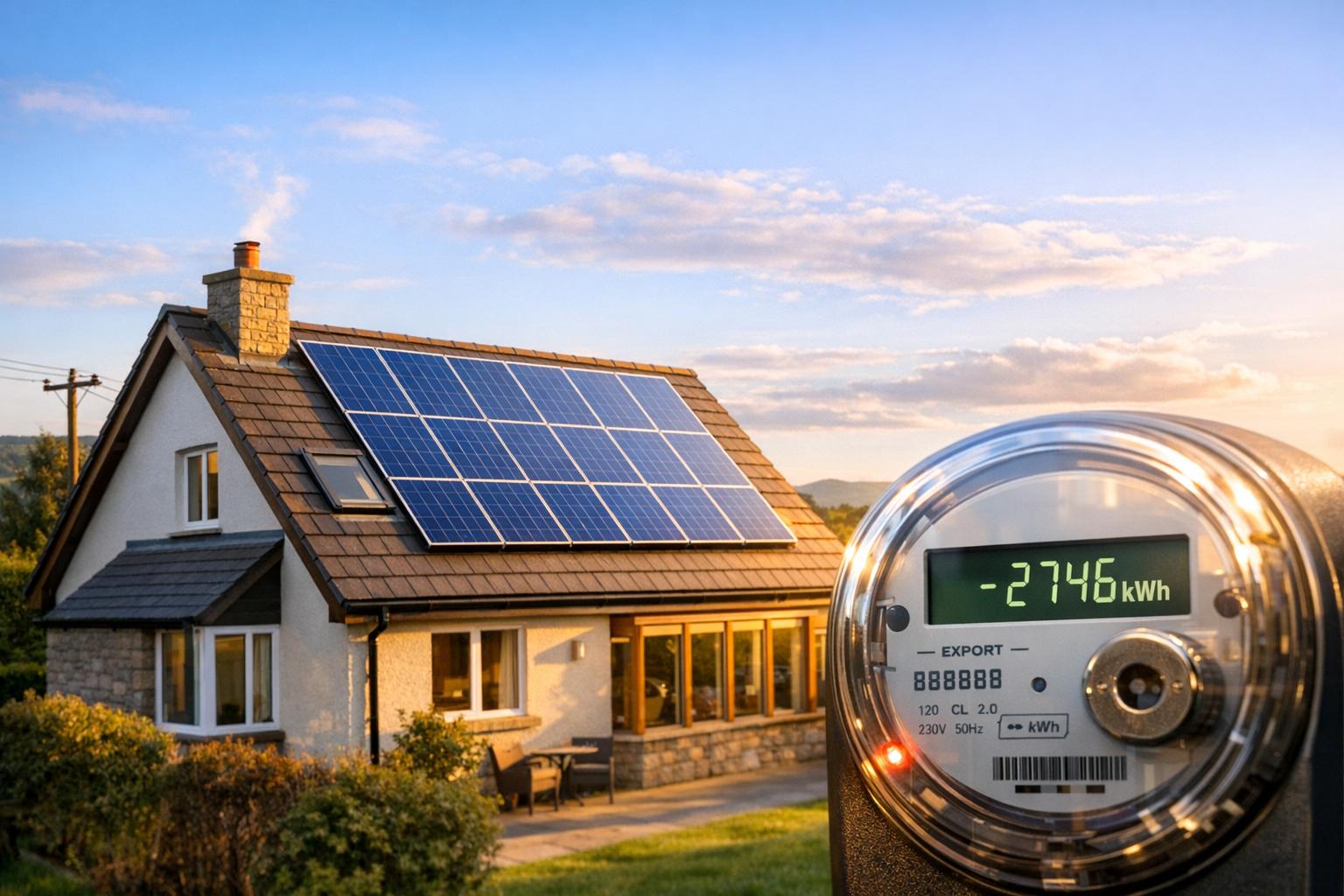
Net metering allows homeowners in Northern Ireland with solar panels to earn money or credits by exporting surplus electricity back to the grid. Here’s how it works:
- How It Works: Your solar panels power your home first. Any excess electricity flows to the grid through a bi-directional meter, and you get paid for it.
- Key Requirements: Systems must meet G98/NI standards, exporting up to 3.68 kW (single-phase) or 11.04 kW (three-phase). NIE Networks handles grid connections, while suppliers like Power NI manage export payments.
- Export Tariffs: Payments, such as Power NI’s current rate of 9.64p per kWh, are reviewed annually. However, exporting energy often pays less than importing from the grid.
- Boosting Savings: Adding battery storage increases self-consumption, reducing reliance on grid electricity and lowering bills. Without a battery, most homes use only 30–40% of solar energy; with one, this can rise to 70–80%.
- Financial Benefits: Solar systems typically pay for themselves in 8–9 years, with monthly savings ranging from £50 to £180. The 0% VAT rate further reduces upfront costs.
Net metering offers a practical way to cut energy bills and earn extra income. By managing your system effectively, you can maximise your returns while contributing to renewable energy efforts in Northern Ireland.
How Net Metering Works
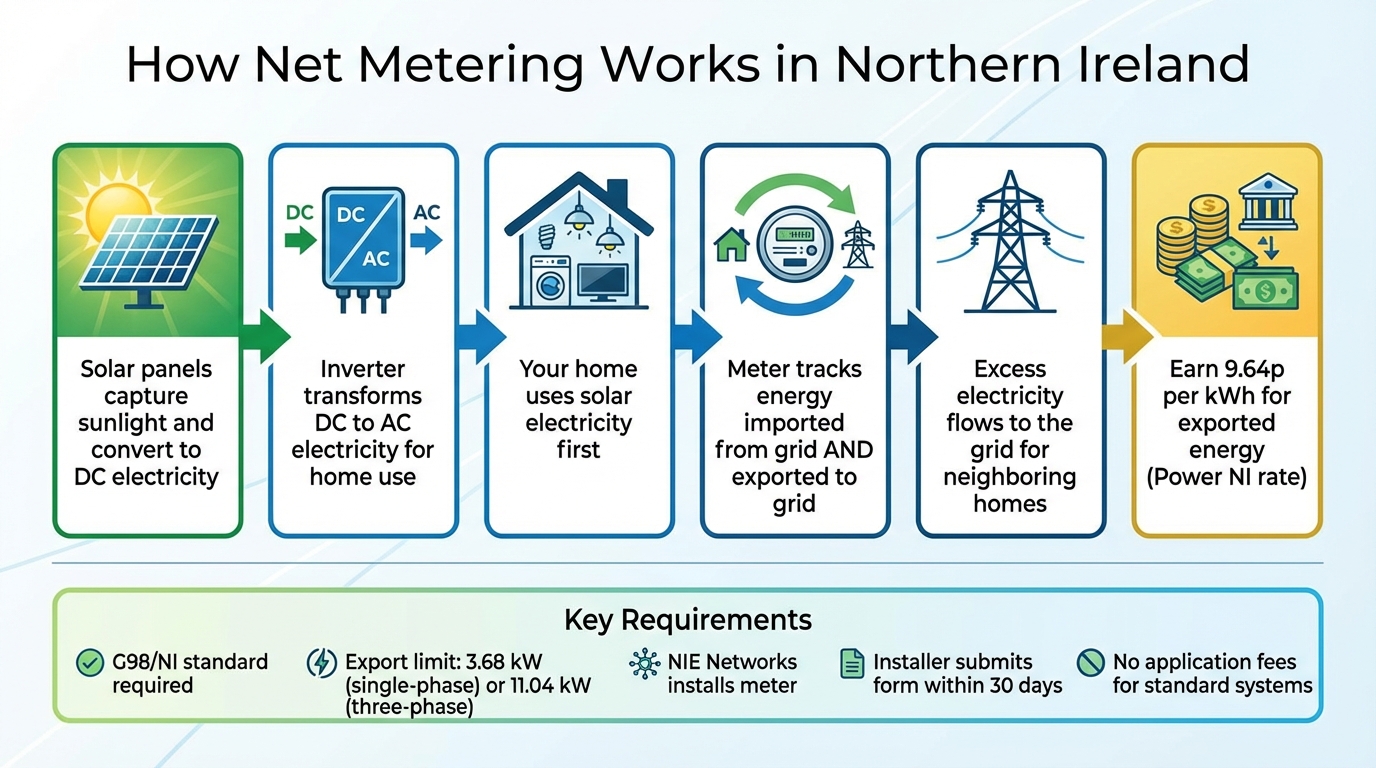
How Net Metering Works: From Solar Panel to Grid Export
The Net Metering Process Step by Step
During daylight hours, your solar panels capture sunlight and convert it into Direct Current (DC) electricity. This DC power then passes through an inverter, which transforms it into Alternating Current (AC) – the type of electricity your home appliances and the national grid use. Your home prioritises using this electricity, and any excess energy flows through a bi-directional meter to the grid, where it can be used by neighbouring homes.
In Northern Ireland, micro-scale connections are regulated under the G98/NI standard. Once your installer has set up the panels and carried out the necessary tests, they must submit the G98/NI Stage 1 Commissioning form to NIE Networks within 30 days. If you don’t already have an import/export meter, NIE Networks will arrange to install one. This meter tracks the energy you consume from the grid and the surplus energy you send back. After this step, it’s up to you to contact an electricity supplier to sign up for an export tariff, so you can start earning payments for the energy you export.
"G98/NI is a set of rules that apply when you connect generation equipment – like solar panels – on your house and export any electricity to the electricity network." – NIE Networks
There are no application fees for standard G98/NI Stage 1 systems. To qualify as micro-scale, your system must export no more than 3.68 kW on a single-phase connection or 11.04 kW on a three-phase connection.
Now, let’s break down some important terms and equipment involved in this process.
Key Terms and Equipment You Need to Know
Microgeneration refers to small-scale renewable energy systems, like solar panels, that produce electricity for your home. An export tariff is the rate your electricity supplier pays you for each kilowatt-hour (kWh) of electricity you send to the grid.
A bi-directional meter plays a central role in net metering. Unlike traditional meters that only measure energy consumption, this meter tracks energy flowing in both directions. It records the electricity you draw from the grid when your panels aren’t producing enough, as well as the surplus energy you export during peak generation. In Northern Ireland, NIE Networks is responsible for connecting your system to the grid and installing the meter. However, they don’t purchase your exported electricity – that’s handled through a separate agreement with your chosen electricity supplier.
Your energy bill will show two Meter Point Administration Numbers (MPANs): one for the electricity you import and a separate Export MPAN for the energy you send to the grid. Smart meters can simplify this process by measuring your energy usage in real time, providing accurate data for calculating your export payments.
How Battery Storage Affects Net Metering
Adding battery storage to your system can significantly change how you manage energy. Instead of immediately sending excess solar power to the grid, you can store it and use it later, such as during the evening when your panels aren’t generating electricity. While this reduces the amount of energy you export – and therefore lowers your export tariff income – it often saves you more money overall. That’s because the cost of importing electricity from the grid is typically higher than what you’re paid for exporting it.
Without a battery, most households only use 30–40% of the electricity their panels generate. A battery can increase this self-consumption rate to 70–80%. By replacing costly grid electricity with stored solar power, you can achieve greater savings, even if your export earnings decrease. However, if your main goal is to maximise export income, keep in mind that adding a battery will reduce those payments. For most homeowners, though, the long-term financial benefits of battery storage make it a worthwhile investment.
Exporting Solar Power in Northern Ireland
Let’s break down the essentials of exporting solar power in Northern Ireland, covering eligibility, tariffs, and how EECO Energy ensures a smooth process for homeowners.
Eligibility and Connection Requirements
If you’re planning to export solar power in Northern Ireland, your system must meet specific technical standards. NIE Networks, the Distribution Network Operator, handles grid connections, while export agreements are arranged separately with your electricity supplier.
For most domestic solar setups, the G98/NI standard applies. This covers systems exporting up to 3.68 kW on a single-phase connection or 11.04 kW on a three-phase supply. If your system exceeds these limits, you’ll need to go through the more detailed G99/NI application process.
The G98/NI process is straightforward, using a "Fit and Inform" approach. Here’s how it works:
- After installation and testing, your installer submits the G98/NI Stage 1 Commissioning form to NIE Networks within 30 days.
- There’s no application fee for standard G98/NI Stage 1 connections.
- Once approved, NIE Networks arranges for an import/export meter installation if you don’t already have one.
It’s essential to use G98/NI-approved inverters. Non-compliant equipment risks being refused connection. Also, keep a copy of your G98/NI commissioning form – it’s needed when setting up export payments with your electricity supplier.
Now, let’s look at how export payments and tariffs work.
Export Payments and Tariffs
In Northern Ireland, export tariffs are offered directly by electricity suppliers, so you’ll need to negotiate rates with them. Suppliers regulated by the Utility Regulator are required to provide export terms to microgenerators, but payments aren’t automatic – you must apply for them.
For example, Power NI offers a tariff of 9.64p per kWh for the period from 1st October 2025 to 30th September 2026. These rates are reviewed annually in October and, once approved, payments are made directly to your bank account, separate from your electricity bill.
However, export rates tend to be lower than the cost of importing electricity from the grid. That’s why many homeowners prioritise self-consumption over exporting energy. Adding battery storage can help you make the most of your solar power, even though it may reduce the amount of energy available for export.
These factors highlight the importance of working with experienced installers who can guide you through the process and help you maximise your savings.
How EECO Energy Handles System Design and Installation
EECO Energy specialises in designing solar systems that fully comply with G98/NI requirements while optimising performance for Northern Ireland’s conditions. As an MCS-accredited installer, they handle the entire G98/NI commissioning process for you, ensuring all inverters and metering equipment meet NIE Networks’ standards to avoid any delays or issues.
They also help you choose the ideal system size. For instance:
- A 4.5 kW system with 10 panels can generate around 3,380 kWh annually.
- A 9 kW system with 20 panels produces approximately 7,099 kWh per year, assuming a south-facing roof.
Once your system is connected and NIE Networks installs the import/export meter, EECO Energy provides advice on which electricity suppliers offer the best export tariffs. Their goal is to help you balance self-consumption savings with export income, ensuring you get the most out of your solar investment.
Financial Benefits of Net Metering
Self-Consumption Savings vs. Export Income
The financial advantage of solar energy lies mainly in reducing your reliance on costly grid electricity. When you use the solar power you generate, you avoid paying the full retail price for electricity from the grid – currently about £0.30 per kWh in many areas. On the other hand, payments for exporting excess electricity, such as in Northern Ireland, tend to be much lower, averaging around 9p per kWh.
This highlights that the greatest savings come from directly offsetting daytime grid electricity usage. While export income can provide an additional revenue stream, it’s not the main factor to consider when determining the size of your solar system. Instead, focus on maximising self-consumption to make the most of your investment.
System Sizes and Battery Options
The setup of your solar system significantly influences both energy production and financial returns. EECO Energy offers examples of how system sizes impact output and costs. A 4.5 kW system with 10 panels, for instance, costs £3,950 and generates around 3,380 kWh annually on a south-facing roof. Meanwhile, a larger 9 kW system with 20 panels costs £5,900 and produces approximately 7,099 kWh per year.
Adding battery storage can further enhance your savings by increasing the amount of solar energy you use directly. Without a battery, households typically consume about 50% of their solar power. By incorporating a 10 kWh battery – such as the Dyness model for £2,400 or the Duracell option for £3,650 – self-consumption can rise to around 80%. This higher self-consumption rate can significantly impact how quickly you recover your initial investment.
Calculating Your Payback Period
The time it takes to recoup your investment depends on factors like system cost, self-consumption savings, and export income. For example, a 4.4 kWp system without battery storage, costing around £6,600, typically pays for itself in about 9 years. By contrast, a 5.2 kWp system with battery storage, priced at roughly £9,400, can achieve payback in around 8 years, largely due to increased self-consumption.
Several factors can influence your payback period. Higher grid electricity prices shorten the timeframe by making each unit of solar energy more valuable. Similarly, an optimally positioned system – such as one on a south-facing roof – maximises production and speeds up payback. Conversely, shading or poor orientation can extend the time needed to break even. As electricity prices continue to rise, the savings from generating your own power become even more compelling.
sbb-itb-d2d975a
Getting More Value from Your Solar System with EECO Energy
Increasing Self-Consumption
The more solar energy you use directly, the bigger your savings can be. Timing is everything – plan your energy use to coincide with peak solar production hours, typically between 10 am and 4 pm. Running energy-intensive appliances during this window can significantly reduce your reliance on the grid. These tips build on earlier advice about designing an efficient solar setup.
For example, smart immersion heater controllers can redirect surplus solar energy to heat your water tank. Instead of exporting excess electricity for just 9p per kWh, you can use it to lower your water heating costs. If you drive an electric vehicle, charging it during daylight hours directly from your solar panels could save you hundreds of pounds each year.
EECO Energy customers have already seen the impact of these changes. Lynsey, a homeowner in Belfast, shared her experience:
"My monthly bill is down 90% from ~£200 per month to £20 per month. It’s had a huge impact on our family".
In Northern Ireland, typical domestic solar installations save households between £50 and £180 per month.
Benefits of Adding Battery Storage
Battery storage takes your solar system to the next level by storing surplus power generated during the day for use in the evening. Instead of exporting excess energy at low rates, you can store it and power your home through the night, reducing your dependence on grid electricity during peak pricing hours. EECO Energy offers Duracell battery systems designed to maximise the use of your solar energy and align with your self-consumption goals.
Adding battery storage can boost your monthly savings by an additional 20% to 50% compared to solar panels alone. Over a 25–30 year lifespan, a solar system with battery storage can deliver total savings of over £30,000 in Northern Ireland. Plus, EECO Energy’s battery options currently come with 0% VAT, making this upgrade even more affordable.
If you already have solar panels, you’re not out of luck – battery storage can be retrofitted to your existing setup. EECO Energy designs systems with hybrid inverters, making it easy to add batteries whenever it fits your budget. This flexibility ensures you can continue to improve the efficiency and value of your solar investment over time.
Monitoring and Maintenance
To keep your solar system running smoothly, regular monitoring and maintenance are essential. Monitoring apps provide real-time insights into your energy generation, usage, and exports. This data helps you adjust your habits, such as identifying and reducing “vampire loads” that drain power unnecessarily. Regular maintenance, on the other hand, ensures your system stays in peak condition. EECO Energy recommends annual servicing to check panel cleanliness, wiring connections, and battery performance.
"It is good practice to get your installation serviced every year to avoid any unwanted surprises and keep your panels and battery operating at their best performance".
Solar systems typically have a lifespan of 25 to 30 years, and keeping up with maintenance protects this long-term investment. Proper care ensures you get the most out of your system for decades to come.
Conclusion: Making Solar Energy Work for You in Northern Ireland
Net metering offers a practical way to make the most of your solar energy. By sending any extra power you generate back to the grid, you can earn credits or payments, helping to lower your energy bills. This approach not only cuts costs but can also provide an additional source of income.
Getting started is straightforward. Once your solar system is installed, you’ll need to register an export account with a supplier like Power NI. Regularly submitting meter readings ensures you receive accurate payments for the energy you export. Adding battery storage to your system can boost your self-consumption and further reduce your reliance on the grid, leading to even greater savings.
The financial advantages of solar energy are undeniable. With a 0% VAT rate and payback periods ranging from 5 to 7 years, investing in solar is a smart choice for long-term savings.
EECO Energy provides tailored solutions for both new solar installations and battery upgrades, ensuring your system operates at its best. With their expertise, you can maximise your savings and take a big step towards energy independence.
FAQs
How does adding a battery to my solar system affect my net metering savings?
Adding a battery to your solar PV system can boost your savings by letting you store surplus electricity generated during the day for use later – like at night or during times when electricity prices are higher. This means you’ll rely less on grid electricity and avoid paying those steeper rates. However, it does mean you’ll likely export less energy back to the grid.
In the UK, schemes like the Smart Export Guarantee allow you to earn credits for every kilowatt-hour of electricity you send back to the grid. While using a battery might reduce the amount of energy you export, the savings from using stored energy during peak pricing periods often outweigh the credits you’d receive. How much you save depends on factors like the size of your battery, your household’s energy habits, and electricity tariffs. But with the right battery setup, you can cut down significantly on expensive grid power, increasing your annual savings.
What do I need to connect my solar panels to the grid in Northern Ireland?
To connect your solar panels to the grid in Northern Ireland, your setup needs to meet specific micro-generation requirements. This includes ensuring the system does not exceed 25 A (around 6 kVA) for a single-phase 230 V supply or 16 A (around 11 kVA) for a three-phase 230/400 V supply. Additionally, you’ll need an approved inverter that’s compatible with the grid and an import/export meter that complies with Ofgem standards.
Your installer will handle submitting the necessary application to ESB Networks. Depending on your system size, they’ll file either NC6 for systems up to 6 kW (single-phase) or 11 kW (three-phase), or NC7 for larger systems up to 50 kW. Once your application is approved, you’ll receive a connection agreement, and an export-limiting meter will be installed before the system becomes operational.
The final step is to arrange a purchase contract with an electricity supplier so you can sell any surplus energy. You’ll also need to provide regular export meter readings. By following these steps, you can safely feed excess electricity back into the grid and benefit from net metering.
How can I choose the right export tariff for my solar energy in Northern Ireland?
To choose the right export tariff for your solar energy system in Northern Ireland, start by ensuring you meet the necessary eligibility criteria. Unlike the Smart Export Guarantee (SEG) available elsewhere in the UK, Northern Ireland has its own schemes provided by licensed electricity suppliers. You’ll need an Ofgem-approved generation meter, registration with Ofgem, and a system capacity of less than 5 MW.
When comparing tariffs, pay close attention to the rate per kilowatt-hour (kWh), as this determines how much you’ll earn. Find out if the rate is fixed or variable. Also, consider the contract length and exit terms – shorter contracts can offer more flexibility, while longer ones might provide a lower, locked-in rate. Take a look at the payment model too, which might be based on actual meter readings or a flat rate. Additionally, check if you’re eligible for Renewable Obligation Certificates (ROCs), which could further boost your returns.
To get the most out of your system, calculate your potential yearly income by multiplying the exported kWh by the tariff rate and including any ROC value. Pick the tariff that offers the best overall earnings, clear payment terms, and the flexibility that fits your preferences.