

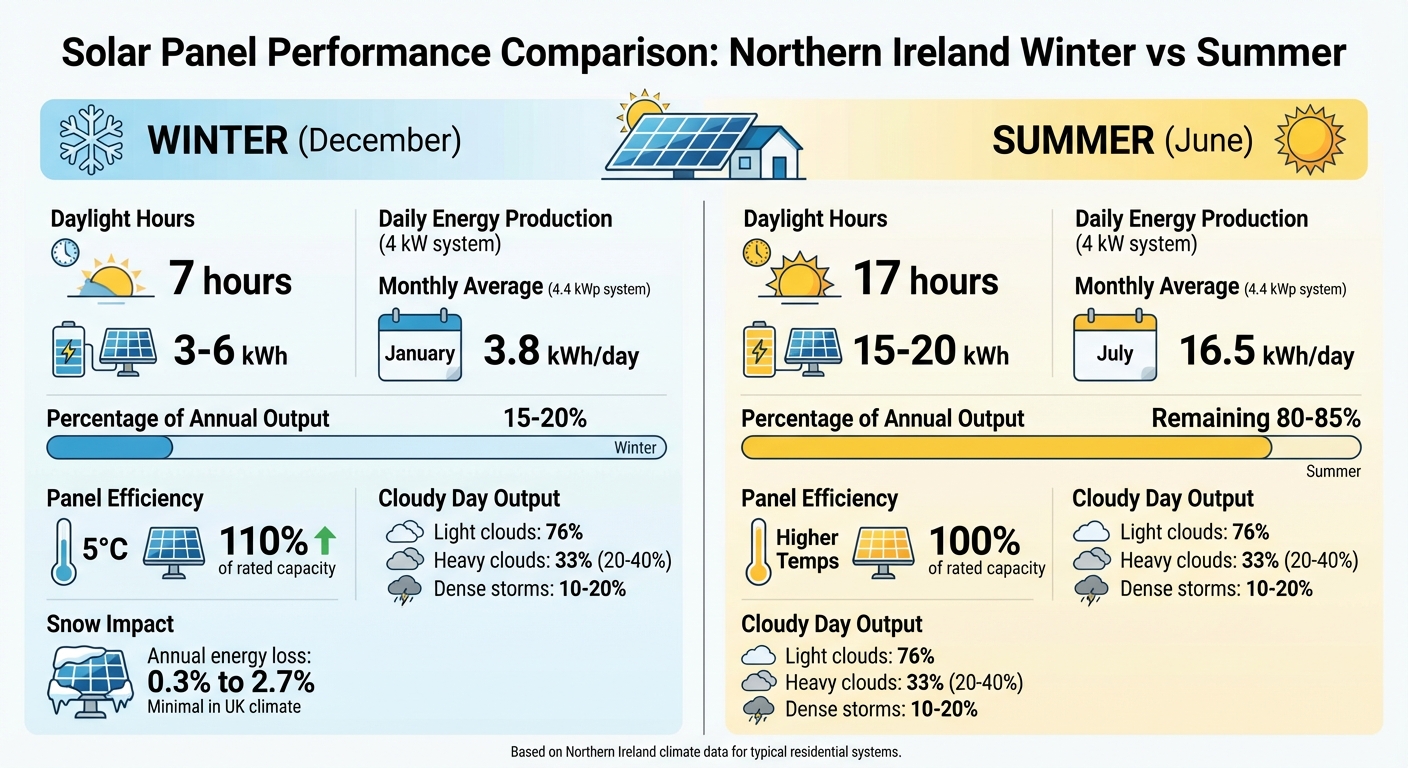
Solar panels work in winter, even under cloudy skies. They generate electricity from daylight, not heat, so shorter days and colder temperatures don’t stop them. In fact, cool weather can improve their efficiency, allowing them to perform at 105–110% of their rated capacity on crisp days. However, with just 7 daylight hours in December compared to 17 in June, winter energy production drops to about 15–20% of annual output.
Key points:
- Cloudy days: Panels produce 20–40% of their clear-sky potential, even with heavy clouds.
- Cold efficiency: Lower temperatures reduce resistance, improving performance.
- Battery storage: Saves daytime energy for evening use, reducing reliance on grid power.
- Snow impact: Minimal in the UK, with light snow melting quickly off panels.
If you’re in Northern Ireland, pairing a well-sized solar system with battery storage ensures you make the most of winter energy production while cutting electricity costs.
Common Myths About Winter Solar Panels
Now that we’ve looked at how solar panels work, let’s tackle some common myths about their winter performance. Misunderstandings can lead to underestimating what solar panels can achieve during the colder months. Here are two key clarifications.
Myth: Panels Need Direct Sunlight
Solar panels don’t rely solely on direct sunlight; they utilise all available daylight to generate electricity. Modern technology allows panels to harness diffused light, even on cloudy days .
For instance, on days with light cloud cover, panels can still produce about 76% of their full capacity. Even under heavy cloud cover, they continue generating electricity. As long as there’s daylight, your panels will keep working – even when the sky is overcast. This reliability is an important factor when deciding on the size of your system and its storage capabilities.
Myth: Cold Weather Reduces Output
Colder temperatures actually improve solar panel efficiency. Lower temperatures reduce electrical resistance, allowing electrons to flow more freely .
"The electrical resistance of a solar cell decreases in colder weather, which means better electron flow and improved efficiency." – Sunsave
On a chilly winter morning, say around 5°C, your panels might even operate at roughly 110% of their rated capacity. However, while efficiency improves, the shorter daylight hours in winter naturally limit overall energy production. This makes battery storage a smart addition to store the energy you generate during the day.
With these myths cleared up, it’s easier to set realistic expectations for solar panel performance during winter.
Winter Performance: What to Expect
Solar Panel Winter vs Summer Performance Comparison
Shorter Days and Energy Production
In Northern Ireland, daylight hours drop significantly from 17 hours in June to just 7 hours in December. This reduction is why winter electricity generation accounts for only 15–20% of your system’s total annual output. To put this into perspective, a typical 4 kW home solar system that generates 15–20 kWh on a sunny summer day will produce just 3–6 kWh during a winter day. For further context, a standard 4.4 kWp system in locations with similar latitudes sees an average daily production of 3.8 kWh in January, compared to 16.5 kWh in July – roughly 23% of its summer output.
Apart from shorter days, cloud cover also plays a significant role in determining energy output.
Output on Cloudy Days
Even with Northern Ireland’s frequent overcast skies, your solar panels will keep generating electricity. Photovoltaic cells are designed to capture diffused light, so grey skies still contribute to energy production.
However, the amount of power depends on how dense the cloud cover is. Light clouds can reduce output by about 24%, while heavy clouds may cut energy production by an average of 67%. On cloudy days, your system will produce around 20–40% of its clear-sky potential, and during dense storm conditions, this may drop to just 10–20%. Despite these variations, panels continue to generate power throughout daylight hours.
Seasonal factors like snow can also influence performance.
Snow Coverage and Maintenance
The dark surfaces of solar panels absorb heat, which helps melt light snow quickly – snow rarely sticks unless temperatures drop below -3°C. Additionally, the smooth glass surface and angled installation allow snow to slide off naturally as it begins to thaw.
In regions like the UK, snow-related losses are minimal, accounting for just 0.3% to 2.7% of annual energy output. If you do need to remove snow manually, use a soft-bristled brush to avoid scratching the glass. Avoid using metal tools or hot water, as these can damage the panels. After winter storms, it’s a good idea to inspect your system for fallen branches or leaves that might be shading your panels.
sbb-itb-d2d975a
EECO Energy Solutions for Winter
EECO Energy offers customised solutions to help tackle the challenges of winter energy demands.
Choosing the Right System Size
Winter energy production drops significantly – down to 20–30% of summer levels. That’s why selecting the right system size is crucial. EECO Energy provides options like their 4.5 kW system (producing 3,380 kWh annually) or their 9 kW system (producing 7,099 kWh annually), which are designed to keep up with shorter December days that average just 7 hours of daylight. If your household uses a lot of energy in the evenings, pairing a larger system with battery storage can help ensure you have enough energy to meet your needs.
Battery Storage Options
Battery storage is a smart way to save excess energy generated during daylight hours for use during peak evening times. EECO Energy offers three battery options:
All these batteries come equipped with self-heating elements, ensuring efficient charging even when temperatures are near freezing. Combining these batteries with an appropriately sized system can help you manage your energy needs more effectively during winter.
Pricing and System Options
EECO Energy provides a range of systems to suit different energy requirements, all backed by a 25-year warranty and MCS accreditation. Installation is quick, taking just one day, and they offer free surveys and quotes across Northern Ireland. Below is a breakdown of system sizes and pricing to help you choose the best option for winter use:
| System Size | Number of Panels | Annual Output (kWh) | Price |
|---|---|---|---|
| 4.5 kW | 10 | 3,380 | £3,950 |
| 5.4 kW | 12 | 4,400 | £4,350 |
| 7.2 kW | 16 | 6,189 | £4,850 |
| 8.1 kW | 18 | 6,685 | £5,700 |
| 9 kW | 20 | 7,099 | £5,900 |
Output figures assume a south-facing roof installation.
Adding battery storage to any of these systems ensures you can make the most of the energy generated during the winter months.
Conclusion
Main Points
Solar panels continue to generate power reliably during Northern Ireland’s winter months, even with shorter days and frequent cloud cover. This is because panels rely on daylight, not heat, to produce electricity. Overcast skies may reduce output by only 15–25%.
Interestingly, colder temperatures can actually improve panel efficiency, often allowing them to perform above their rated capacity. While winter output might be smaller compared to summer, it still plays an important role in annual energy production. Plus, Northern Ireland’s mild maritime climate helps keep panels clean naturally with regular rainfall. Pairing a well-sized system – like EECO Energy’s 7.2 kW or 9 kW options – with battery storage ensures that any power generated during the day can be stored and used during long winter evenings.
If you’re considering solar, now is a great time to explore customised solutions designed for winter performance.
Getting Started with EECO Energy
EECO Energy offers free consultations across the UK and one-day installations, making the process quick and convenient. Their systems come with a 25-year warranty and are MCS accredited, giving you confidence in your investment. Booking in winter can also mean shorter wait times, as this season is less busy compared to spring and summer.
With improved performance during low-light months and efficient battery storage, solar panels continue to deliver value year-round. EECO Energy’s tailored solutions help reduce electricity bills and increase energy independence. Their systems typically pay for themselves within five years and are guaranteed for 30 years, making them a smart long-term investment.
Contact EECO Energy today to schedule your free consultation and see how much you could save with a solar system designed for Northern Ireland’s unique climate.
FAQs
Does cold weather make solar panels more efficient?
In colder weather, solar panels can actually perform better. The lower temperatures help reduce electrical resistance in the silicon cells, making it easier for electricity to flow. As a result, solar panels can work more efficiently in cold conditions, even if sunlight is less abundant.
Do solar panels still work effectively in snowy conditions?
Yes, solar panels can perform well even in snowy weather. In fact, cooler temperatures can enhance their efficiency, as solar panels tend to work better in colder conditions. Thanks to their smooth surface and angled positioning, snow usually slides off or melts quickly, allowing the panels to keep generating power.
That said, if snow completely covers the panels, they won’t produce electricity until it’s cleared. Fortunately, this issue often resolves itself as sunlight melts the snow or it slides off naturally. As long as daylight reaches the panels, they can keep producing energy – even during overcast winter days.
How does battery storage improve solar panel performance in winter?
Battery storage is key to ensuring solar energy remains dependable during the winter months. With daylight lasting as little as 7 hours in December and sunlight levels dropping, solar panels naturally produce less electricity. A battery system steps in to store any surplus energy generated during sunnier moments, making it available for use later – whether on overcast afternoons, during long winter nights, or when panels are obstructed by snow or debris.
Interestingly, cooler winter temperatures can actually enhance the efficiency of both solar panels and battery systems, helping them operate closer to their peak performance. By combining your solar panels with a properly sized battery, you can rely less on the grid, maintain essential systems like heating, and maximise the benefits of your solar setup throughout the year.