
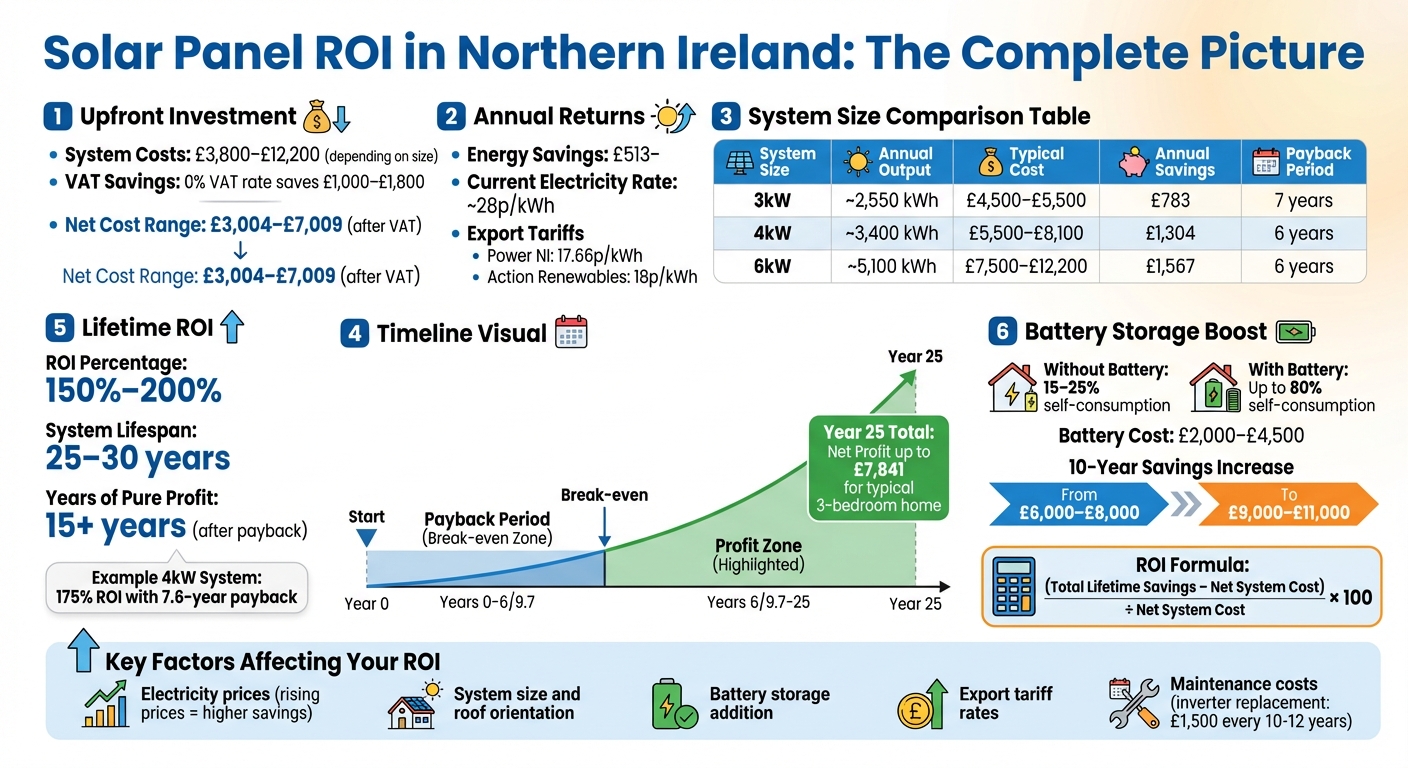
Solar panels in Northern Ireland can save you thousands over 25–30 years. Here’s the bottom line:
- Upfront Costs: £3,800–£12,200 depending on system size, with a 0% VAT rate reducing costs by £1,000–£1,800.
- Annual Savings: £513–£1,304 for a medium-sized home, depending on energy usage and export tariffs.
- Payback Period: 6–9.7 years on average; after that, it’s all profit.
- Lifetime ROI: 150%–200%, with a net profit of up to £7,841 for a typical three-bedroom home over 25 years.
- Export Tariffs: Power NI pays 17.66p/kWh, and Action Renewables offers 18p/kWh for surplus energy.
Key factors affecting ROI include electricity prices (currently ~28p/kWh), system size, roof orientation, and whether you add battery storage. Batteries can boost energy usage from 25% to 80%, further increasing savings. Rising electricity prices also enhance long-term returns.
Solar panels are a smart way to reduce energy costs, lock in savings, and lower your carbon footprint while protecting against future price hikes.
Solar Panel ROI Calculator for Northern Ireland: Costs, Savings & Payback Periods
How to Calculate Solar ROI Step-by-Step
The Solar ROI Formula
Calculating your solar return on investment (ROI) is simpler than it might seem. The formula is: (Total Lifetime Savings – Net System Cost) ÷ Net System Cost × 100. The result is a percentage that indicates the profit you’ll earn compared to your initial investment.
Here’s how it works: Net System Cost includes the installation expenses – think panels, inverter, mounting, and labour – minus any available incentives. In Northern Ireland, while there are no government grants, the 0% VAT rate saves you between £1,000 and £1,800 on average installations. Total Lifetime Savings combines two things: the money you save by reducing your reliance on grid electricity (avoided costs) and the income from selling any surplus energy back to the grid (export income).
It’s worth noting that the savings from self-consumed solar power are higher because you avoid paying the full retail rate of roughly 35p per kWh. On the other hand, exported power earns less, around 18p per kWh. This difference underscores the importance of using as much solar energy as possible during the day to boost your ROI.
Now, let’s break down how to gather the numbers you’ll need for this calculation.
Gathering the Numbers for Your ROI Calculation
To calculate your solar ROI, you’ll need to collect a few key numbers:
- Net System Cost: Get quotes that include the 0% VAT rate. Typical costs range from £3,004 for a smaller 2.1 kWp system to £7,009 for a larger 4.9 kWp setup.
- Annual Energy Savings: This depends on how much solar energy you use during the day. Without a battery, most households in Northern Ireland only use 15–25% of what their system generates, with the rest being exported. For example, a three-bedroom home can save about £514 annually.
- Annual Export Income: Calculate this using local rates, such as Power NI’s 17.66p per kWh or Action Renewables’ 18p per kWh.
- System Lifespan and Maintenance Costs: Solar systems typically last 25 years. Don’t forget to account for maintenance, like replacing the inverter every 10–12 years, which costs around £1,500 each time.
Once you’ve got these numbers, you’re ready to see how the formula works in practice.
Example: ROI for a 4kW Solar System
Let’s look at a real-world example to make things clearer. Imagine a 4kW solar installation for a home in Northern Ireland. The upfront cost is £5,500, which is mid-range for this system size and already includes the 0% VAT rate.
Here’s how the savings add up annually: the system generates roughly 3,380 kWh per year. If 20% of this (676 kWh) is used directly, you save £237 (676 kWh × 35p). The remaining 80% (2,704 kWh) is exported, earning £487 (2,704 kWh × 18p). Combined, your total annual benefit is £724. Over 25 years, these savings add up to £18,100. After deducting the cost of two inverter replacements (£1,500 each), your net savings come to £15,100.
Now, apply the formula: (£15,100 – £5,500) ÷ £5,500 × 100 = 175% ROI. The payback period is just 7.6 years (£5,500 ÷ £724), meaning every pound saved after that is pure profit. This example beats the average payback period of 9.7 years for smaller systems in Northern Ireland, showing how maximising your energy use during the day can speed up returns.
What Affects Solar ROI in Northern Ireland
When calculating your solar ROI, it’s essential to consider several local factors that influence your savings.
Electricity Costs and Rising Prices
Electricity prices play a big role in determining your solar savings. In Northern Ireland, homeowners currently pay around 28p per kWh for grid electricity. Every unit of electricity your solar panels generate and you use directly saves you this amount, boosting your return on investment.
What’s more, as electricity prices rise in the future, your savings will grow automatically. Higher grid rates mean your solar panels become even more cost-effective over time. Next, let’s look at how system size and roof orientation influence your solar output.
System Size, Roof Orientation, and Energy Output
The size of your solar system directly impacts both its upfront cost and the amount of energy it generates. For example, in Northern Ireland, a 4kW system typically produces about 3,400 kWh annually, while a 6kW system generates approximately 5,100 kWh. Larger systems cost more initially, but they generate more energy, which could improve your ROI – especially if your household uses a significant amount of power during daylight hours.
Roof orientation also matters. South-facing roofs are ideal for capturing the most sunlight, but east- and west-facing roofs still perform well. During site surveys, installers will assess shading from trees or nearby buildings, as shade can reduce energy output. If your roof has a complex design, installation costs could increase by £500–£1,500, which would slightly extend your payback period. Fortunately, Northern Ireland’s mild temperatures help keep solar panels efficient all year round by preventing overheating.
| System Size | Annual Output (NI) | Typical Cost | Est. Annual Savings | Payback Period |
|---|---|---|---|---|
| 3kW | ~2,550 kWh | £4,500–£5,500 | £783 | 7 years |
| 4kW | ~3,400 kWh | £5,500–£8,100 | £1,304 | 6 years |
| 6kW | ~5,100 kWh | £7,500–£12,200 | £1,567 | 6 years |
Government Incentives and Rebates
Financial incentives can also significantly improve your solar ROI. The 0% VAT rate on solar installations, introduced in May 2023 and running until 2027, reduces upfront costs by £1,000 to £1,800. This is especially helpful given the absence of large-scale government grants for residential solar in Northern Ireland.
Export payments provide another source of financial return. For surplus energy, Power NI pays 17.66p per kWh, and Action Renewables offers at least 18p per kWh. As Mark Compston, Head of Projects at Action Renewables, explains:
This year we will be paying our clients at least 18p [per kWh]
These export rates are significantly higher than the average 5p per kWh offered elsewhere in the UK under the Smart Export Guarantee. This means homeowners in Northern Ireland benefit from better returns on their excess energy compared to many other regions.
Payback Period vs Lifetime ROI
When evaluating solar investments, two key metrics come into play: the payback period and lifetime ROI. The payback period is the time it takes for your savings to equal the cost of your solar system, essentially marking the point when you’ve broken even. On the other hand, lifetime ROI measures the total profit your system generates over its lifespan, typically 25 to 30 years. In Northern Ireland, the average payback period is about 9.7 years. After this point, your solar panels stop being a cost and start turning a profit. Over 25 years, solar panels often deliver a 150% to 200% return on your initial investment. These figures set the stage for understanding how system size affects the time it takes to break even.
Payback Period with Examples
Here’s a breakdown of how long it takes for different system sizes to pay for themselves in Northern Ireland:
| House Size | System Cost | Annual Savings | Payback Period |
|---|---|---|---|
| 1-2 Bedrooms | £3,004 | £308 | 9.7 years |
| 3 Bedrooms | £5,006 | £514 | 9.7 years |
| 4+ Bedrooms | £7,009 | £719 | 9.7 years |
Note: The similar payback periods across different system sizes reflect proportional relationships between costs and savings.
For larger homes with bigger systems, the higher upfront costs are balanced by greater annual savings. This consistent payback period aligns with the ROI figures mentioned earlier, reinforcing the idea that the initial break-even phase is just one part of the overall financial benefit. Additionally, the 0% VAT on installations helps reduce upfront costs, making it easier to reach the break-even point sooner.
Lifetime ROI and Long-Term Savings
Once you pass the payback period, the true financial benefits of solar become evident. For example, a typical three-bedroom home could generate a net profit of approximately £7,841 over 25 years, even after accounting for the initial system cost.
High-quality solar panels are designed to maintain around 80% of their original output over 25 to 30 years, ensuring that your savings remain consistent throughout their lifespan. If electricity prices continue to rise, your actual returns could exceed these estimates, further increasing your profit.
After breaking even, every year of operation adds to your savings, making solar a smart long-term investment for homeowners in Northern Ireland. The long-term financial benefits highlight the strategic value of going solar, especially as energy costs continue to climb.
sbb-itb-d2d975a
How to Increase Solar ROI: Battery Storage and Rising Electricity Prices
Once your solar panels are installed, there are two major ways to boost your returns: adding battery storage and taking advantage of rising electricity prices. Batteries allow you to store surplus energy for later use, while both options help cut down on reliance on costly grid power.
How Battery Storage Affects ROI
Installing a battery can dramatically increase your solar energy usage. Typically, solar users consume only 15–25% of the energy they generate, but with a battery, this can shoot up to over 80%. Plus, the value of stored solar energy increases significantly – by 5 to 7 times – compared to energy exported back to the grid.
In Northern Ireland, batteries are particularly useful for "energy shifting" strategies. For example, with tariffs like Click Energy’s Twilight Tariff, you can charge your battery overnight when electricity costs about 7p/kWh and then use that stored energy during peak hours when prices rise to around 27p/kWh. This approach is especially helpful in the winter months when solar production tends to dip.
"Much like solar panels, the financial benefit of a battery system is incredibly varied per customer. It really depends on the energy tariffs they’re on, how and when they use electricity, and how well they can align that usage with solar generation or low-rate times." – Solar Together
The upfront cost of a solar battery typically ranges from £2,000 to £4,500, depending on the capacity. While this might slightly lengthen the initial payback period, the long-term savings are well worth it. Over 10 years, savings can jump from around £6,000–£8,000 to £9,000–£11,000. Most homeowners in the UK see an annual return on investment (ROI) of 8–12% from their solar battery.
To get the most out of your battery, tweak its settings based on the season. In winter, charge it overnight using cheaper electricity rates, and in spring and summer, rely more on solar power to charge it. Running energy-hungry appliances during battery-powered hours can further cut down your grid energy costs.
But battery storage isn’t the only factor that boosts your ROI – rising electricity prices also play a crucial role.
How Electricity Price Inflation Improves Solar ROI
Rising electricity prices have a direct impact on your savings. As grid electricity becomes more expensive, every kilowatt-hour your solar panels generate saves you more money. This means your annual savings steadily grow, potentially shortening the time it takes to recoup your initial investment.
When combined with efficient battery usage, the benefits multiply. You can store solar energy or charge your battery at off-peak rates, then use it during peak-rate periods when grid electricity costs are at their highest.
"As grid electricity costs rise, your solar savings increase proportionally." – Volt Renewables
For households with high evening energy consumption, the combination of battery storage and rising electricity prices can significantly increase overall ROI. While solar panels alone already offer a strong return, adding a battery and capitalising on energy price inflation can take your investment to the next level.
Conclusion: Is Solar a Smart Investment for Northern Ireland Homeowners?
For homeowners in Northern Ireland, solar panels offer a compelling mix of financial and environmental benefits. With payback periods typically between 6 and 9.7 years, and a lifespan of 25–30 years, solar systems can deliver over 15 years of pure profit after breaking even. A typical three-bedroom home can see substantial financial gains over 25 years, all while cutting its carbon footprint by approximately 13%.
Northern Ireland’s climate also makes solar energy a practical option. While the region receives about 5% less sunshine than the UK average, it still enjoys up to 1,600 hours of sunlight annually – more than enough to power a medium-sized home. Plus, cooler temperatures help maximise the efficiency of solar panels, making them even more effective in this environment.
The financial benefits become even more pronounced when you factor in rising electricity prices. Solar panels act as a safeguard against energy inflation, locking in lower energy costs for decades. Adding battery storage can further boost self-consumption rates from around 35% to over 70%, significantly improving return on investment. On top of that, solar installations can increase property values by an estimated 4% to 6%, which is a major draw for energy-conscious buyers.
FAQs
How do rising electricity costs affect the return on investment (ROI) of solar panels?
Rising electricity prices are giving UK homeowners a reason to smile – at least when it comes to solar panels. As energy costs climb, the savings on your electricity bills grow, which can dramatically shorten the time it takes to recoup your investment in a solar panel system. The higher the prices, the greater the financial advantage of producing your own power.
Solar panels also offer a long-term safeguard against unpredictable energy price hikes. By relying less on the grid, you gain more control over your energy costs, making solar an increasingly attractive and economical option for households across the UK.
What affects how quickly I can recover the cost of installing solar panels?
The time it takes to recoup your initial investment in solar panels – commonly referred to as the payback period – depends on a variety of factors. Key considerations include the installation costs, the size of the solar panel system, and how much electricity your household uses, along with your energy tariff. Another crucial element is the amount of sunlight your property gets, which is influenced by details like the roof’s orientation, its angle, and your geographical location.
Government grants or export incentives can help lower the overall costs, making the system more affordable. On the other hand, specific conditions at your site, such as shading or inefficiencies, might affect the system’s performance. By taking all of these factors into account, you can estimate how long it will take for your solar panels to start generating savings beyond their initial cost.
How does adding battery storage improve the savings from solar panels?
Adding battery storage to your solar system lets you save the extra energy your solar panels generate during the day for use later – like in the evening or when electricity prices are higher. This can dramatically boost how much of your own solar energy you use, often increasing from about 30–40% to as much as 70–80%. The result? Less dependence on the grid and lower energy bills.
Storing solar energy also shields you from future electricity price hikes. Plus, the cost per kilowatt-hour from the battery is usually cheaper than buying electricity from the grid. If you have a grid-tied system, a battery can even act as a backup during power cuts, ensuring essential appliances keep running without needing a generator. These combined benefits not only make your solar system a smarter investment but also give you greater energy independence.