
Switching to solar energy in Northern Ireland can save you over £500 annually on electricity bills while reducing your reliance on the grid. With over 1.4 million UK homes already using solar panels, it’s clear this is an effective way to cut costs and energy waste. Here’s how to get started:
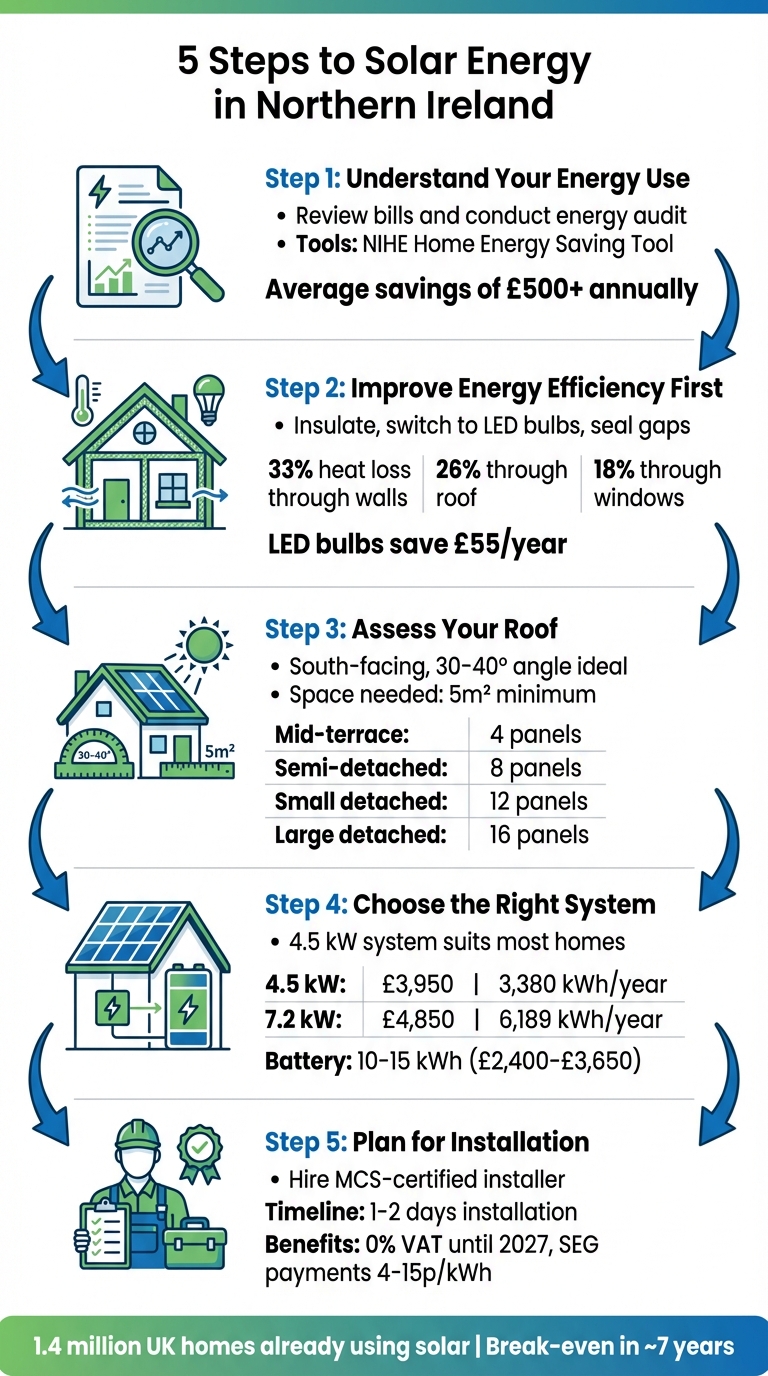
- Understand your energy use: Review your bills and conduct an energy audit to size your system correctly. Tools like the NIHE Home Energy Saving Tool can help.
- Improve energy efficiency: Insulate your home, switch to LED bulbs, and seal gaps to reduce energy waste before installing solar panels.
- Assess your roof: South-facing roofs with a 30–40° angle are ideal, but even flat roofs can work with angled frames. Avoid shaded areas.
- Choose the right system: For most homes, a 4.5 kW system suits average energy needs. Pairing solar panels with a battery allows you to store energy for later use.
- Plan for installation: Most solar systems qualify as "permitted development", but listed buildings may need special permissions. Hire an MCS-certified installer to ensure quality and access to export tariffs.
With proper planning, solar energy can lower your bills, reduce energy waste, and prepare your home for future needs like EV chargers or heat pumps. Start by evaluating your home’s potential today.
5-Step Guide to Installing Solar Panels in Northern Ireland
Understanding Your Home’s Energy Needs
Before diving into solar panels or battery storage, it’s crucial to understand how much energy your household uses. This step ensures your system is sized correctly – preventing wasted money on an oversized setup or frustration from an undersized one that can’t keep up. A solid grasp of your energy needs sets the stage for getting the most out of your solar and battery investment.
Conducting an Energy Audit
Start by reviewing your electricity bills to figure out your annual energy use in kilowatt-hours (kWh) and the associated costs. Look for patterns in your consumption and pinpoint peak usage times. This is especially important for matching your battery’s capacity to your household’s demands. As Joe Sandham, Director at Kembla, explains:
"Check your evening and overnight electricity use. Your battery should comfortably cover that demand to maximise savings."
There are free tools that can help you with this, like the NIHE Home Energy Saving Tool and the Energy Saving Trust‘s Home Renewables Selector. These tools can provide tailored reports that estimate costs for energy-saving upgrades, potential annual savings, and reductions in CO₂ emissions. An Energy Performance Certificate (EPC) is another useful resource, offering an efficiency rating (from A to G) and suggestions for improvements. Smart meters can also give you real-time data, often revealing that heating and cooling systems are the biggest energy users in your home.
Improving Energy Efficiency First
Once you know how much energy your household uses, the next step is to cut down on waste. Lowering your overall energy demand can make your solar system more efficient and cost-effective. For example, in homes without insulation, a significant amount of heat escapes – around 33% through the walls, 26% through the roof, and 18% through the windows. Addressing these losses could mean you need a smaller and less expensive solar setup.
Even small changes can make a noticeable difference. Swapping halogen bulbs for LEDs, for instance, costs about £180 for an entire home and saves roughly £55 a year. Turning your thermostat down by one degree could save around £80 annually. Installing heating controls – like a programmer, room thermostat, and thermostatic radiator valves – might cost £550 but could save you £110 each year. Adding loft insulation to at least 270mm can save around £20 a year, while cavity wall insulation could reduce your bills by £240 annually.
Brighton & Hove Energy Services Co-op (BHESCo) sums it up perfectly:
"It makes no sense to begin installing solar panels, heat pumps, or battery storage until all efforts have been made to minimise heat loss and energy waste."
There are also plenty of affordable DIY projects to tackle. For instance, sealing gaps between floorboards and skirting boards with sealant can make a big difference. And don’t forget about your hot water cylinder – adding an 80mm jacket (or replacing it for around £18) could save approximately £35 a year. These simple steps lower your energy consumption baseline, making your shift to solar power more manageable and budget-friendly.
Assessing Your Home’s Solar Potential
Once you’ve tackled energy waste, the next step is figuring out if your home is ready for solar panels. Most homes in Northern Ireland can accommodate solar systems, but understanding your roof’s layout and your home’s electrical setup is key. This ensures you avoid costly missteps and get a system that works efficiently.
Roof Suitability and Orientation
The direction your roof faces plays a big role in how much sunlight your panels can capture. South-facing roofs are ideal, as they receive sunlight throughout the day, generating the most electricity. East-facing panels are better for morning energy needs, while west-facing ones perform well in the afternoon and evening. North-facing roofs, on the other hand, aren’t recommended.
The best roof angle for solar panels in Northern Ireland is between 30 and 40 degrees. Even flat roofs can work if the panels are mounted on angled frames. Before installation, a professional survey will confirm whether your roof is structurally sound enough to support the panels.
Shading is another key factor. Trees, chimneys, or nearby buildings can block sunlight and reduce your system’s performance. If shading can’t be avoided, using microinverters or power optimisers can help ensure a shaded panel doesn’t affect the entire system. Trimming overhanging trees can also improve efficiency throughout the year.
Most standard roof tiles are compatible with solar panels, but solar roof tiles are an option for those who want a sleeker look that blends in with traditional roofing styles. For installation, you’ll need around 5 square metres of clear roof space for a basic solar water heating system. For solar PV systems, the number of panels will depend on your home type:
| House Type | Typical Number of Panels |
|---|---|
| Mid-terrace | 4 panels |
| Semi-detached / End-terrace | 8 panels |
| Small detached | 12 panels |
| Large detached | 16 panels |
Planning Permission and Electrical Readiness
In most cases, solar installations in Northern Ireland are considered "permitted development", so you won’t need planning permission. However, if your house is listed or located in a conservation area, it’s best to check with your local planning office before moving forward.
Your installer will also need to register the system with NIE Networks, Northern Ireland’s Distribution Network Operator, to ensure the grid can handle the extra electricity your panels produce.
During the initial survey, the installer will evaluate your electrical system to ensure it’s compatible with solar panels and optional battery storage. If you’re considering adding a battery later, installing a hybrid inverter upfront can make future upgrades easier. Always hire an MCS-certified installer to guarantee the installation meets safety standards and qualifies for export tariffs.
Sizing Your Solar System
Getting the right system size means balancing your available roof space with your household’s energy needs. A system that’s too small won’t cover your usage, while an oversized system might not save enough to justify the extra cost.
Start by reviewing your annual energy consumption in kWh and measuring your roof area. For instance, a 4.5 kW system with 10 panels can generate roughly 3,380 kWh per year on a south-facing roof. A larger 7.2 kW system with 16 panels might produce about 6,189 kWh annually under ideal conditions. Keep in mind that actual output will depend on factors like shading, orientation, and weather.
If your household uses around 3,500 kWh a year, a 4.5 kW system could cover most of your daytime energy needs. For homes with higher consumption, such as 6,000 kWh annually, a larger system might be more suitable, especially if paired with a battery to store excess energy for evening use. On average, solar panels can save households over £500 a year.
Choosing Solar Panels and Battery Storage
Once you’ve assessed your roof and system size, the next big step in your journey to energy independence is selecting the right solar panels, inverter, and battery. With your home confirmed as solar-ready, it’s all about choosing equipment that maximises energy production and storage.
Solar Panels and Inverter Options
Modern monocrystalline panels are a popular choice, especially in areas like Northern Ireland, where low-light conditions can be common. These panels are known for their ability to efficiently convert sunlight into energy. When choosing your panels, focus on two key factors: energy conversion efficiency and how well they complement the look of your roof.
Equally important is the inverter, which transforms the direct current (DC) electricity generated by your panels into alternating current (AC) that your home can use. A hybrid inverter is a smart choice as it allows you to add battery storage later without needing to replace the inverter. This feature ensures your system is ready for future upgrades.
Solar panels typically come with 25-year warranties and retain about 85% of their initial output over that time. Inverters, however, have a shorter lifespan – usually lasting between 10 and 15 years. This means you may need to replace your inverter once during the system’s life.
Battery Storage Benefits and Sizing
Adding a battery to your system allows you to store surplus electricity generated during the day for use in the evening when your panels aren’t producing energy. This is especially useful for load shifting, such as running energy-intensive appliances like washing machines during peak sunlight hours and saving stored energy for later.
For homes connected to the grid, it’s best to size your battery based on your daily excess energy production. Residential batteries usually range between 10 kWh and 15 kWh. If you’re looking for backup power during outages, you’ll need to decide between a partial backup – which covers essentials like your fridge, lights, and internet – or a whole-home backup, which requires multiple batteries and can be quite expensive.
Lithium-ion batteries are a better option than lead-acid ones because they can safely discharge fully. When comparing batteries, look at usable capacity (the energy you can actually access) and round-trip efficiency, which is about 90% for most solar batteries. Some of the popular battery brands available in Northern Ireland include:
Choosing the right battery size not only helps you save more but also boosts your home’s energy reliability.
"The solar panels can recharge the battery even if the grid is down… In theory, you can design a system that will keep recharging forever so you never run out of power." – Josh Lutton, President, Certasun
Once you’ve finalised your equipment, it’s time to evaluate your system’s performance and financial benefits.
Performance and Cost Expectations
The output of your solar system depends on factors like its size, shading, and orientation. Costs also vary by system size. For example, a 4.5 kW system starts at around £3,950, while a 7.2 kW system costs roughly £4,850. Thanks to the 0% VAT rate on solar and battery installations (available until 2027), you can save approximately £1,400 on a typical £7,000 system.
Another financial benefit comes from the Smart Export Guarantee (SEG), which pays between 4p and 15p per kWh for any excess energy you send back to the grid. To qualify for SEG payments, make sure your installer is MCS-accredited and that you have a smart meter capable of tracking exported energy.
As of late 2022, the break-even point for solar storage in the UK was estimated to be about seven years. With over 1.4 million homes in the UK now using solar panels, it’s clear that solar technology has established itself as a reliable, long-term investment.
sbb-itb-d2d975a
From Installation to Energy Independence
With your chosen equipment and a well-thought-out system design, you’re ready to bring your solar energy plans to life.
Preparing for an Installer Survey
Before the installation kicks off, an assessor will visit your property to evaluate roof safety, measure the available space, and design a system tailored to your roof’s orientation and any shading issues. Bringing along recent energy bills can help ensure the system is accurately sized to meet your energy needs.
It’s essential to check that your roof is in solid condition. Solar panels are built to last over 25 years, so you’ll want to avoid the hassle of removing them for roof repairs later. Look out for potential shading from chimneys, nearby trees, or neighbouring buildings, and make sure there’s at least 15–20m² of clear roof space available. Additionally, decide on a location for the battery or diverter – common spots include the garage, utility room, or hot press – and let your installer know. Taking these steps ahead of time ensures the installation process runs smoothly.
The Installation Process
Installing a solar system typically takes one to two days. Scaffolding is set up beforehand to provide safe roof access. The process involves fitting roof brackets, mounting the panels, and running the necessary wiring to connect them to the inverter. The inverter is then linked to your home’s electrical system, often located near the fuse board.
To help the installation team, ensure clear access to your driveway, fuse board, and the area where the battery will be installed. During the panel connection, your home’s power will need to be briefly turned off. Once everything is mounted and wired, the installer will test the system and register it with NIE Networks to confirm the grid can handle any excess electricity you generate. Make sure your installer is MCS-accredited – this certification is not only a mark of quality but also a requirement for export payments.
Getting the Most from Your Solar System
Once your system is installed and up and running, efficient use is key to maximising its benefits. Shift energy-intensive tasks – like running the dishwasher, washing machine, or charging an electric vehicle – to daylight hours when your solar panels are producing power. This helps you rely on your own solar energy rather than drawing from the grid during more expensive evening hours.
Most modern systems include monitoring apps that let you track real-time energy generation and usage. These apps are invaluable for spotting performance issues and keeping an eye on daily production. To maintain efficiency, clean the panels every three to six months using a hose or soft brush. Additionally, schedule an annual professional inspection to check wiring, connections, and update the inverter if needed.
Don’t forget to register for an export tariff to earn payments for any surplus energy you send back to the grid. In Northern Ireland, fixed annual rates are available for generators up to 50 kW, though the actual rates may vary depending on market conditions. With consistent monitoring and maintenance, your solar system can provide long-term savings and a steady supply of clean energy.
Planning for Future Energy Needs
Planning for Future Upgrades
Once your current system is running efficiently, it’s important to think ahead and prepare for growing energy needs. As your household evolves, you might want to integrate features like EV chargers, heat pumps, or even expand your solar capacity.
Starting with a hybrid inverter is a smart move – it ensures your system is ready for battery storage down the line. If you’re considering adding an EV charger or a heat pump in the future, let your installer know during the initial setup so they can plan accordingly.
Smart Energy Management Systems can help you get the most out of your solar panels, batteries, and heat pumps. These systems are designed to schedule tasks, such as charging your EV, during times of peak energy production. To maximise the efficiency of a heat pump, ensure your home is well-insulated. For context, installing an air source heat pump in Northern Ireland costs approximately £11,000 and could save you up to £1,300 annually on energy bills.
It’s also worth reviewing your Energy Performance Certificate (EPC) to decide whether to prioritise adding more solar panels or improving your home’s insulation. Before making significant upgrades, check with your local planning office to ensure compliance. Regularly monitoring your system’s performance will provide valuable insights for guiding future improvements.
Tracking Energy Savings and Carbon Reductions
As you enhance your system, keeping an eye on its performance is essential for maintaining and improving efficiency. Many solar setups come with apps that show real-time data on energy generation and consumption, making it easier to track progress.
The ESBN portal offers detailed insights into your energy usage, highlighting demand patterns, peak cost periods, and the surplus electricity you’re exporting back to the grid. If you notice consistent excess energy production during the day, it might be time to invest in battery storage or shift energy-heavy activities – like running the washing machine or charging your EV – to daylight hours. Smart charging stations can even automate this, ensuring your EV charges when your solar panels are generating the most power.
Your EPC rating is another useful tool for measuring improvements. Homes with an A rating are the most energy-efficient and produce the least carbon emissions, while lower ratings point to areas needing attention. By comparing your EPC rating before and after upgrades, you can clearly see the impact of your efforts. Tools like the Energy Saving Trust’s solar calculator can also help estimate your potential savings and reductions in carbon emissions.
With more than 1.4 million homes across the UK already equipped with solar panels, tracking your progress becomes part of a larger push towards a cleaner energy future. Regular monitoring, combined with annual system servicing, ensures your solar setup continues to deliver both financial savings and environmental benefits for years to come.
Conclusion
Switching to renewable energy is easier than you might think when you take the right steps. Start by improving your home’s energy efficiency to reduce overall consumption – this simple change can make a big difference. Next, have a professional evaluate your property’s potential for solar energy. A well-designed solar system, whether standalone or paired with battery storage, not only reduces your reliance on the grid but can also lead to significant savings. In fact, over 1.4 million homes across the UK have already embraced this change, enjoying annual savings of more than £500 on average.
Solar power is a vital step towards creating a greener Northern Ireland. Once your system is installed, make sure to register it with NIE Networks through your installer. You can even sell surplus electricity through local export schemes, adding an extra financial benefit. If you’re considering future upgrades like heat pumps or EV chargers, opting for a hybrid inverter now can make those additions easier down the line.
Why wait? Start your journey today towards a smarter, greener home.
FAQs
How can I check if my roof is suitable for solar panels?
Determining whether your roof is a good fit for solar panels involves a few straightforward considerations:
- Roof orientation: In the UK, south-facing roofs are the best option as they capture the most sunlight. East- and west-facing roofs can still work effectively, but north-facing roofs are typically not suitable.
- Shading: Check for any significant shading from trees, chimneys, or nearby buildings. Even partial shading can impact the efficiency of solar panels.
- Size and angle: You’ll need at least 10 square metres of unobstructed roof space. The ideal roof pitch for maximising sunlight is between 15° and 45°.
- Structural condition: Your roof should be in good shape and strong enough to support the weight of the panels. If you’re uncertain, it’s wise to get a professional structural evaluation.
For the most precise assessment, it’s worth arranging a professional survey with a local solar installer. They can provide a detailed evaluation of your roof and guide you on the next steps towards adopting solar energy.
What are the advantages of combining solar panels with battery storage?
Pairing solar panels with battery storage lets you save the extra electricity generated during sunny hours to use later, like at night or on cloudy days. This not only helps lower your electricity bills but also boosts your energy independence, making you less reliant on the grid.
Using stored energy during peak demand times can help you dodge higher electricity rates, ensuring you get the most out of your solar setup. Plus, this combination promotes a greener future by making better use of renewable energy and cutting down on your carbon footprint.
Do I need planning permission to install solar panels on my home in Northern Ireland?
In Northern Ireland, installing roof-mounted solar panels usually falls under permitted development, so planning permission isn’t typically required. However, there are some exceptions to be aware of. If your property is a listed building, situated in a conservation area, or includes specific types of outbuildings, you might need to obtain approval from your local council.
To avoid any issues, it’s wise to consult your local council before beginning the installation process.