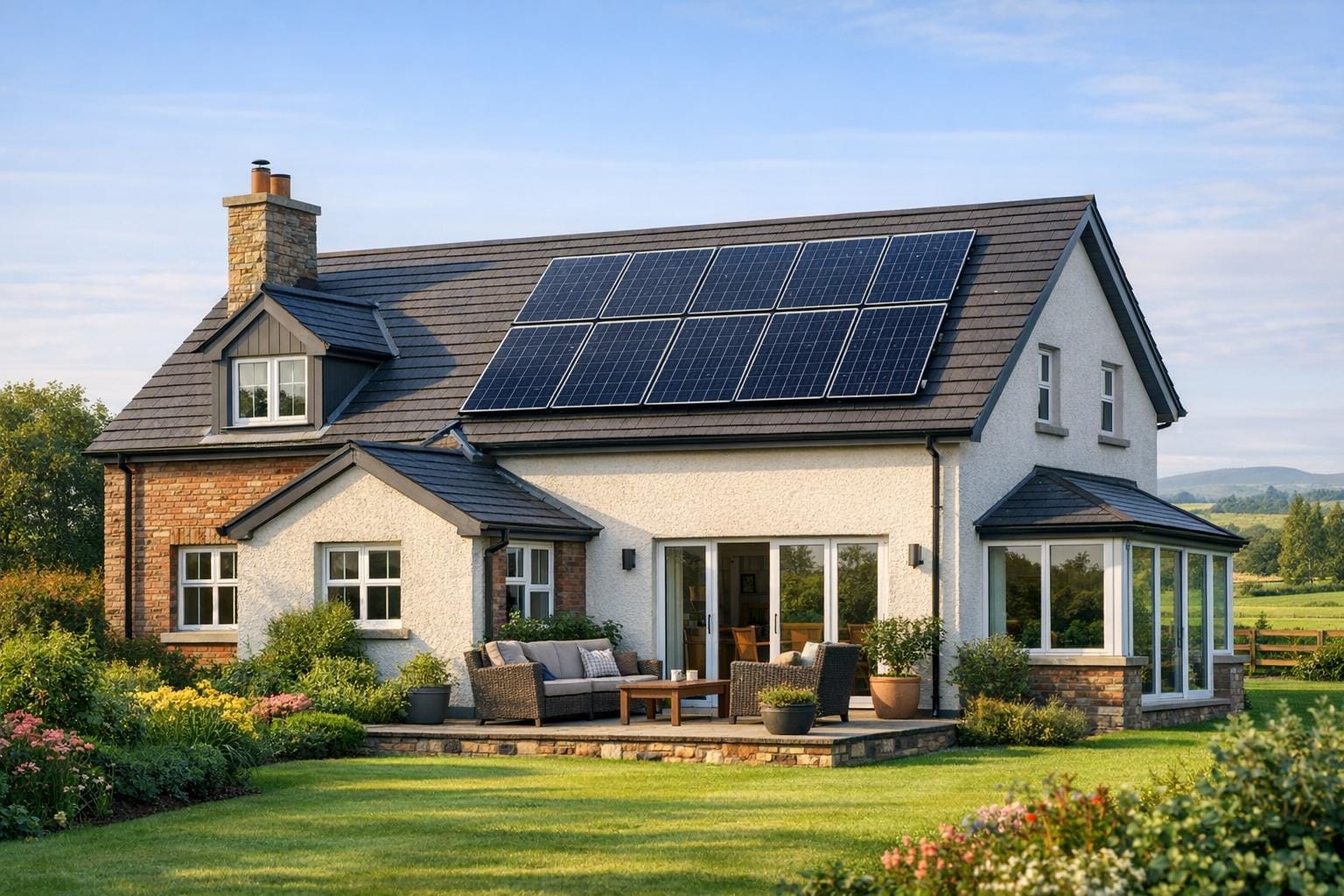
In Northern Ireland, most homeowners can install solar panels without applying for planning permission, thanks to permitted development rights. However, there are exceptions. If your property is listed, located in a conservation area, or within a designated zone (like an Area of Outstanding Natural Beauty), formal permission is required. Additionally, installations exceeding specific size or placement limits also need approval.
Key Points:
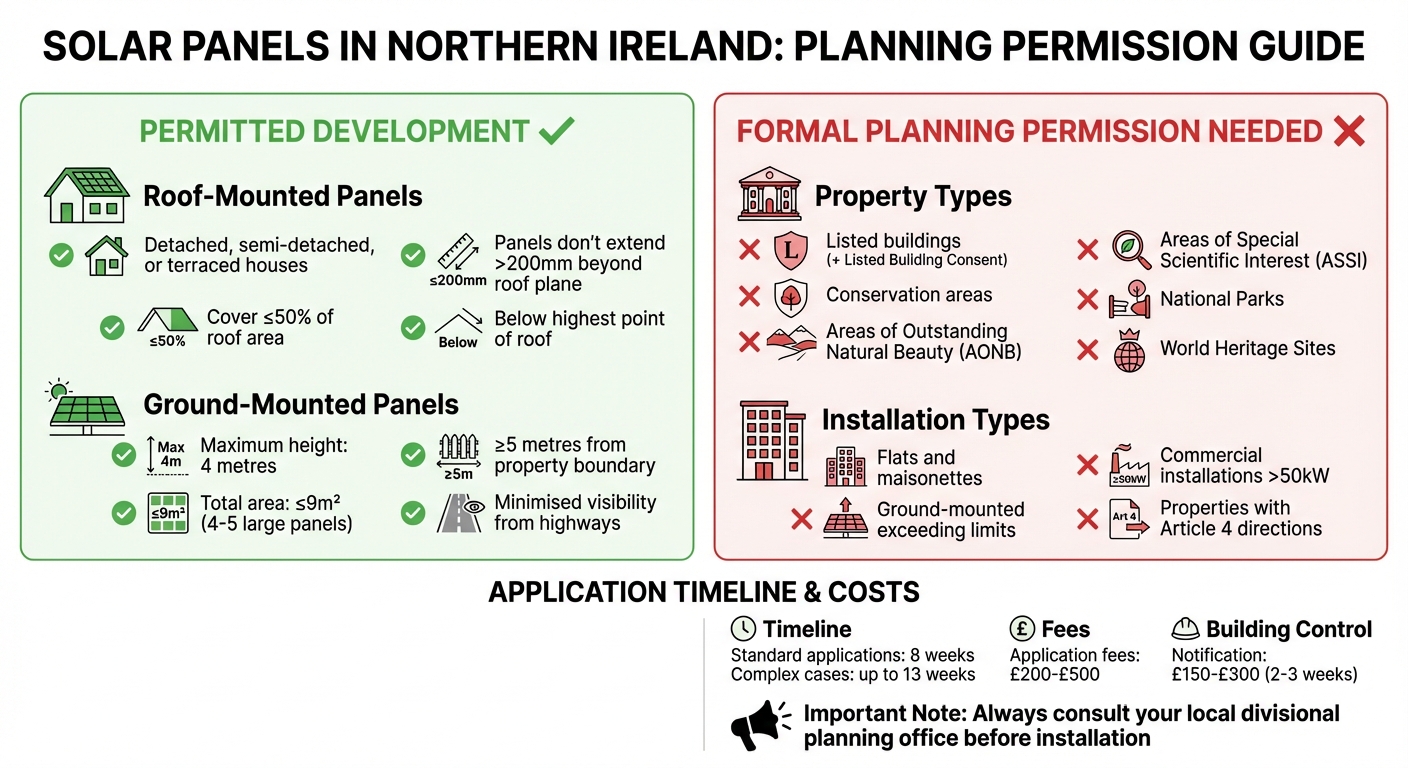
- Permitted Development: Applies to roof-mounted panels on detached, semi-detached, and terraced houses if they meet certain conditions (e.g., panels must not extend more than 200mm beyond the roof plane or cover over 50% of the roof).
- Exceptions: Listed buildings, conservation areas, and ground-mounted systems exceeding limits (e.g., over 9m² or 4m in height) require planning permission.
- Building Regulations: Regardless of permission, your roof must be strong enough to support the panels.
To avoid issues, consult your local planning office before starting any work. If permission is needed, applications can be submitted online, with decisions typically made within 8-13 weeks. Costs range from £200 to £500, plus additional fees for building control notifications.
Solar Panel Planning Permission Requirements in Northern Ireland
When You Don’t Need Planning Permission
In Northern Ireland, most homeowners can install solar panels without needing planning permission. Roof-mounted systems on detached, semi-detached, and terraced houses typically fall under permitted development. The same applies to panels installed on many outbuildings. However, if your property is listed or located in a conservation area, planning permission will be required. Below are the specific conditions that determine whether your installation qualifies as permitted development.
Requirements for Permitted Development
Roof-mounted solar panels are considered permitted development if they meet these conditions:
- They do not extend more than 200mm beyond the roof plane.
- They cover no more than 50% of the roof area.
- They remain below the highest point of the roof (excluding chimneys).
If your property is in a conservation area, additional restrictions apply, especially if the panels face a highway from the main elevation. To avoid any issues, it’s always a good idea to check with your local divisional planning office to confirm your property’s eligibility for permitted development rights.
Rules for Ground-Mounted Solar Panels
Ground-mounted solar panels also come under permitted development rights if they comply with certain criteria. These include:
- A maximum height of 4 metres.
- A total area not exceeding 9m² – enough space for around four to five large panels.
- Placement at least 5 metres away from the property boundary.
- A design that minimises visibility from highways.
When You Need Planning Permission or Listed Building Consent
If your solar panel installation exceeds permitted limits or doesn’t meet specific development criteria, you’ll need formal planning permission.
While many homeowners enjoy permitted development rights, some properties and locations come with additional restrictions. Knowing these rules ahead of time can save you from unnecessary expenses or delays.
Listed Buildings and Conservation Areas
If your property is in a conservation area, you’ll need to submit a planning application before installing solar panels. This also applies to designated areas like Areas of Outstanding Natural Beauty (AONB), Areas of Special Scientific Interest (ASSI), National Parks, and World Heritage Sites.
For listed buildings, you might also need Listed Building Consent to ensure the installation doesn’t harm the building’s character. You can request a "Section 5" or "Section 57" declaration from your local planning authority to determine whether the proposed work affects the building’s protected status. In short, listed properties and those in conservation areas almost always require planning consent.
Installation Factors That Require Permission
Apart from the type of property, certain installation features may also require formal approval. For example, flats, maisonettes, and ground-mounted systems that exceed permitted limits or original conditions will need planning permission. Additionally, Article 4 directions can impose further restrictions on permitted development rights.
For commercial installations, anything generating over 50 kilowatts of electricity (or 45 kilowatts thermal for heat) doesn’t qualify as microgeneration and will need planning permission.
Here’s a quick reference to clarify when formal permission is required:
Permitted Development vs Required Permission
| Property/Installation Type | Planning Permission Status |
|---|---|
| Standard Residential (Detached/Semi-Detached/Terraced) | Generally permitted under development rights |
| Flats and Maisonettes | Permission required for additions/extensions |
| Listed Buildings | Permission and Listed Building Consent required |
| Conservation Areas / AONB | Permission usually required; permitted rights are restricted |
| Ground-mounted (Exceeding limits) | Permission required |
| Commercial/Large Scale (>50kW) | Permission required (exceeds microgeneration limits) |
Before starting any work, it’s always a good idea to check with your local planning office, particularly if your property falls into one of these categories.
How to Apply for Planning Permission in Northern Ireland
If your solar panel installation requires formal planning permission, you’ll need to submit an application to your local council. This involves gathering specific documents and following outlined procedures to ensure your application is handled efficiently.
Application Steps
You can submit your planning application online through the Planning Portal, which is used by 10 of the 11 councils in Northern Ireland. If your property falls under the Mid Ulster District Council, you’ll need to use their dedicated system instead.
Your application should include a current OSNI map at a 1:2500 scale with the site boundary clearly marked in red (four hard copies if required) and professionally scaled drawings detailing the proposed development. This is particularly important for listed buildings or properties in conservation areas. OSNI maps can be purchased online via the nidirect MapShop. Keep in mind that all submitted documents become part of the public Planning Register, though personal details are redacted.
It’s strongly advised to seek pre-application advice before submitting your application. Your local council can guide you on the necessary documents and help you avoid potential issues. This step can save both time and money. If your case is complex and you’re not working with a professional, consider seeking free, independent planning advice from local organisations.
Once you’ve gathered the required documents, review the expected timelines and costs before proceeding with the submission.
Timeline and Costs
After submission, councils aim to decide on planning applications within 8 weeks. However, more complex cases, such as those involving listed buildings or conservation areas, may take up to 13 weeks. If your council doesn’t make a decision within the standard eight-week period, you have the right to appeal to the Planning Appeals Commission.
The application fees for domestic solar panel planning permission usually range between £200 and £500, depending on the specifics of your development. It’s always a good idea to confirm the exact fee with your local planning office to avoid delays in processing. Additionally, even after planning permission is granted, you’ll need to submit a separate Building Control notification. This costs between £150 and £300 and typically takes 2 to 3 weeks to process.
sbb-itb-d2d975a
How EECO Energy Helps with Planning Compliance

EECO Energy takes the stress out of planning compliance with a free survey designed to quickly determine whether your solar installation qualifies as permitted development or requires formal planning permission. The survey evaluates key factors like conservation area status, listed building designation, and roof strength. Following this, MCS-accredited installers assess your roof’s ability to support the weight of solar panels and recommend the best placement – ideally within 90° of due south – to meet both planning and building standards. Use the checklist below to see if your property meets the criteria for permitted development.
Property Eligibility Checklist
Before moving forward with your solar panel installation, review these criteria to check if your property is likely to qualify for permitted development:
| Requirement | Permitted Development Criteria |
|---|---|
| Property Type | Detached, semi-detached, or terraced houses (flats, maisonettes, or converted properties usually don’t qualify under these criteria). |
| Building Status | The property must not be a listed building. |
| Location | The property must be outside conservation areas or Areas of Outstanding Natural Beauty (AONB). |
| Pitched Roof | Panels must not exceed the highest part of the roof and should not protrude more than 20cm if visible from a road. |
| Flat Roof | Panels must not extend more than 1.5 metres above the roof plane and must stay within the roof boundaries. |
| Free-Standing Panels | Only one installation is allowed, with a total area no larger than 14 square metres and a maximum height of 2 metres. |
| Structural Soundness | The roof must be strong enough to support the additional weight of the panels, in line with building regulations. |
Note: In conservation areas, panels must not face or be visible from a road to remain eligible for permitted development. It’s always a good idea to double-check these details with your local divisional planning office before starting the installation. Applying for permission retroactively can be both difficult and expensive.
Why Choose EECO Energy
EECO Energy provides specialist support to help you navigate Northern Ireland’s regulatory framework, preventing costly delays or planning mistakes. By working within this clear eligibility framework, EECO Energy stands out with its professional expertise and efficient service. Their MCS-accredited installations meet UK quality standards, and every system comes with a 25-year warranty, giving you long-term confidence in your investment. With most installations completed in just one day and coverage across all of Northern Ireland, EECO Energy handles the technical challenges so you can focus on enjoying the benefits of renewable energy.
"Most domestic systems are between 1.5 and 3 kilowatts (kW) and can produce around half a domestic property’s electricity requirements." – nidirect
This streamlined process not only saves time and money but also helps you avoid future complications, making the transition to solar energy as smooth as possible.
Conclusion
Navigating planning permission requirements for solar panels in Northern Ireland doesn’t have to be overwhelming. In most cases, installations on detached, semi-detached, and terraced houses fall under permitted development, meaning you won’t need formal approval. However, if your property is listed, sits in a conservation area, or lies within an Area of Outstanding Natural Beauty, you’ll need to apply for permission before starting any work. Checking these details early can save you from unexpected delays later.
Before installation, it’s essential to confirm your property’s eligibility. Verifying its status in advance is a smart step. Also, don’t forget about building regulations – your roof must meet structural standards to safely support the panels. Proper preparation ensures a smooth and hassle-free installation process.
To make things even easier, EECO Energy offers a free survey to determine if your project qualifies as permitted development. Their MCS-accredited team handles everything, from structural assessments to panel placement, ensuring compliance with Northern Ireland’s regulations. Plus, with a 25-year warranty and one-day installations, you can confidently embrace renewable energy while meeting all the necessary standards.
FAQs
Do I need planning permission to install solar panels in Northern Ireland?
In Northern Ireland, installing solar panels usually doesn’t require planning permission because they fall under permitted development. This applies to panels installed on the roofs of detached, semi-detached, or terraced houses, as well as many outbuildings.
That said, if your property is a listed building or situated in a conservation area, planning permission will be necessary. It’s also important to ensure the installation adheres to regulations regarding panel size and placement to avoid any compliance issues.
Do I need planning permission to install solar panels on a listed building or in a conservation area?
If your property is classified as a listed building or situated within a conservation area, you’ll likely need planning permission before installing solar panels. These types of properties are subject to stricter regulations designed to protect their historical or architectural importance.
To ensure your plans align with local requirements, it’s essential to consult your local planning authority. Getting their guidance early on can save you from unnecessary delays or complications during the installation process.
How can I check if my roof is suitable for solar panels?
Before getting solar panels installed, it’s crucial to make sure your roof is in good condition and able to handle the extra weight. This is something a professional installer or structural engineer will examine as part of the process.
They’ll inspect the roof to confirm that the tiles or materials are in solid shape and can support the weight of the panels, which usually ranges from 10 to 15 kg per square metre for standard systems. If your roof is old or has damage, repairs or reinforcements might be needed. They’ll also consider the roof’s pitch and orientation to ensure the panels can perform efficiently and be installed safely.
For added assurance, ask your installer for a written statement confirming that your roof meets all structural and regulatory standards. This not only ensures everything is up to code but also gives you confidence to move forward with the installation.