Switching from home heating oil to solar energy is becoming a practical choice for many households in Northern Ireland. With over half of energy bills spent on heating and hot water, and oil systems contributing to carbon emissions, alternatives are more relevant than ever. Solar panels, paired with battery storage or heat pumps, offer a reliable way to cut costs and emissions, even in Northern Ireland’s cloudy climate. Here’s what you need to know:
- Solar PV panels: Convert sunlight into electricity, powering electric heating systems like heat pumps.
- Solar thermal systems: Heat water directly, meeting up to 90% of summer hot water needs.
- Battery storage: Saves excess energy for use during evenings or cloudy days, reducing dependence on oil and the grid.
- Costs: Solar PV systems start at £3,950, with battery options from £2,400. Heat pumps cost around £11,000 but can save up to £1,300 annually.
Switching to solar energy can reduce heating oil use, lower bills, and help meet Northern Ireland’s net-zero emissions target by 2050. Start by assessing your home’s energy needs and exploring solar options tailored to your property.
How Solar Energy Reduces Heating Oil Dependence
How Solar Panels Generate Energy for Heating and Power
Solar energy systems offer an effective way to cut down on heating oil usage through two main approaches. First, solar photovoltaic (PV) panels transform sunlight into electricity, which can power electric heating systems like air or ground source heat pumps, replacing traditional oil boilers. Second, solar thermal systems directly heat water using solar collectors. For instance, a standard 3kW solar PV system, which typically requires around 20m² of roof space, can produce approximately 2,600 kWh of electricity annually. This output can cover between 40% and 60% of an average household’s energy consumption.
Solar thermal systems are particularly effective during the summer, meeting up to 90% of a home’s hot water needs. However, their efficiency drops to about 25% during winter months. To further reduce reliance on fossil fuels, battery storage systems can save surplus electricity generated during the day for use at night or on cloudy days. Together, these systems provide a pathway to energy independence, especially for rural homes where off-grid solutions are highly advantageous.
By understanding how these technologies work, it becomes clear why solar energy is a practical alternative for reducing heating oil dependence.
Why Solar Energy Works in Northern Ireland’s Climate
Even with Northern Ireland’s often cloudy skies, solar energy systems continue to perform efficiently. Modern solar panels are designed to capture diffuse sunlight, which allows them to achieve up to 75% of their peak output on overcast days. This capability ensures that solar systems can generate both electricity and heat throughout the year, although their output naturally decreases during the shorter, darker days of winter.
Interestingly, Northern Ireland’s moderate climate actually benefits solar energy systems. For example, air source heat pumps – frequently paired with solar setups – can extract warmth from the air even at temperatures as low as -25°C. The widespread adoption of solar technology further highlights its feasibility, with over 119,000 homes across Ireland now equipped with solar PV panels. Beyond energy savings, switching to solar can significantly cut a household’s carbon emissions, reducing them by 1.5 to 2 tonnes of CO2 each year. Additionally, the financial appeal is growing, with the average payback period for solar panel installations now ranging between 4 and 7 years.
This combination of environmental and economic benefits underscores why solar energy is a solid choice for households in Northern Ireland.
EECO Energy‘s Solar Panel Systems for Northern Irish Homes

Solar Energy System Options and Costs for Northern Ireland Homes
Solar Panel System Options and Pricing
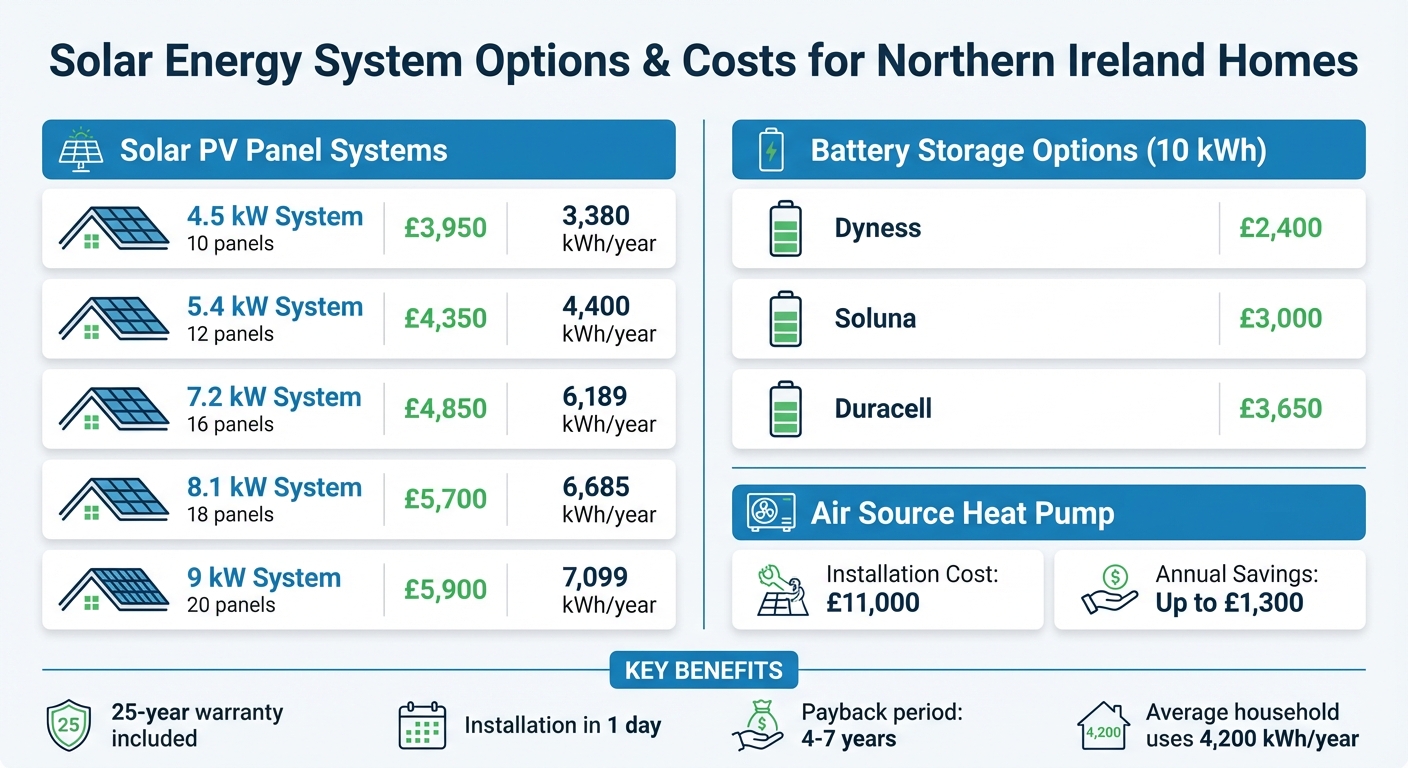
EECO Energy provides a range of solar PV systems tailored to suit different household energy needs. The options start with a 4.5 kW system (10 panels) priced at £3,950, which can generate around 3,380 kWh annually on a south-facing roof. For mid-sized homes, there’s the 5.4 kW system (12 panels) at £4,350, producing approximately 4,400 kWh per year, or the 7.2 kW system (16 panels) for £4,850, delivering about 6,189 kWh annually. Larger households can opt for the 8.1 kW system (18 panels) at £5,700, generating roughly 6,685 kWh, or the 9 kW system (20 panels) for £5,900, which produces around 7,099 kWh each year.
To help homeowners cut back on heating oil usage, EECO Energy includes Smart Immersion technology with its solar installations. This clever system redirects surplus solar electricity to your immersion heater, reducing oil consumption by using solar power for water heating instead of exporting it to the grid. For those looking for even more ways to reduce oil reliance, EECO Energy also offers Solar Thermal systems and modern, energy-efficient radiators to replace or complement traditional oil-fired heating systems.
When planning your solar installation, it’s worth maximising your roof’s panel capacity from the outset. Adding panels later can be tricky and more expensive. EECO Energy ensures peace of mind with 25-year warranties on its systems, and installations are typically completed within a day, covering locations across Northern Ireland.
To further enhance energy independence, EECO Energy also provides advanced battery storage solutions.
Battery Storage Options for Energy Independence
Adding battery storage to your solar panel system is a smart way to reduce reliance on heating oil. Batteries store the excess electricity generated during the day, making it available during evening hours when energy demand – especially for heating – is at its peak. As a Duracell Approved Installer, EECO Energy offers three 10 kWh battery options: the Dyness for £2,400, the Soluna for £3,000, and the Duracell for £3,650.
How to Transition from Heating Oil to Solar Energy
Assess Your Home’s Energy Needs
The first step in switching to solar energy is understanding your home’s energy requirements. Start by reviewing your electricity bills from the past year to calculate your total annual consumption in kilowatt-hours (kWh). On average, households in Ireland use around 4,200 kWh annually, though this can vary depending on the size of your home and your energy habits.
Next, look up your property’s Energy Performance Certificate (EPC) on the National Register. As AIB (NI) points out:
Finding out the EPC (Energy Performance Certificate) rating of the property is a good place to start. The lower the EPC rating, the more work that will be needed to make your home energy efficient.
If your EPC rating is low, focus on improving your home’s insulation before investing in solar. Start with attic insulation, then move on to walls and floors. Poor insulation allows heat to escape, undermining the benefits of generating renewable energy.
You should also assess your roof’s suitability for solar panels. South-facing roofs are ideal, but east-to-west orientations can still perform well. Check for shading from trees or nearby buildings and ensure your roof has enough space – typically, you’ll need between 5 and 20 square metres. Finally, decide whether you want solar thermal panels for water heating or solar photovoltaic (PV) panels to generate electricity. If you aim to replace your oil boiler, an electric heat pump powered by solar PV may be the way to go.
Once you’ve gathered this information, you’ll be in a better position to choose the right solar and battery system for your home.
Select the Right Solar and Battery System
With your energy needs in mind, you can now determine the size of the solar system that fits your home. A typical three-bedroom house generally requires 10–12 solar panels to meet most of its energy demands. For instance, a 5.4 kW system with 12 panels can generate around 4,400 kWh annually, which is suitable for average-sized homes. Larger households might consider systems with capacities of 7.2 kW or 8.1 kW.
Battery storage is another important consideration. Think about how much energy independence you want. Hybrid systems, which are connected to the grid, are popular among UK homeowners. They provide backup power and allow you to export surplus energy. Fully off-grid systems, on the other hand, require much larger battery capacities and are often less practical for properties in Northern Ireland.
If you’re looking to replace your oil boiler entirely, solar PV panels can power an air source heat pump. In Northern Ireland, installing an air source heat pump costs about £11,000, but it can save you up to £1,300 annually. Alternatively, if you’re only looking to reduce oil usage for hot water, solar thermal panels are a good option. EECO Energy also offers Smart Immersion technology, which uses surplus solar electricity to heat water via your immersion heater – an easier and more affordable solution.
Installation and System Integration
Installing a solar system is a straightforward process when handled by certified professionals. For example, EECO Energy can complete most installations within a day and manage all the necessary paperwork, including registering your system with NIE Networks. If you’re opting for solar thermal panels, you may need to upgrade to a dual-coil hot water cylinder so both the solar system and your oil boiler can contribute to heating water.
Solar thermal systems often work alongside your existing boiler or immersion heater, providing backup heating during the winter months when solar energy generation is lower. EECO Energy’s Smart Immersion technology, included in their solar PV installations, allows you to enjoy solar-heated water without needing a separate thermal system.
After installation, your system is covered by a 25-year warranty from EECO Energy. Most homeowners recover their investment within 5 years. Adding smart heating controls can further reduce energy usage by up to 20%. To maintain peak performance, ensure regular annual maintenance and keep the panels clear of debris.
Next, explore local success stories to see how these installations have helped others achieve substantial cost savings.
sbb-itb-d2d975a
Local Success Stories and Cost Savings
Case Studies: Reduced Heating Oil Dependence
In November 2021, the Northern Ireland Housing Executive rolled out a pilot scheme in Lisnaskea, County Fermanagh, involving six homes. One of the participants, Irene McKiernan, had her home fitted with a hybrid system combining solar panels and a heat pump, while keeping her oil boiler as a backup for particularly cold conditions. This setup led to a 40% to 55% reduction in carbon emissions. Robert Clements, Sustainable Development Manager at the Housing Executive, highlighted the impact:
This system is reducing the carbon emissions between 40 to 55%.
Irene herself shared her motivation for joining the project:
I wanted to be part of something that was greener and more efficient.
Another success story from Fermanagh features Frank and Mary Maguire, who installed solar panels and praised the support they received throughout the process. Frank remarked:
I found the installation team to be professional, approachable, and very competent, patiently explaining how to operate my system.
These examples highlight how renewable energy solutions are not only reducing heating oil dependence but are also making a noticeable difference in people’s lives.
Financial and Environmental Benefits
The benefits of solar panel systems extend far beyond the initial setup. A standard residential solar system can reduce carbon emissions by 1.5 to 2 tonnes annually, which is comparable to the carbon absorbed by 100 trees. On top of that, homeowners can cut their electricity bills by up to 50%, saving more than £20,000 over 20 years. Most systems pay for themselves within 4 to 7 years.
Pairing solar panels with an air source heat pump amplifies the savings. Although heat pumps cost around £11,000 to install in Northern Ireland, they can save households as much as £1,300 each year. Similarly, solar thermal systems, which cost approximately £6,000, can cover about 50% of a household’s annual hot water needs – providing up to 90% in summer and 25% in winter.
Conclusion
Benefits of Switching to Solar Energy
Switching to solar energy can significantly lower electricity costs, cutting bills by around 50%. Over 20 years, this could mean savings of over £20,000, with most systems covering their initial costs within 4 to 7 years. On top of the financial perks, solar panels can reduce carbon emissions by 1.5 to 2 tonnes annually. That’s roughly the same as planting 100 trees each year – an impactful step towards Northern Ireland’s 2050 net-zero goals.
Adding battery storage to your solar setup takes things a step further. It allows you to store excess energy generated during the day for use at night or during peak hours. This not only reduces dependency on the national grid but also offers protection against energy price hikes and supply issues. Solar thermal systems are another excellent option, providing a reliable supply of hot water year-round and meeting about 50% of annual hot water needs. Together, these benefits make solar systems an appealing and practical choice for homes in Northern Ireland.
Next Steps for Homeowners
Thinking about making the switch? Start by evaluating your home’s energy efficiency and reviewing your recent electricity bills to understand your energy usage. EECO Energy offers free surveys and quotes to help you find the perfect system size for your needs. Details about pricing and system options can be found in earlier sections.
With EECO Energy’s MCS-accredited installers, you can have your system up and running in just one day. Plus, every installation comes with a 25-year warranty, giving you long-term peace of mind. To make things even more affordable, you can take advantage of financial support through the Northern Ireland Sustainable Energy Programme (NISEP). Contact EECO Energy today to arrange your free survey and take the first step towards cutting your energy bills and achieving greater energy independence.
FAQs
Are solar panels effective in Northern Ireland’s cloudy weather?
Yes, solar panels work well in Northern Ireland, even with its famously cloudy skies. The region benefits from around 1,100–1,200 kWh/m² of solar energy each year, which is only slightly less than what southern England receives. Thanks to advancements in photovoltaic (PV) technology, modern solar panels can efficiently harness diffuse sunlight. This means they can still produce up to 75% of their capacity even on overcast days.
For a typical 3 kW domestic solar system, this translates into a noticeable reduction in electricity consumption and lower energy bills, despite the occasional lack of sunshine. Solar panels offer a practical way for Northern Irish households to cut down on their dependence on home heating oil and enjoy long-term savings.
What are the upfront costs and savings of installing solar panels in Northern Ireland?
Installing solar panels requires an upfront cost to cover the photovoltaic (PV) system, which includes the panels, inverters, and, if chosen, battery storage. In Northern Ireland, the price for a standard domestic setup typically ranges from £6,000 to £8,500, depending on the system’s size and configuration. This cost accounts for both the equipment and professional installation.
Once up and running, solar panels can lead to substantial savings on energy bills. Many households report annual savings of up to £1,000, with some cutting their electricity costs by as much as 85%. This means that the initial investment often pays for itself within 5 to 7 years, after which the energy generated is essentially free. On top of the financial savings, solar energy offers an environmentally friendly way to power your home, helping to lower your carbon footprint.
How can solar energy systems help reduce carbon emissions in homes?
Solar energy systems generate clean electricity by converting sunlight into power, reducing the dependence on fossil fuels such as coal and gas. By adopting solar energy, homeowners can make a meaningful impact on reducing their carbon footprint and take a step towards a greener future.
What’s more, combining solar panels with battery storage systems can boost energy efficiency. These batteries store surplus power, which can be used during the evenings or on cloudy days. This setup not only decreases reliance on traditional energy sources but also helps households save on energy bills over time.