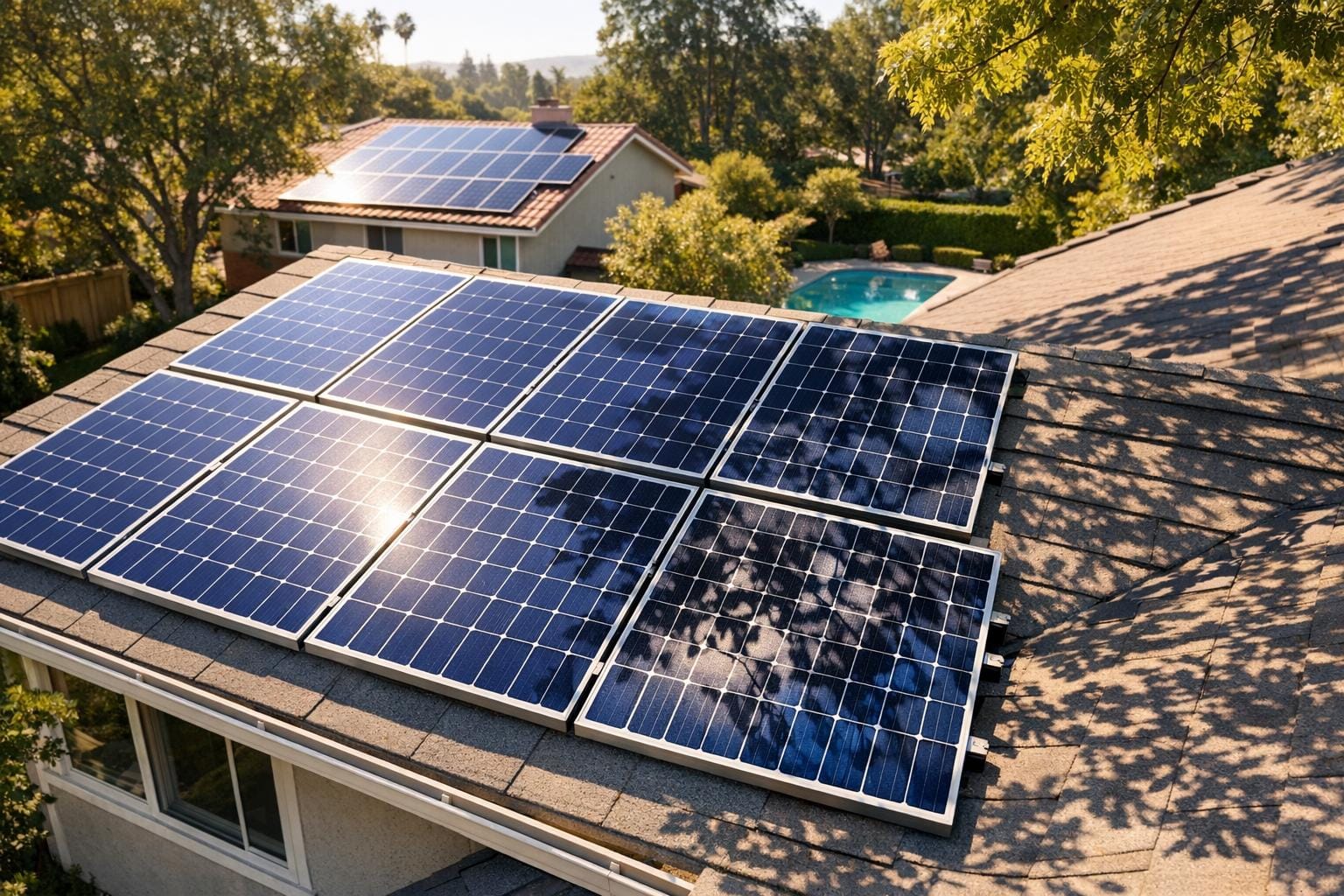
When it comes to solar panels, shade is a bigger issue than most people realise. Even slight shading – like a single cell being blocked – can cut a panel’s output by 50% to 80%. In a system where panels are connected in series, shading just 10% of one panel can halve the energy production of the entire array. This is especially challenging in places like Northern Ireland, where the low sun angle and frequent cloud cover lead to longer shadows and reduced sunlight, with an average of only 3.8 hours of sunlight per day.
Key Points:
- How shading works: Solar panels are highly sensitive to shade due to their series connection. A shaded cell can act as a resistor, causing energy loss and overheating.
- Bypass diodes: Modern panels use diodes to limit shading impact, but they still result in some energy loss (up to 33% of the panel’s output per affected section).
- Common shading causes: Trees, chimneys, nearby buildings, and cloud cover are major culprits. Seasonal factors like low winter sun angles make this worse.
- Solutions: Proper panel placement, microinverters, power optimisers, and regular maintenance (like trimming trees or cleaning panels) can significantly improve energy output.
If you’re in a region with limited sunlight, like Northern Ireland, addressing shading is crucial to getting the most out of your solar investment. Simple steps like strategic placement and using advanced tech can make a measurable difference in energy production and system safety.
How Shade Reduces Solar Panel Efficiency
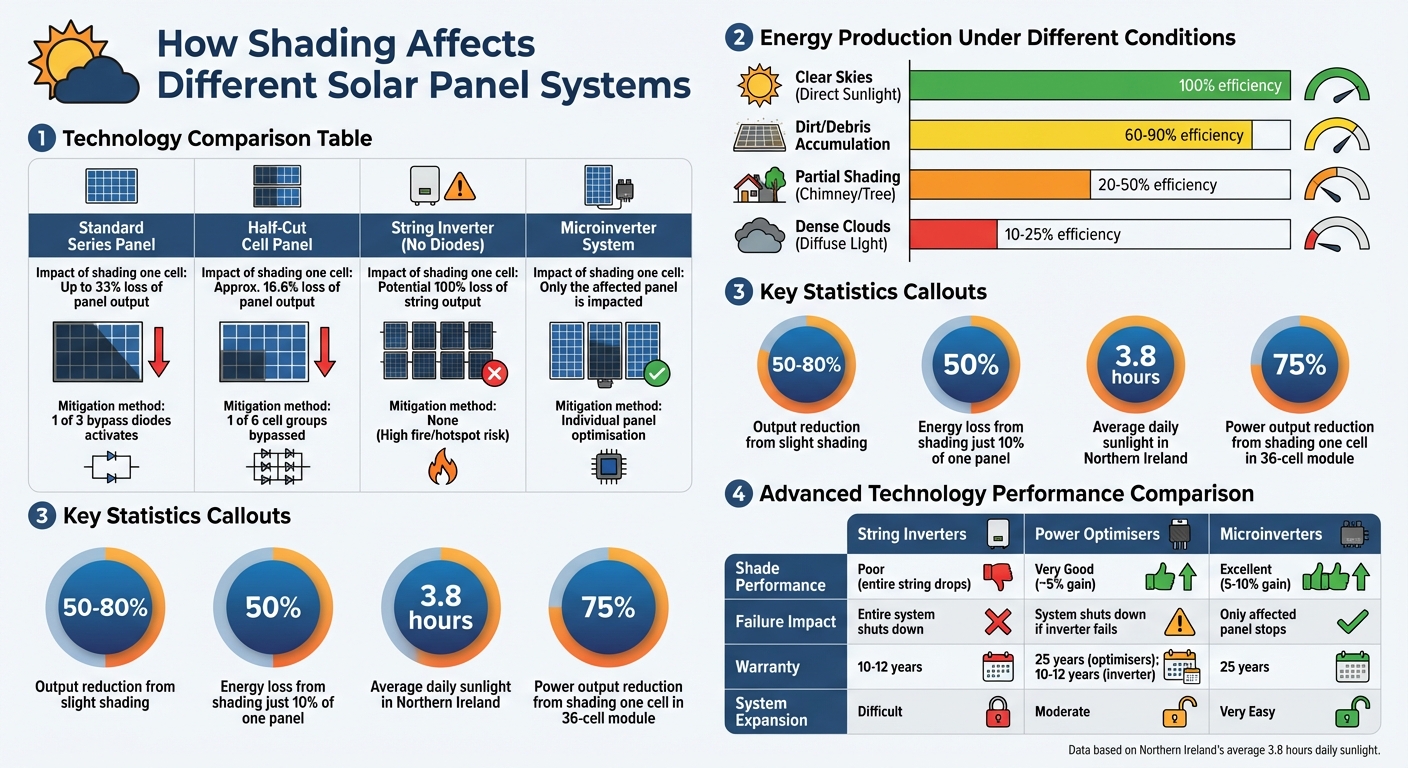
Solar Panel Shading Impact Comparison: Technology Performance and Energy Loss
Solar panels are made up of multiple photovoltaic (PV) cells connected in series. This setup means electricity flows through each cell one after the other. When even a single cell is shaded, it disrupts the flow of electricity for the entire string of cells it’s part of, reducing overall efficiency.
In fact, shading just one cell in a 36-cell module can cut the panel’s total power output by as much as 75%. This happens because the shaded cell stops producing electricity and instead starts consuming it. Its voltage turns negative, effectively making it act like a resistor. This not only reduces energy production but also generates excessive heat, which could damage the panel. This phenomenon underscores how even minimal shading can have a surprisingly large impact on energy output.
The Effect of Partial Shading on Energy Output
Partial shading can cause disproportionate energy losses. According to research from Stanford University, shading just 10% of a solar panel’s surface can result in a 50% reduction in energy production. The reason? Solar panels are typically connected in series. If one panel’s output drops due to shading, the inverter adjusts the performance of the entire string to match the weakest panel.
Bypass Diodes and Shading Mitigation
To minimise these losses, modern solar panels employ various strategies. One of the most common solutions is the use of bypass diodes. These diodes – usually three per panel – act like electrical detours, allowing current to bypass shaded sections. This prevents the creation of hotspots, which can reach temperatures over 105°C, potentially causing glass to crack or even fires.
Most 60-cell panels are divided into three substrings of 20 cells, with each substring protected by one bypass diode. When a bypass diode activates, it disables one-third of the panel’s cells, meaning no electricity is produced from that section. While bypass diodes reduce the impact of shading, they still result in some energy loss – each activated diode effectively sacrifices one-third of the panel’s capacity. Despite this limitation, bypass diodes play a critical role in maintaining productivity and safety when shading occurs.
| Technology | Impact of Shading One Cell | Mitigation Method |
|---|---|---|
| Standard Series Panel | Up to 33% loss of panel output | 1 of 3 bypass diodes activates |
| Half-Cut Cell Panel | Approx. 16.6% loss of panel output | 1 of 6 cell groups bypassed |
| String Inverter (No Diodes) | Potential 100% loss of string output | None (High fire/hotspot risk) |
| Microinverter System | Only the affected panel is impacted | Individual panel optimisation |
Common Causes of Shading in Northern Ireland
Understanding the factors behind shading is crucial for safeguarding your solar investment. Northern Ireland’s distinctive geography and climate present challenges that set it apart from sunnier regions.
Weather and Cloud Patterns
Northern Ireland’s low sun angle during much of the year results in elongated shadows from various obstructions. Frequent cloud cover also leads to diffuse shading, which occurs when clouds evenly reduce light levels across the surface of solar panels, unlike the sharp shadows cast by physical objects.
"Ireland’s weather, heavily influenced by its proximity to the Atlantic Ocean, is characterized by mild temperatures, frequent rainfall, and unpredictable shifts in conditions throughout the year." – Joe Brennan, Founder, Going Solar
On overcast days, solar panels typically achieve only 10% to 25% of their potential efficiency. The region receives about 1,100 to 1,300 kilowatt-hours (kWh) of solar radiation per square metre annually, much of which comes as diffuse radiation scattered by clouds rather than direct sunlight. Unpredictable elements like morning mists or sudden afternoon rainstorms can further complicate daily energy production. Beyond weather, natural features like trees also play a major role in shading.
Nearby Trees and Seasonal Foliage
Trees are a leading cause of shading, casting sharp, distinct shadows that can significantly reduce solar panel performance – sometimes by as much as 50%. Northern Ireland’s low sun angle makes tree shadows particularly long, meaning even distant trees can affect rooftop panels.
Evergreen trees provide consistent shading year-round, while deciduous trees create seasonal variations. Dense foliage in summer can block more light, but even bare branches in winter may still cast dappled shadows. Overgrown hedgerows and tall shrubs are especially problematic for smaller residential properties where panels are installed closer to property boundaries. Over time, young trees that seem harmless now can grow tall enough to become significant obstacles, posing long-term concerns for systems designed to last over 25 years.
Buildings and Chimneys
Man-made structures add another layer of complexity to shading issues. Buildings, chimneys, dormer windows, satellite dishes, and vent pipes can all cast hard shadows that shift throughout the day. For example, a chimney might shade the eastern section of your solar array in the morning and the western section in the evening as the sun moves. Such solid shading can reduce panel performance by as much as 80%.
"In Ireland, south facing solar panels will provide the most electricity throughout the day. This is because here in the Northern Hemisphere, the sun is to the south of us." – Briain Kelly
The problem becomes more pronounced in winter when the sun’s path is at its lowest. Objects that don’t obstruct panels in summer may cast significant shadows during colder months, just when energy demand tends to rise. Even partial shading of 40% to 60% of a solar cell can cause temperatures to spike from a standard 25°C to as high as 105°C, creating dangerous hotspots that can damage the system.
Measuring and Quantifying Shade Impact
Understanding how much energy you’re losing due to shade is crucial if you want to make smart decisions about your solar system. Without precise measurements, it’s impossible to truly grasp the effect shading has on your energy output.
Solar installers often rely on tools like the Solmetric SunEye, which captures 360° images and translates them into digital shading files to calculate radiation loss. For obstructions as far as 200 metres away, laser devices can create detailed 3D models of nearby objects. These models are then used in software like PV_SOL and T_SOL to simulate how shadows move across your solar panels throughout the year.
For real-time data, module-level power electronics (MLPE) – such as micro-inverters or power optimisers – are invaluable. These devices provide panel-specific performance data via apps or web portals. If a panel isn’t performing as expected, you can quickly figure out whether shading or a hardware issue is to blame. On the other hand, traditional string inverters only show the total output of the entire array, making it impossible to isolate individual panel problems.
Comparing Energy Output in Different Conditions
Knowing how various conditions impact your system’s energy production helps you set realistic expectations, especially in Northern Ireland’s climate. Here’s a breakdown of typical performance levels under different scenarios:
| Condition | Estimated Energy Production Efficiency | Impact Description |
|---|---|---|
| Clear Skies (Direct Sunlight) | 100% | Maximum output; serves as the baseline for systems in Northern Ireland. |
| Partial Shading (e.g., Chimney/Tree) | 20%–50% | Output drops significantly due to obstructed sunlight. |
| Dense Clouds (Diffuse Light) | 10%–25% | Panels rely on scattered light; output is much lower but still functional. |
| Dirt/Debris Accumulation | 60%–90% | Moderate reduction; cleaning is often needed to restore full efficiency. |
With Ireland receiving an average of just 3.8 hours of sunlight per day, measuring every bit of lost energy becomes essential for calculating your system’s return on investment. Systems equipped with MLPE generally produce 5–10% more energy in shaded areas compared to those using standard string inverters. This added efficiency highlights the value of investing in advanced monitoring and shading measurement tools.
These insights into shading and performance set the stage for exploring targeted strategies to optimise your solar system, which we’ll cover next. Quantifying shading losses is the first step towards improving your system’s energy output.
sbb-itb-d2d975a
Solutions to Reduce Shading and Increase Energy Production
Once you’ve identified how shading impacts your energy output, it’s time to take action. By carefully positioning your panels, leveraging advanced technology, and committing to regular upkeep, you can significantly boost your system’s performance – even if eliminating all shade isn’t possible. Below, we’ll explore ways to refine panel placement, integrate smarter technologies, and maintain your system for optimal results.
Optimising Panel Placement
In the UK, a south-facing orientation remains the top choice for solar panels, as it captures the most sunlight throughout the day and delivers the highest energy yield. However, east- and west-facing orientations can still be highly effective, achieving 80–90% of the efficiency of south-facing systems. Splitting panels across east and west roofs can help balance energy production, smoothing out dips caused by shading during specific times and aligning better with household energy use during morning and evening peaks.
For Northern Ireland, where the latitude plays a role, the ideal tilt angle for solar panels ranges between 20° and 50°. Angles closer to 40° are particularly effective for capturing the lower winter sun. Prioritise installing panels in areas that remain unshaded year-round since a single shaded panel can reduce the output of an entire string by as much as 50–80%.
"Strategic panel placement across different roof faces, combined with appropriate shading mitigation technology, delivers better results than attempting to cover every available roof surface." – Jamie Grady, Director of West Yorkshire Electrical
Using professional solar design software can help you evaluate shading caused by obstructions like chimneys or trees at various times of the day and year. At EECO Energy, we offer a free shading analysis during surveys to pinpoint the most productive areas of your roof, ensuring your system performs at its best from the start.
Using Microinverters and Power Optimisers
Traditional string inverters connect panels in series, meaning the performance of the entire string can be dragged down by a single shaded panel – similar to how a weak link can compromise a chain. Microinverters and power optimisers solve this problem by allowing each panel to function independently.
Power optimisers work by adjusting voltage and current at the panel level, ensuring shaded panels don’t significantly impact the rest of the system. This typically results in about a 5% improvement in efficiency compared to traditional string systems in shaded conditions. Microinverters take it further by converting DC to AC at each panel, ensuring shading on one panel has no effect on the others. In partially shaded environments, microinverters can boost energy output by 5–10% compared to string inverters.
Here’s how these technologies stack up:
| Feature | String Inverters | Power Optimisers | Microinverters |
|---|---|---|---|
| Shade Performance | Poor (entire string drops) | Very Good (~5% gain) | Excellent (5–10% gain) |
| Failure Impact | Entire system shuts down | Entire system shuts down if central inverter fails | Only the affected panel stops |
| Warranty | 10–12 years | 25 years (optimisers); 10–12 years (inverter) | 25 years |
| System Expansion | Difficult (limited by inverter) | Moderate (limited by inverter) | Very Easy (plug-and-play) |
Both microinverters and power optimisers also offer panel-level monitoring, making it easier to identify and address issues like shading, dirt, or technical faults. While microinverters are generally 20–30% more expensive than string systems and power optimisers add a 15–25% premium, the potential energy gains – especially in a region like Northern Ireland with just 3.8 hours of sunlight per day – can make these technologies a smart long-term investment.
Maintenance and Mitigation Practices
Even the best solar setup needs regular attention to maintain peak performance. Annual tree trimming and site assessments can prevent the gradual impact of growing vegetation or seasonal changes.
Using a monitoring app to track real-time system performance can quickly alert you to drops in output, often signalling the need for cleaning or adjustments. Cleaning panels alone can improve energy production by up to 15%, especially in coastal areas where salt spray accumulates or rural regions prone to dust.
Bird-proofing measures can also make a big difference. Nesting or droppings can block sunlight and create hotspots, reducing output by up to 40%. Regular cleaning – every two to three years, or more often if necessary – helps keep panels running efficiently.
Finally, keep an eye on any changes around your property, such as new buildings or growing trees that could cast additional shadows. Proactively managing these factors ensures your solar system continues to deliver strong returns for years to come.
Conclusion
Shading doesn’t have to stand in the way of your solar energy goals. With a mix of smart panel placement, advanced technology, and regular maintenance like trimming nearby trees or bushes, you can reduce energy losses and get the most out of your system – even when conditions aren’t ideal. Placing panels to face south at a 30–40° angle and using microinverters or power optimisers can work wonders for protecting your energy production.
In Northern Ireland, where the sun is lower in the sky and provides an average of only 3.8 hours of effective daylight, every bit of efficiency counts. Tackling shading issues isn’t just helpful – it’s essential for ensuring a strong return on your solar investment. By taking this proactive approach, you can safeguard your energy output while enjoying a smoother, more reliable experience.
At EECO Energy, we kick off every project with a free shading analysis to find the best installation spots on your roof. Whether it’s microinverters for a more complex layout or power optimisers for areas with partial shade, we’ll recommend the right technology to make sure your system captures as much sunlight as possible throughout the year.
All our installations come with a 25-year warranty and MCS accreditation, so you can rest easy knowing your system is designed to last. Plus, we offer ongoing maintenance services, like panel cleaning and performance monitoring, to keep your solar setup running efficiently for years to come.
Whether you’re a homeowner looking to lower electricity bills or a business aiming to cut energy costs, EECO Energy is here to help you overcome shading challenges and maximise your solar output in Northern Ireland. Let us help you make the most of the sun, no matter the obstacles.
FAQs
How can I reduce the impact of shading on my solar panels?
Shading can have a noticeable impact on how well your solar panels perform, but the good news is there are ways to reduce its effects. Start by evaluating your site to pinpoint potential sources of shade – things like trees, chimneys, or nearby buildings. This is especially important during the winter months when the sun sits lower in the sky. Proper placement is crucial too; positioning your panels to face true south and angling them between 30° and 40° can help capture the most sunlight.
You might also want to look into technologies like micro-inverters or power optimisers. These clever tools ensure that each panel works independently, so if one panel ends up in the shade, it won’t drag down the performance of the others. Don’t forget about regular upkeep – keep your panels clean, clear away debris, and trim back any branches that could block the sun. By combining these steps, you can make the most of your solar panels, even if shading is an occasional challenge.
What are the advantages of using microinverters in shaded areas?
Microinverters are designed to connect directly to individual solar panels, allowing each panel to function independently. This setup is particularly handy in areas where shading might be an issue. For instance, if a tree or chimney casts a shadow over one panel, only that panel’s output is affected – while the rest of the system continues generating energy at full capacity.
Each microinverter is equipped with its own Maximum Power Point Tracking (MPPT) technology. This feature optimises the energy output of each panel by adjusting to its specific conditions, such as sunlight intensity and temperature. Thanks to this, systems with microinverters can produce 5–10% more energy in shaded environments compared to traditional string inverters. Over time, this translates to noticeable savings on electricity bills (£).
Another advantage of microinverters is their flexibility. They make it easier to install panels on roofs with unusual shapes or panels positioned at different angles, all without sacrificing performance. Plus, they offer detailed monitoring for each panel, making it simple to spot and resolve any shading or performance issues quickly.
How does Northern Ireland’s weather affect solar panel performance?
Northern Ireland’s weather, with its frequent clouds, rain, and low winter sunlight, presents some challenges for solar panels. One major issue is shading. Even partial shading – like that from trees or nearby buildings – can drastically cut energy output. For instance, a small shadow on a panel might reduce its efficiency by 50–80%. If just 10% of one panel is shaded, it could cut the output of an entire string in half. The region’s daylight hours also vary significantly, ranging from up to 16.5 hours in summer to just 7 hours in winter. On average, a standard 4 kW solar system in Northern Ireland generates between 3,400 and 4,200 kWh annually, with the bulk of this energy produced during the sunnier summer months.
That said, Northern Ireland’s mild climate has its perks for solar panels. Photovoltaic cells actually perform better in cooler temperatures, losing around 0.4% efficiency for every degree above 25°C. On cold, clear winter days – when temperatures hover around 5°C – solar panels can even exceed their rated output by 5–10%. This consistently cool weather also reduces strain on the system, helping to maintain performance and extend the panels’ lifespan. While shading and shorter winter days can be obstacles, the region’s moderate temperatures help balance things out, keeping solar energy a viable option year-round.