
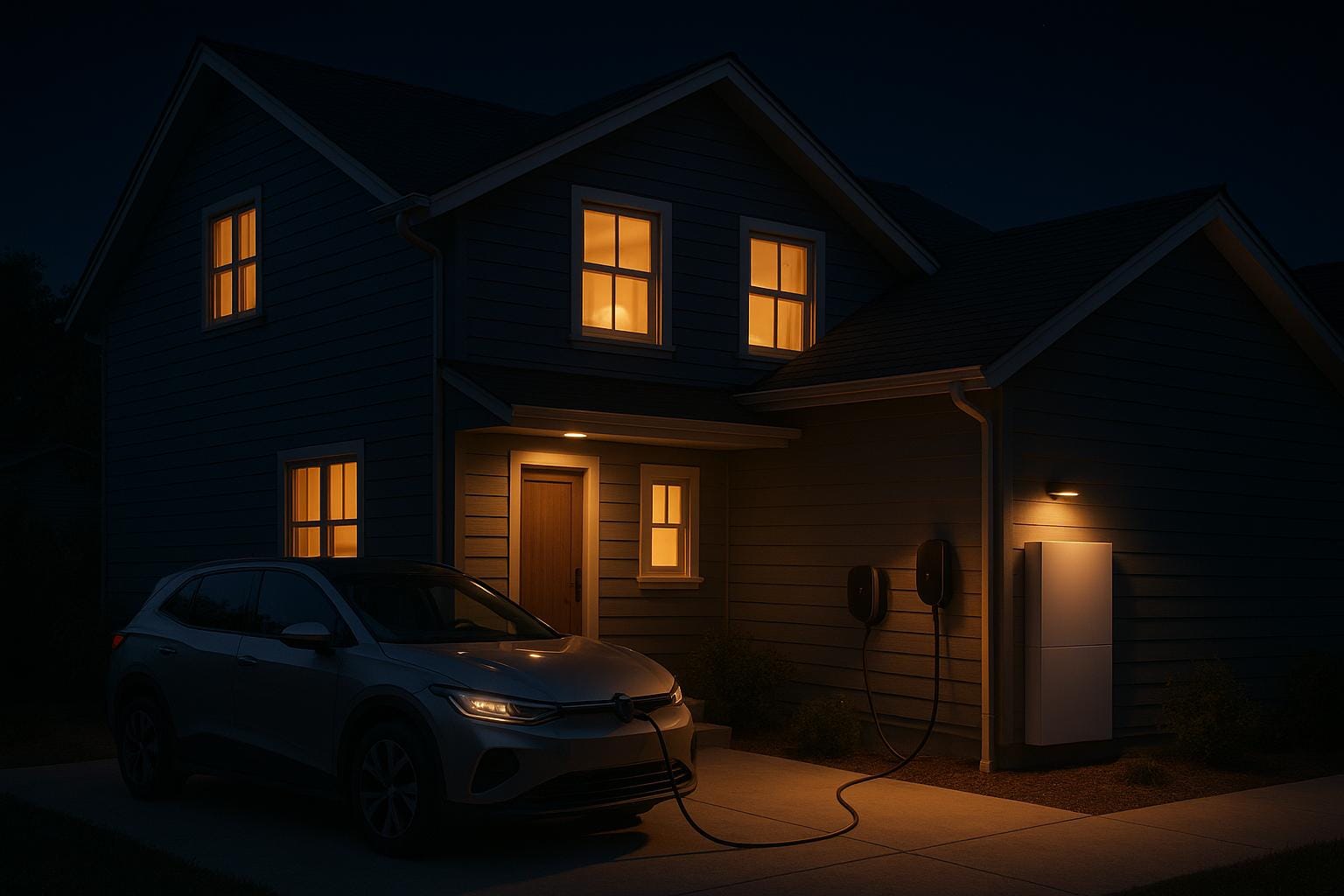
Charging your EV at night using solar energy is possible with battery storage. Here’s how it works:
- Solar panels generate excess energy during the day. This surplus can be stored in a battery instead of being sent back to the grid.
- At night, the stored energy powers your EV charger. This reduces reliance on expensive grid electricity and lowers your energy bills.
- In Northern Ireland, short winter days make this especially useful. Combining solar panels, battery storage, and off-peak tariffs can save hundreds of pounds annually.
- Smart systems optimise energy use. They prioritise solar power, manage off-peak charging, and ensure your EV is ready by morning.
Battery storage offers a practical way to charge your EV affordably at night while making the most of renewable energy. Learn how to size your system and maximise savings.
The Night-Time EV Charging Challenge in Northern Ireland
EV Adoption and Increased Charging Demand
Electric vehicle (EV) registrations in Northern Ireland are steadily rising, with more drivers making the shift to electric transport every year. For most UK drivers, daily journeys are relatively short – often under 40 miles. This makes evening charging at home the go-to option, ensuring their EV is ready to hit the road the next morning. However, this habit of plugging in at night creates a problem: the demand for charging peaks after dark, just when solar panels stop generating power.
For commuters, the evening is often the only practical time to charge. After a long day at work, they arrive home, connect their car to the charger, and let it power up overnight. Home chargers in the UK, typically offering 7 kW output, are designed with this routine in mind. But this surge in night-time demand highlights a key issue – solar energy, which is abundant during the day, becomes unavailable just when it’s needed most.
Solar Generation Limitations at Night
The growing reliance on EVs has brought the limitations of solar power into sharper focus. In Northern Ireland and across the UK, solar panels generate electricity during daylight hours, peaking around midday and producing nothing after sunset. By the time most people return home in the evening, their rooftop solar systems are no longer generating power, leaving no direct solar energy to charge their EVs overnight.
Winter makes this challenge even harder. Shorter days, lower sun angles, and frequent cloud cover significantly reduce solar output, just as household electricity demand for heating and lighting increases. Even on clear winter days, the energy generated by solar panels is often only enough to cover basic household needs, meaning EV charging must rely heavily on the grid unless surplus daytime energy can be stored for later use.
Reliance on Grid Electricity and Its Drawbacks
Without battery storage, charging an EV directly from the grid comes at the cost of paying standard electricity rates. For an EV requiring 20–40 kWh for a substantial recharge, this can add several pounds to the household electricity bill each night. While off-peak tariffs offer some savings, they still don’t compare to the cost-effectiveness of using stored solar energy.
There’s also the risk of rising electricity costs as EV adoption grows, with future tariffs potentially becoming less predictable. From an environmental standpoint, relying on grid electricity for night-time charging isn’t ideal either. The UK’s night-time energy mix includes renewables, nuclear power, and fossil fuels, but without battery storage to capture their own solar energy, households miss out on the chance to maximise their use of local, zero-carbon electricity. These factors make integrating battery storage a crucial step for households aiming to achieve more sustainable and cost-effective EV charging at night.
How Battery Storage Solves the Night-Time Charging Problem
Storing Excess Solar Energy During the Day
Battery storage systems are a practical solution for capturing surplus solar energy. During the day, when your solar panels generate more electricity than your home uses, a solar inverter redirects that extra energy into a battery instead of sending it back to the grid. Most home batteries in the UK rely on lithium-ion cells and typically hold between 8–12 kWh, which is enough for several hours of household use or even a decent electric vehicle (EV) charge. For households with EVs, larger battery setups are becoming more common. For example, two 13.5 kWh batteries combined offer 27 kWh of storage – enough for multiple nights of partial EV charging or a significant single charge.
Increasing Self-Consumption of Solar Power
Without a battery, many UK homes end up exporting much of their solar energy because peak solar production – around midday – doesn’t align with when people are home or charging an EV. When exported, homeowners typically earn only about 8–12p per kWh under current UK export tariffs, while using that same energy on-site offsets the higher retail electricity cost of 26–28p per kWh. Each stored kWh can save 2–3 times more in avoided electricity costs compared to exporting it.
Adding a battery changes the game. It allows excess solar energy to be stored during the day and used later – like in the evening or overnight – dramatically increasing the proportion of solar power used on-site. For example, a typical home might initially use only 30–40% of its solar energy directly, but with a well-sized battery and smart controls, that figure can jump to 60–80%, significantly cutting reliance on grid electricity. One case in the UK highlighted a 31% reduction in electricity bills simply by storing energy. When about 50% of the battery was charged from excess solar power, the savings rose to an impressive 71%.
This increased self-consumption is particularly useful for EV charging after the sun goes down.
Night-Time EV Charging from Stored Energy
With a battery in place, night-time EV charging becomes far more efficient. During the day, solar panels charge the battery while also powering household appliances. In the late afternoon and early evening, the battery discharges to cover household demand. Then, at night, when the home’s energy needs are lower, the remaining stored energy can be directed to the EV charger.
A typical UK home charger, rated at 7–11 kW, might not fully charge a large EV from empty using a 10–20 kWh battery, but it can still provide a substantial "solar miles" boost – adding anywhere from 20 to 60 miles of range overnight. If needed, grid power can supplement the charge.
Smart energy management systems help optimise this process. They ensure the EV charger prioritises battery power and only switches to grid electricity when the battery’s reserves run low. This keeps essential household power needs covered throughout the night. For homes on time-of-use tariffs, batteries can be charged both with excess solar energy and during off-peak hours, when electricity costs are lower – typically 7–10p per kWh between midnight and 5:00 am. This stored energy can then be used to power the EV and the home during the day when electricity prices are higher.
One UK example showed how charging 10 kWh into a home battery at 8p/kWh (£0.80) and using it when grid electricity costs 28p/kWh could save around £1.20 per day – adding up to over £400 annually.
In Northern Ireland, this "solar-plus-off-peak" approach keeps EV charging costs low and maximises the use of renewable energy. Companies like EECO Energy design systems tailored to local conditions, factoring in grid limitations, roof sizes, and household driving habits to ensure solar panels, battery storage, and EV chargers work seamlessly together.
Designing Solar and Battery Systems for EV Charging
Once you’ve decided to use battery storage for night-time EV charging, the next step is creating a system that combines solar power with your EV’s energy needs. Here’s how to approach it.
Sizing the Solar Array
To size your solar array, start by evaluating both your household’s electricity use and your EV’s charging requirements. On average, a UK household consumes about 2,900 kWh annually (roughly 8 kWh daily). If you drive your EV 8,000–10,000 miles a year, you’ll need an additional 1,500–2,000 kWh for charging. Together, this often leads to a 5–7 kWp solar array, depending on your roof size and budget.
Northern Ireland’s solar potential is modest but effective. A well-positioned array can generate 900–1,000 kWh per kWp annually. To estimate your needs, combine your daily household consumption with your EV’s energy usage (e.g., driving 40 miles at 0.18 kWh per mile adds up to 7 kWh). Add a 20–30% margin to account for reduced winter output. For instance, if you aim for 4,000 kWh annually from solar and expect about 950 kWh per kWp, you’ll need around 4.2 kWp of solar panels. The aim is to produce enough energy to charge your battery on sunny days while also powering daytime activities, although winter may still require grid support.
South-facing roofs are ideal, but east-west configurations can extend energy generation into mornings and evenings – perfect for when your EV is parked at home. Be mindful of shading from trees or nearby structures, as even partial shading can significantly reduce performance. Local experts like EECO Energy can assess your roof’s suitability and customise the array to fit your energy demands and driving patterns. Once your solar array is planned, align your battery capacity with both household and EV charging needs.
Choosing the Right Battery Capacity
Your battery’s capacity should meet your evening and night-time energy demands. Most UK home batteries range from 8–12 kWh, which is typically enough for several hours of household usage or a partial EV charge. For example, a household using 10 kWh daily, plus an EV needing 7 kWh, might find a 10 kWh battery sufficient for evening use but lacking for late-night EV charging. A 15 kWh battery, on the other hand, could handle typical night-time household use (8–10 kWh) and provide a small EV charge (5–7 kWh), especially when paired with off-peak charging.
If you drive long distances, own multiple EVs, or want to save more using time-of-use tariffs, consider larger batteries in the 13–20+ kWh range. With off-peak rates – often 7–10p per kWh between midnight and 5:00 am compared to 26–28p per kWh during the day – a larger battery allows you to store more low-cost energy for daytime use. Check your battery inverter’s power rating (usually 3.6 kW or 5 kW) as it determines how quickly the battery can discharge to support your home and EV charger at the same time. Even with a 7 kW EV charger, the battery typically reduces grid imports rather than supplying the entire load.
Integrating Smart EV Chargers and Controls
Smart EV chargers and home energy management systems (HEMS) are key to optimising solar, battery, and grid use. These systems can schedule EV charging during low-tariff hours, such as 00:30 to 04:30, and prioritise solar and battery energy while minimising grid reliance.
Look for smart chargers that support time-of-use tariffs and let you adjust charge limits to align with your battery and inverter capacities. This helps protect your main fuse, which usually ranges between 60–100 A. Load-balancing chargers can automatically reduce EV charging speed if your household’s total energy draw approaches the limit, safeguarding your home’s electrical system.
To prioritise solar energy, configure your system to charge the home battery first during the day, using any surplus for your EV. Some smart chargers include a "solar-aware" mode, which only charges your car when there’s extra solar energy available after meeting household and battery needs. Additionally, scheduling EV and battery charging during off-peak hours can further cut down on expensive daytime grid usage. Local installers like EECO Energy can adjust these settings to suit Northern Ireland’s solar conditions, roof types, and common UK tariffs – helping you make the most of your solar power and reduce your energy bills.
sbb-itb-d2d975a
Benefits and Considerations of Battery-Backed EV Charging
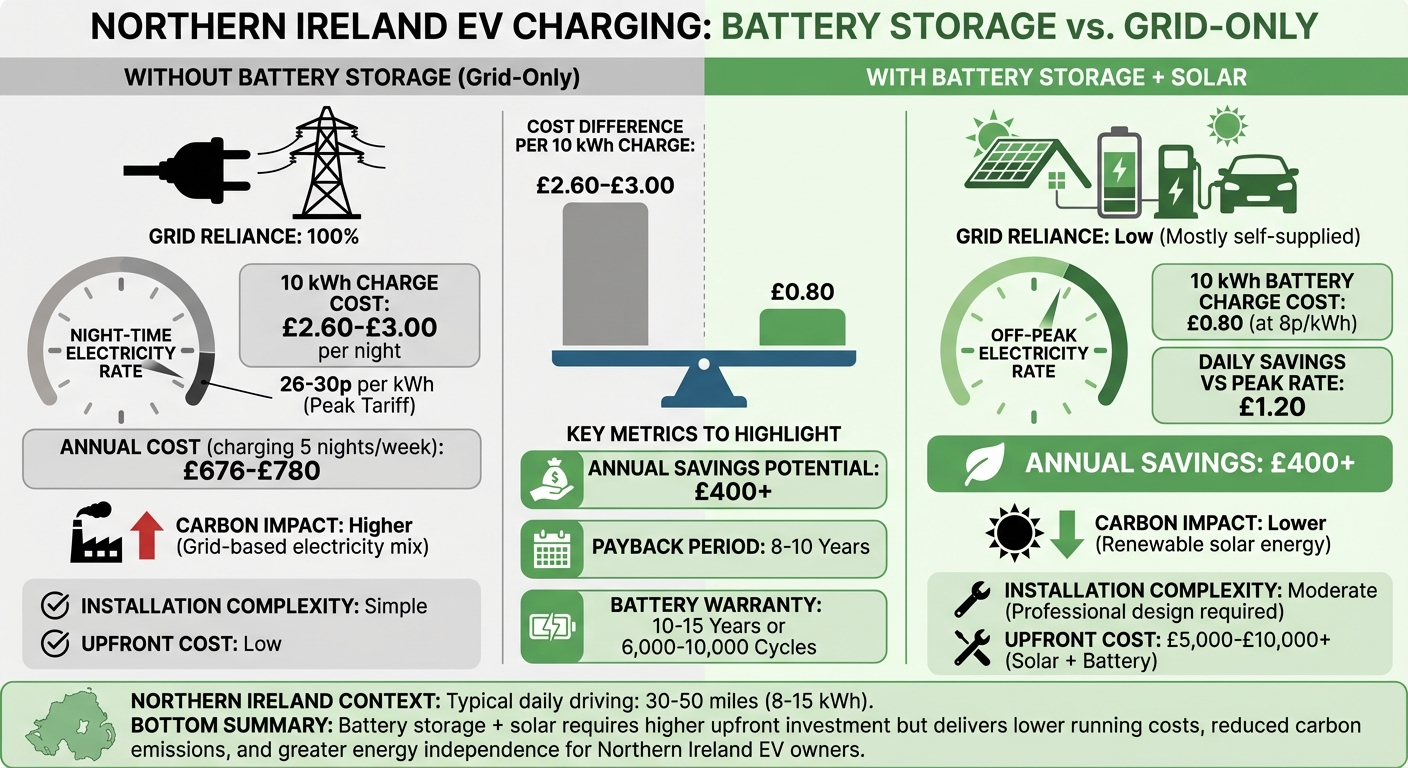
Cost Comparison: EV Charging With vs Without Battery Storage in Northern Ireland
Key Benefits of Battery Storage
Battery-backed EV charging brings both financial and environmental advantages. One standout benefit is cost savings, especially when paired with time-of-use tariffs in the UK. Night-time electricity rates typically range between 7–10p per kWh, significantly lower than daytime rates of 26–30p per kWh. For example, charging a 10 kWh battery at 8p per kWh costs just £0.80. Using that stored energy instead of paying 28p per kWh during the day could save around £1.20 daily – adding up to over £400 annually.
From an environmental perspective, battery storage helps cut your carbon footprint by maximising the use of stored solar energy instead of relying on the grid, which still includes fossil fuel-generated electricity. Additionally, it provides backup power during outages, ensuring essential circuits stay operational for several hours. This can be especially useful in rural areas like parts of Northern Ireland, where power interruptions are more common.
Trade-Offs and Limitations
Despite its benefits, battery-backed systems come with notable challenges. One of the biggest hurdles is the upfront cost. Installing a domestic solar panel system typically costs between £5,000 and £10,000, with battery storage adding several thousand pounds to the initial investment. Over time, lithium-ion batteries also lose capacity. They are typically warrantied for 6,000–10,000 cycles or 10–15 years, by which point their capacity may drop to 60–80%. While most savings are achieved within the first 8–10 years, degradation can slightly extend the payback period.
Installation complexity is another factor. Unlike a simple EV charger, integrating battery storage requires careful planning. It involves finding a suitable indoor or sheltered space with proper ventilation, setting up dedicated circuits, and ensuring the system integrates seamlessly with the main consumer unit, battery inverter, and EV charge point. Local experts, such as EECO Energy in Northern Ireland, can help assess your site, secure permissions, and design a safe, efficient system.
Comparison Table: EV Charging with and Without Battery Storage
Here’s a quick comparison of the key differences between relying on grid electricity alone and using a battery-backed solar system for night-time EV charging:
| System Setup | Night-Time Energy Source | Impact on Bills | Grid Reliance | Carbon Impact | Installation Complexity |
|---|---|---|---|---|---|
| Without Battery | Grid electricity | Higher costs due to peak tariffs | High | Higher (grid-based electricity) | Simple |
| With Battery-Backed Solar | Stored solar energy | Lower costs by avoiding peak tariffs | Low | Lower (renewable-based energy) | Moderate (requires professional system design) |
This table highlights the trade-offs involved. While battery-backed solar systems demand a larger upfront investment and more detailed installation, they offer lower electricity bills, reduced grid dependence, and a smaller carbon footprint in the long run. On the other hand, relying solely on the grid is simpler to set up but leaves you vulnerable to fluctuating energy prices. With battery storage, you gain control over your energy use, shifting from primarily grid-supplied power to mostly self-supplied energy – improving both resilience and cost predictability.
Applications in Northern Ireland
Domestic Use Cases
In Northern Ireland, most drivers travel between 30 and 50 miles daily, which means they typically need only 8–15 kWh of energy overnight to recharge their electric vehicles (EVs). For homes with a 4–6 kWp solar array and a 5–10 kWh battery, this setup often covers overnight EV charging needs, especially during spring and summer.
Here’s how a typical day looks: solar panels first power the home, and any extra energy charges the battery. As evening sets in and demand increases, the battery provides energy for household appliances. Later in the evening or overnight, the remaining stored energy is used to charge the EV. For example, a 5 kWp solar array on a sunny day can fully charge a 10 kWh battery by late afternoon. This energy is then split – 4–5 kWh for evening household use and 5–6 kWh for the EV, which translates to roughly 20–25 miles of driving. During winter or cloudy days, the system can utilise off-peak electricity tariffs (around 7–10p/kWh) to keep both the home and EV running efficiently, potentially saving households hundreds of pounds annually by avoiding higher daytime rates.
For commuters, EV charging can be scheduled between early evening and midnight, with additional charging from off-peak grid power after midnight if needed. Shift workers returning home during the early hours can prioritise charging the battery with low-cost night tariffs and save daytime solar energy for recharging both the battery and car before their next shift. Rural residents, who often have longer commutes, might require larger setups – such as a 6–8 kWp solar array and a 10–15 kWh battery bank – to meet their higher energy demands. In households with two EVs, the higher-mileage vehicle is typically prioritised for charging using stored solar energy and off-peak electricity, while the second car follows a lower-priority charging schedule. Smart chargers and home energy management systems make this process seamless.
Similarly, tailored solar-plus-battery setups can address the specific needs of commercial and agricultural settings.
Commercial and Agricultural Use Cases
For commercial properties, limited grid capacity can make simultaneous EV charging a challenge. By integrating a battery system, businesses can "pre-charge" the battery using daytime solar energy or low-cost night tariffs. This stored energy can then be distributed to multiple EVs without overloading the grid. A small fleet depot, for instance, might install a 20–40 kWp solar array paired with a 30–60 kWh battery. During the day, solar energy powers the building and charges the battery. At night, the stored energy is used to charge 2–4 EVs via AC chargers, ensuring they’re ready for the next day. By combining stored solar energy with off-peak electricity rates (7–10p/kWh compared to 25p/kWh or more during peak hours), businesses can significantly cut operating costs and improve the return on investment for both their EVs and energy systems.
Agricultural sites face unique challenges, such as high daytime energy demands from equipment like milking parlours, refrigeration units, and ventilation systems, alongside limited rural grid capacity. A solar-plus-battery system can help by capturing midday solar peaks and storing them for evening and overnight use. For example, a farm might install a 30 kWp solar array on barn roofs, paired with 40–80 kWh of battery storage. During the day, solar energy powers the farm’s operations, with any surplus charging the battery. At night, the stored energy can run cold storage units or charge farm EVs and electric ATVs without overloading the grid. On cloudy winter days, time-of-use tariffs allow the battery to be charged with cheaper grid electricity, ensuring critical farm operations and vehicle charging continue seamlessly.
EECO Energy‘s Expertise in Local System Design
EECO Energy brings local knowledge to the table, ensuring systems are designed to meet the specific needs of Northern Ireland’s residents and businesses. By assessing the region’s solar potential, available space, and typical EV charging habits, they tailor systems to optimise energy use. For example, a homeowner might receive a 4–6 kWp solar array with a 5–10 kWh battery, designed to prioritise evening and overnight energy needs. Meanwhile, a small business or farm might be equipped with larger systems featuring advanced load management to ensure all vehicles are charged by morning without exceeding grid limits.
EECO Energy’s expertise extends beyond system design. They handle planning permissions, grid applications, and equipment selection, ensuring everything is suited to Northern Ireland’s unique weather, building characteristics, and regulatory requirements. Their ability to integrate smart controls also allows clients to maximise the use of solar energy and low-cost electricity for both household or business needs and EV charging, all while staying within grid capacity limits.
Conclusion
Battery storage provides an effective solution for night-time EV charging by storing excess solar energy generated during the day for use when it’s needed most. This is particularly valuable in Northern Ireland, where daytime solar production often doesn’t align with the peak demand for evening EV charging. A well-designed solar and battery system ensures a reliable, around-the-clock energy supply.
By charging a battery at off-peak rates – typically between 8–11p/kWh – compared to the higher daytime rates of 26–30p/kWh, households and businesses can significantly lower running costs. At the same time, they reduce carbon emissions by replacing grid electricity with clean, locally stored solar power. This not only cuts reliance on the grid but also secures more predictable, lower energy costs, offering greater energy independence.
While upfront costs and proper system sizing are important considerations, the long-term advantages far outweigh these initial challenges. EECO Energy offers tailored solar panel and battery storage solutions for homes, farms, and businesses across Northern Ireland. By factoring in local weather patterns, building characteristics, and typical EV charging habits, they ensure each system is fine-tuned to your unique needs. Their expertise helps maximise savings, reduce emissions, and enhance energy independence – forming the foundation for a more sustainable and reliable EV charging strategy.
FAQs
How does battery storage help make EV charging at night more affordable?
Battery storage lets you keep extra solar energy produced during the day, so you can use it later – like charging your electric vehicle (EV) at night. This means you’ll rely less on electricity from the grid, which can lead to noticeably lower energy costs.
By tapping into stored solar energy, you could cut your charging expenses by 20% to 50% over time. Over the lifetime of your system, this could translate into savings of £20,000–£30,000 or more. It’s an efficient way to power your EV, even when the sun isn’t out.
What are the benefits of combining battery storage with solar panels for charging an EV?
Combining battery storage with solar panels for charging electric vehicles (EVs) comes with some clear perks. For starters, it lets you store surplus solar energy generated during daylight hours. This means you can tap into that stored energy to charge your EV at night, cutting down on your reliance on electricity from the grid. The result? Lower energy bills and more savings in the long run.
It also makes charging your EV more sustainable and convenient, especially during times when your solar panels aren’t producing as much energy, like on cloudy days or after sunset. By using more of your own renewable energy, you’re not just saving money – you’re also shrinking your carbon footprint and moving a step closer to energy self-sufficiency.
How can I choose the right size solar and battery system for charging my EV?
Choosing the right solar and battery system for charging your EV starts with understanding your daily electricity consumption, including the extra energy needed for your vehicle. You’ll also need to factor in your home’s potential for solar power generation. This is influenced by things like your roof’s size, its orientation, and the average sunlight hours in your area.
The goal is to have a system that meets your highest energy demands while letting you make the most of solar power, especially for charging your EV at night. Speaking with a professional can be a smart move – they can evaluate your energy habits, property features, and local conditions to create a system that keeps your EV charged and helps lower your electricity bills.