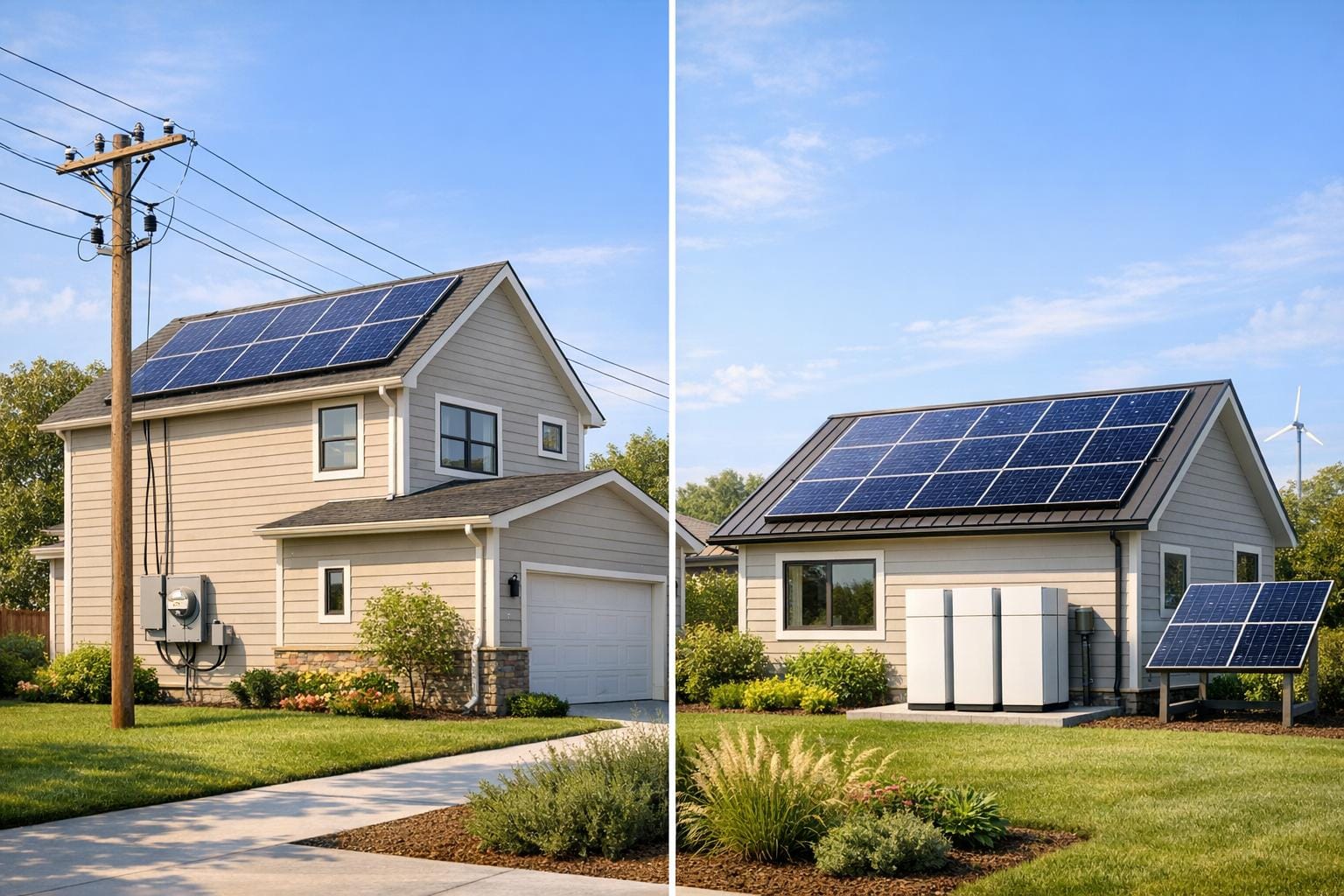
When choosing a solar system for your home, the main options are grid-tied or off-grid systems. Grid-tied systems connect to the mains electricity grid, offering lower upfront costs (£5,000–£7,000 for a 4kW system) and allowing you to sell excess energy back to the grid through Smart Export Guarantee (SEG) payments. Off-grid systems are completely independent but cost significantly more (£10,000–£18,000+), as they rely on batteries and backup generators to store energy.
Key Points:
- Grid-Tied Systems: Lower cost, rely on the grid for backup, earn SEG payments, but lose power during outages.
- Off-Grid Systems: Total independence, higher costs, require batteries and generators, ideal for remote areas without grid access.
- Weather in Northern Ireland: Grid-tied systems handle cloudy days better, while off-grid setups need careful planning for winter’s shorter daylight hours.
Quick Comparison:
| Factor | Grid-Tied Solar (£5,000–£7,000) | Off-Grid Solar (£10,000–£18,000+) |
|---|---|---|
| Grid Connection | Yes | No |
| Backup Power | Grid | Batteries & Generator |
| Cost | Lower | Higher |
| Energy Independence | Partial | Full |
| Maintenance | Minimal | Higher (batteries, generator) |
| Weather Performance | Reliable in cloudy weather | Challenging in winter |
For most homes with grid access, grid-tied systems are the practical choice. Off-grid systems suit rural or remote properties but require higher investment and maintenance. Choose based on your location, energy needs, and budget.
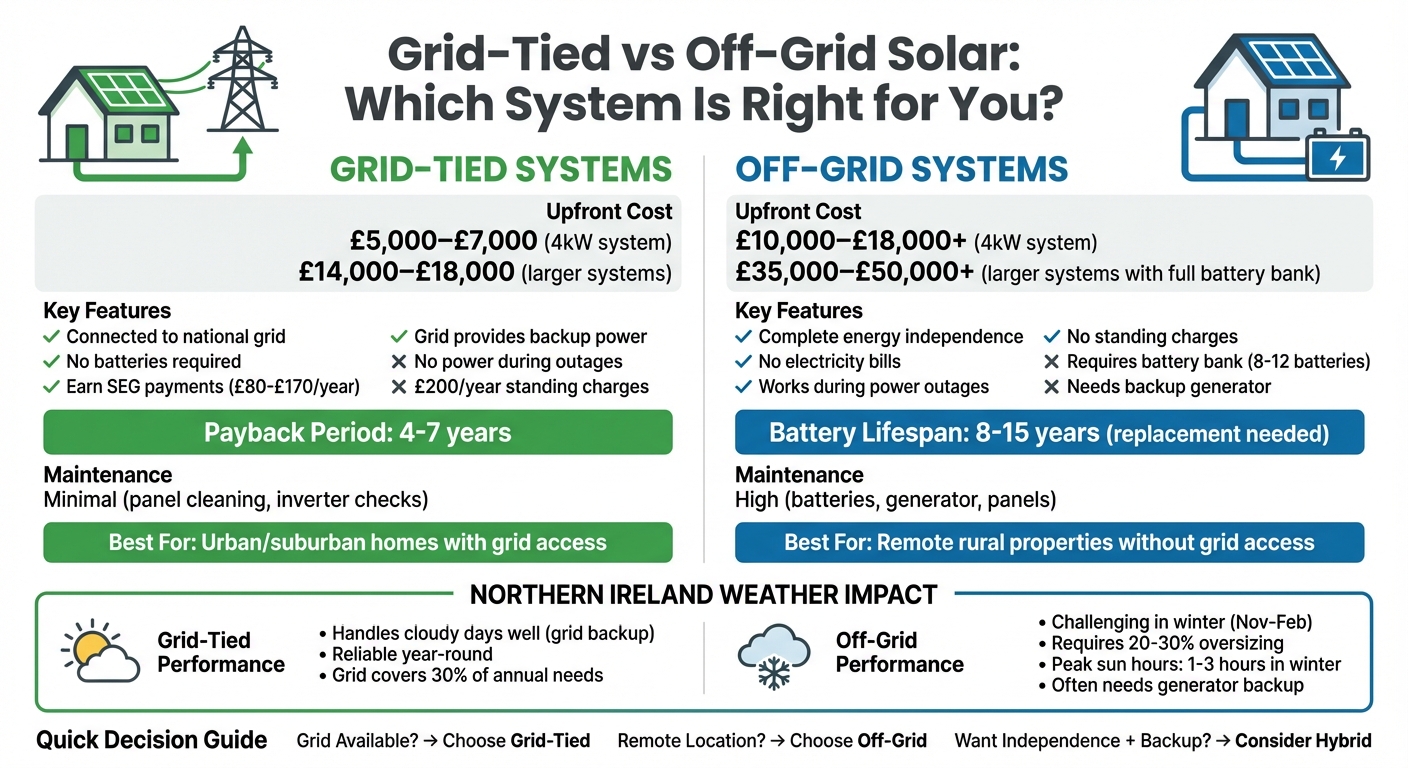
Grid-Tied vs Off-Grid Solar Systems Comparison: Costs, Features and Performance
How Grid-Tied Solar Systems Work
A grid-tied solar system works by harnessing sunlight through solar PV panels, which generate direct current (DC) electricity. This DC power is sent to a grid-tie inverter, where it’s converted into alternating current (AC) – the type of electricity used by your household appliances. This conversion allows your home to switch seamlessly between solar power and electricity from the grid.
The system is directly connected to the national utility grid, giving you access to two power sources. Your home automatically uses the solar energy first. If the panels aren’t producing enough – like during the night or on cloudy days – the system switches to grid electricity without any manual input.
When your solar panels generate more electricity than your home needs, the surplus energy is sent back to the utility grid. In the UK, this surplus can earn you payments through the Smart Export Guarantee (SEG), which compensates you for each kilowatt-hour of electricity you export.
"Net metering is an electric billing tool that makes solar even more affordable. Think of it as a virtual piggy bank for your electricity; when your panels overproduce, the extra energy flows into the grid, earning you credits through your utility."
A key safety feature of grid-tied systems is that during a power cut, the inverter will automatically shut down. This prevents electricity from being sent back into the grid, which could endanger utility workers repairing the lines – a situation known as "islanding". These operational details highlight why grid-tied systems are both practical and cost-efficient.
Key Features of Grid-Tied Systems
Grid-tied systems stand out for their simplicity and affordability. Because they rely on the grid for backup, there’s no need for expensive batteries, which keeps initial costs lower. For a typical 4kW system, installation costs range from £5,000 to £7,000.
The financial benefits are attractive. These systems often pay for themselves within 4 to 7 years and avoid the energy losses associated with battery storage. While you’ll still need to pay standing charges to stay connected to the grid – around £200 per year – the ability to export surplus energy and reduce electricity bills makes this a worthwhile investment for many homeowners.
"Grid-tied systems are the most affordable type of solar installation because they don’t require expensive battery storage. By relying on the utility grid for backup power, homeowners can keep initial costs low." – Liz Martin, Owner, SPV Energy
To qualify for SEG payments, your solar installation must be carried out by an MCS-certified professional, and most energy suppliers require a smart meter to accurately measure your electricity exports. The essential components include solar panels, a grid-tie inverter, a generation metre, and safety isolators.
How Off-Grid Solar Systems Work
An off-grid solar system works independently of the national utility grid, producing and storing all the electricity your home needs. It starts with solar PV panels that capture sunlight and convert it into direct current (DC) electricity.
This DC power flows through a charge controller, which manages the voltage and current to prevent overcharging and safeguard the battery bank. Any surplus energy is stored in deep-cycle batteries, often either lead-acid or Lithium Iron Phosphate (LFP), for use at night or during cloudy weather.
When electricity is needed, an inverter transforms the stored DC power into alternating current (AC), which is what powers most household appliances. Since there’s no grid connection to fall back on, having enough battery storage is critical. The system must hold sufficient energy to keep your home running for several days without sunlight, which is especially important during the shorter, darker days of winter in Northern Ireland. This makes backup solutions a key component of off-grid systems.
Most systems include a backup generator – powered by diesel, petrol, or LPG – to ensure electricity supply during prolonged periods of low solar generation. In the UK, the winter months from November to February can reduce peak energy production to as little as one hour daily under heavy cloud cover, with average peak sun hours ranging between one and three. To account for this, systems are often oversized – sometimes up to 15 kW – to guarantee energy reliability throughout the year. For instance, a 5.5 kW petrol generator uses around 0.75 gallons of fuel per hour, costing approximately £400 annually when used sparingly during low-generation periods.
"The heart of most off grid systems is the battery store." – Energy Saving Trust
Key Features of Off-Grid Systems
Given the demands of operating off-grid, these systems require precise design and planning. A standard 4 kW off-grid setup typically costs between £10,000 and £18,000 or more, with much of the expense tied to the battery bank and backup generator. Modern LFP batteries can last over a decade without losing efficiency, while older lead-acid batteries usually need replacing every five to seven years. Although the upfront investment is higher, off-grid systems offer complete independence from the grid.
These systems are ideal for properties where connecting to the grid isn’t practical, such as rural farms, cabins, or homes on remote islands. In the UK, an estimated 150,000 households live off-grid. Reducing energy demand through high-quality insulation and energy-efficient appliances can help lower the required system size and cost. Additionally, smart energy usage – like running high-demand appliances during peak sun hours when batteries are fully charged – can significantly improve the system’s efficiency.
Grid-Tied vs Off-Grid: Main Differences
When choosing between grid-tied and off-grid solar systems, it’s essential to weigh factors like upfront costs, maintenance, energy independence, and how they perform in Northern Ireland’s weather conditions.
Grid-tied systems are generally more affordable initially, as they don’t require costly battery banks or backup generators. These systems typically cost between £14,000 and £18,000, whereas off-grid systems demand a much larger financial commitment, ranging from £35,000 to £50,000 or more, with batteries accounting for a significant portion of the expense. Moreover, the maintenance requirements differ significantly. Grid-tied systems are relatively low-maintenance, while off-grid setups incur higher ongoing costs due to the upkeep of batteries and generators.
Energy independence is another key distinction. Off-grid systems provide total autonomy and can operate even during power outages, albeit at a premium. On the other hand, grid-tied systems rely on the national grid for backup and automatically shut down during outages to protect utility workers. They also offer the advantage of earning credits through net metering schemes, which off-grid systems cannot.
Northern Ireland’s weather, known for its frequent overcast skies, further complicates the decision. Grid-tied systems tend to perform better in such conditions because they can draw power from the grid when solar production dips. Off-grid systems, however, face challenges during prolonged cloudy periods and require larger battery banks or backup generators to ensure uninterrupted power during the winter months.
Comparison Table: Grid-Tied vs Off-Grid
| Factor | Grid-Tied Solar | Off-Grid Solar |
|---|---|---|
| Upfront Cost | £14,000–£18,000 (no batteries required) | £35,000–£50,000+ (battery bank is essential) |
| Grid Reliance | High; system shuts down during outages | Fully independent |
| Energy Storage | Not required; grid acts as a backup | Essential; typically requires 8–12 batteries |
| Ongoing Expenses | Low; mainly inverter replacement every 5–10 years | High; includes battery replacement and generator upkeep |
| NI Weather Performance | Reliable; grid covers gaps during low sunlight | Challenging; needs oversized capacity for winter |
| Maintenance Demands | Minimal; primarily panel cleaning | Substantial; ongoing battery and generator upkeep |
| Revenue Potential | Can earn credits via net metering | None; excess energy is not monetised |
This comparison highlights the trade-offs between cost, convenience, and independence, helping you decide which system best suits your needs and circumstances.
Grid-Tied Systems: Pros and Cons
Grid-tied systems are a cost-effective way to start generating your own electricity. A typical 4kW installation costs between £5,000 and £7,000 – around half the price of an off-grid setup. Why? These systems don’t require expensive battery banks because they rely on the grid for backup power.
With the Smart Export Guarantee (SEG), you could earn between £80 and £170 annually by exporting surplus energy back to the grid. Combine that with potential savings of £600–£690 per year on energy bills, and you might see your investment pay off within 4 to 7 years. Plus, installing a grid-tied system could increase your property’s value by more than 6%.
Maintenance is straightforward. Keeping the panels clean and occasionally checking the inverter is usually enough. Another benefit? You avoid the 10–15% energy losses that come with charging and discharging batteries.
That said, grid-tied systems aren’t perfect. If there’s a power cut, your system shuts down automatically for safety reasons, leaving you without electricity. You’re also still tied to utility companies, which means standing charges (around £200 annually) and exposure to rising energy prices. And while the grid provides a reliable backup, you don’t achieve complete energy independence.
Here’s a quick look at the pros and cons:
| Advantages | Disadvantages |
|---|---|
| Lower initial cost compared to off-grid systems | No electricity during power cuts |
| Earn SEG payments for surplus energy | Dependent on utility companies and their policies |
| Avoid energy losses from battery storage cycles | Must pay standing charges |
| Easier installation with a smaller footprint | Not an option for remote locations without grid access |
| Grid acts as a constant backup | Doesn’t provide full energy independence |
| Minimal upkeep required | Vulnerable to rising electricity prices |
Understanding these trade-offs is key when deciding between grid-tied and off-grid systems. Later in this guide, we’ll explore how these options stack up against each other.
sbb-itb-d2d975a
Off-Grid Systems: Pros and Cons
Off-grid systems come with their own set of benefits and challenges, offering complete energy independence while requiring careful planning and maintenance. For rural areas in Northern Ireland, where connecting to the grid can be prohibitively expensive, off-grid solutions are often the only practical option. While these systems provide a level of autonomy unmatched by grid-tied alternatives, they also come with significant trade-offs.
One of the biggest advantages of going off-grid is eliminating monthly electricity bills and standing charges, which typically amount to about £200 annually. By adopting this system, households can potentially cut their annual energy costs by up to 60%. However, these savings are offset by the high initial investment and ongoing upkeep.
Costs and Maintenance
Setting up an off-grid system for a standard three-bedroom home typically costs between £12,000 and £24,000, which is about twice the cost of a grid-tied system. A key component of any off-grid setup is a large battery bank, which comes with its own challenges. These batteries usually need replacing every 8 to 15 years. On top of that, maintaining the system requires regular attention, including monitoring the batteries, cleaning the solar panels twice a year, and servicing backup generators.
Seasonal Challenges
Winter months in Northern Ireland present another hurdle. From November to February, solar energy production drops significantly, often requiring systems to be oversized by 20–30% or supplemented with a diesel or LPG generator to meet energy demands. The Energy Saving Trust highlights this reality:
"Living with an off grid energy system is never like living on the mains, but it can be cheaper than getting an electrical or gas mains connection".
Pros and Cons of Off-Grid Systems
| Advantages | Disadvantages |
|---|---|
| Complete energy independence from the grid | High upfront costs (£12,000–£24,000) |
| No monthly electricity bills or standing charges | Expensive battery banks requiring replacement every 8–15 years |
| Unaffected by power cuts or grid failures | Regular maintenance needed (batteries, panels, generator) |
| Ideal for remote locations without grid access | Limited energy production during winter, requiring careful management |
| Protection from rising utility prices | Backup generator often necessary for consistent power |
| Potential to cut energy costs by up to 60% | Not eligible for Smart Export Guarantee payments |
| 100% renewable energy consumption |
Off-grid systems can be a practical and cost-effective choice for those in remote areas, but they demand a significant commitment in terms of time, money, and effort. Proper planning and an understanding of the trade-offs are essential for anyone considering this option.
How to Choose Between Grid-Tied and Off-Grid
Deciding between grid-tied and off-grid solar systems comes down to what suits your location, budget, and energy needs. Factors like your property’s connection to the mains, your financial resources, and your goals for solar energy all play a role in this decision. Let’s break it down further by looking at how mains connectivity and costs impact your choice.
If your property is connected to the mains, a grid-tied system is typically the more affordable and practical option. These systems require less equipment, making them cheaper upfront, while off-grid systems demand a larger initial investment due to the need for batteries and backup generators. Additionally, grid-tied systems offer a faster return on investment – usually within 4 to 7 years – and give you the opportunity to benefit from SEG payments.
On the other hand, off-grid systems are ideal for remote areas where connecting to the national grid is either impossible or too expensive. As the Energy Saving Trust explains:
"Off‐grid solar schemes are most sensible where no mains supply exists (remote cabins, islands, rural lodges)".
Going off-grid eliminates electricity bills and the roughly £200 annual standing charge for maintaining a grid connection. However, it requires careful energy management, especially during Northern Ireland’s darker winter months, to avoid running out of power. These considerations lead to several key factors that can guide your decision.
Key Decision Factors
Here are the main points to consider when choosing between grid-tied and off-grid systems:
- Grid availability is the first thing to assess. If your property has reliable mains access, especially in urban or suburban areas, a grid-tied or hybrid system is usually the best choice. For rural or remote properties without grid access, off-grid systems are often the only viable option.
- Budget plays a major role. Grid-tied systems are less expensive upfront because they don’t require costly battery storage or backup generators. In contrast, off-grid systems can cost around twice as much, with additional expenses for battery replacements over time.
- Energy usage patterns can also steer your decision. Grid-tied systems allow you to rely on the grid during high-demand periods or at night. Off-grid systems, however, demand strict energy management to avoid draining your batteries. In Northern Ireland, where winters bring shorter days and frequent cloud cover, off-grid systems need to be carefully sized or paired with a diesel or LPG generator to handle seasonal energy shortages.
For those who want some energy independence without going fully off-grid, hybrid systems provide a middle ground. They combine battery storage with the reliability of the grid. Companies like EECO Energy offer free surveys across Northern Ireland to help you find the best solution for your property.
Solar Systems in Northern Ireland
Northern Ireland’s ever-changing weather plays a key role in how solar energy systems perform. While the region experiences frequent cloud cover and varying daylight hours – ranging from 18 hours in summer to just 8 in winter – modern solar panels are designed to work efficiently even in these conditions. Interestingly, cooler temperatures can actually improve their performance. These unique local factors influence how well solar systems operate throughout the year.
During winter, when solar generation drops significantly, grid-tied systems become particularly practical. On average, standard solar setups in Northern Ireland can only meet around 70% of a household’s annual energy needs, with the grid stepping in to supply the rest.
Northern Ireland-Specific Considerations
Northern Ireland benefits from a reliable electrical grid, making grid-tied solar systems the most practical and affordable option for most properties. These systems also qualify for Smart Export Guarantee (SEG) payments, allowing homeowners to earn money by exporting surplus energy back to the grid.
However, rural areas sometimes face occasional power outages. Since grid-tied systems automatically shut down during outages for safety reasons, this has led some rural homeowners to explore hybrid systems. Hybrid setups combine grid connectivity with battery storage, offering backup power during outages while still allowing you to benefit from SEG payments. This combination provides a flexible solution for those who want reliability and the ability to store unused energy.
A study conducted by Ulster University, published in June 2025, examined the potential of solar PV systems and the impact of battery storage across Northern Ireland. The findings highlight the increasing popularity of hybrid systems, which strike a balance between grid-tied and off-grid options. To help homeowners make an informed choice, EECO Energy offers free surveys throughout Northern Ireland, helping determine the best system for your property’s specific energy needs and location.
These local factors play an important role in choosing between grid-tied, off-grid, or hybrid solar systems.
Conclusion
Deciding on the right solar energy system depends on your location, budget, and energy requirements. For most homes in Northern Ireland with stable grid access, grid-tied systems are often the most economical option. A standard 4kW system typically costs between £5,000 and £7,000 and offers a quick return on investment through SEG payments. On the other hand, off-grid systems, while providing energy independence, come with a higher price tag – ranging from £10,000 to £18,000 or more – and require careful management of batteries and generators.
If your property experiences inconsistent grid access, a hybrid system might be the ideal compromise. These systems combine the dependability of grid power with the flexibility of battery storage.
Given Northern Ireland’s unpredictable weather and dependable grid infrastructure, seeking expert advice is essential. Understanding these local conditions ensures you choose the most efficient and cost-effective solution. EECO Energy provides free surveys across Northern Ireland, helping homeowners find systems tailored to their specific energy needs.
Get in touch with EECO Energy today to find the right solar solution for your home and start cutting down on energy costs.
FAQs
What should I think about when choosing between grid-tied and off-grid solar systems?
When choosing between a grid-tied and off-grid solar system, the first thing to think about is whether your property is connected to the National Grid. Grid-tied systems tend to have a lower upfront cost because they don’t need large battery storage. Instead, the grid acts as your backup, storing any extra electricity your panels generate and supplying power when your panels aren’t producing enough. Another perk? You can earn money under the UK’s Smart Export Guarantee (SEG) by selling surplus energy back to the grid. But keep in mind, during power cuts, a standard grid-tied system won’t work unless you add a battery or hybrid solution.
On the other hand, off-grid systems offer total energy independence, making them a great choice for remote or rural areas where grid access is limited or non-existent. These systems require a significant investment in battery storage and often need a backup generator, which increases the initial cost. You’ll also need to plan carefully to ensure your system can handle the shorter days and reduced sunlight during winter. Other key considerations include your typical energy consumption, available roof space for solar panels, and the impact of Northern Ireland’s weather, which might mean relying more on storage or backup power. If you value flexibility, a grid-tied system can be upgraded with batteries later, whereas off-grid systems are built for complete self-sufficiency from the outset.
How does Northern Ireland’s weather impact grid-tied and off-grid solar systems?
Northern Ireland’s mild, maritime climate, characterised by frequent cloud cover and shorter daylight hours in winter, naturally impacts solar energy production. Solar panels here typically generate less electricity compared to sunnier locations, with the colder months seeing a noticeable drop in output.
A grid-tied system provides a practical solution by staying connected to the national grid. This means you can draw electricity when solar production dips, such as on overcast days or during winter. It ensures a steady energy supply without the need for oversized solar equipment.
On the other hand, an off-grid system operates independently, relying entirely on stored solar energy. To cope with limited sunlight, these setups require larger solar arrays and batteries with greater storage capacity. In such cases, improving your home’s energy efficiency becomes essential to maximise the use of stored energy during extended cloudy periods. While cooler temperatures can slightly enhance the efficiency of solar panels, the overall energy output in Northern Ireland remains lower, making careful system planning critical for off-grid solutions.
Can I combine grid-tied and off-grid features with a hybrid solar system for greater flexibility?
Yes, a hybrid solar system blends the perks of being connected to the national grid with the convenience of battery storage. This setup lets you send any extra electricity you generate to the grid, earning Smart Export Guarantee (SEG) credits, while also saving surplus energy in batteries for later. When there’s a power cut or the sun isn’t shining, that stored energy can keep your home powered – something a standard grid-tied system just can’t do.
By adding a battery to your grid-tied system, you essentially create a hybrid setup. This gives you the flexibility to pull energy from the grid when necessary, store solar power for peak usage times, and export any excess. It’s especially handy in Northern Ireland, where shorter winter days and high peak electricity prices make energy savings and independence even more attractive. A hybrid system offers a practical and efficient way to keep your household running smoothly while cutting costs.