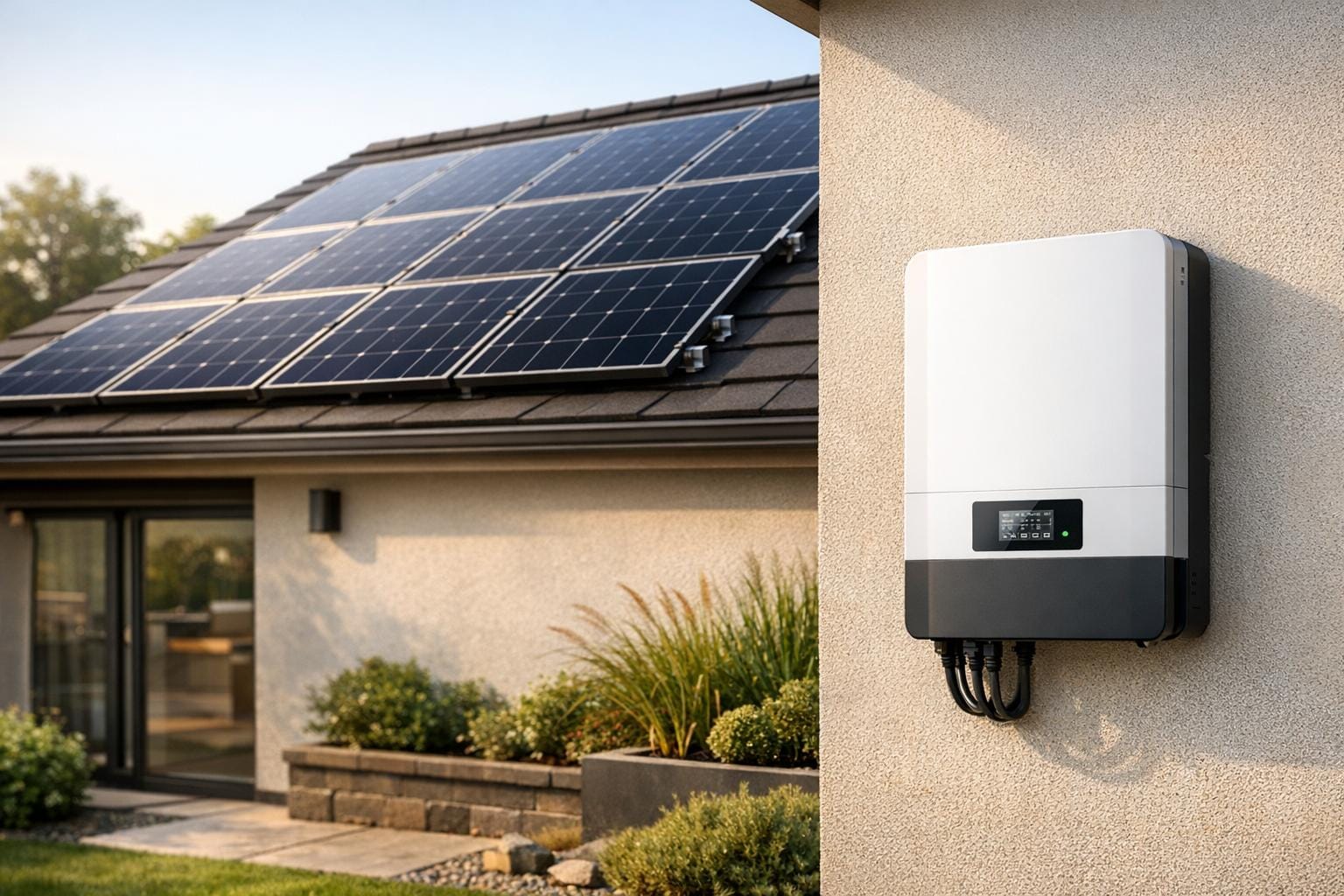
Solar inverters are the backbone of any home solar system. They convert the DC electricity generated by your solar panels into AC electricity, which powers your home and integrates with the National Grid. Beyond this basic function, modern inverters also manage energy flow, optimise efficiency, and support battery storage for night-time or backup use.
Key Points to Know:
- Types of Inverters:
- String Inverters: Affordable (£500–£1,000), suitable for unshaded, simple roof layouts. Lifespan: 10–15 years.
- Microinverters: Ideal for shaded or complex roofs. Costlier (£2,100 for 12 panels) but last up to 25 years.
- Hybrid Inverters: Designed for systems with battery storage. Prices range from £900–£2,800.
- Efficiency: Most inverters operate at 93–98% efficiency, ensuring minimal energy loss.
- Lifespan: Inverters typically last 10–15 years, except for microinverters, which can last up to 25 years.
- Northern Ireland Considerations: Inverters with MPPT technology optimise performance in variable weather, ensuring reliable energy even on cloudy days.
Choosing the right inverter depends on your roof’s layout, energy needs, and whether you plan to add battery storage. Proper sizing and placement are also essential for long-term performance and energy savings.
How Solar Inverters Convert DC to AC Power
Solar inverters work their magic through a fascinating process of rapid electrical switching. Inside the inverter, transistors flip the DC polarity thousands of times each second, creating an AC waveform at the standard frequency of 50Hz. This is the foundation that enables the inverter to perform its other essential tasks.
"The job of a solar inverter is to simulate an AC input, prompting the transformer to deliver household-suitable voltage." – Bright Spark Energy
An internal transformer plays a crucial role by adjusting the voltage from your solar panels to levels appropriate for home use. To ensure your appliances prioritise solar energy, the inverter supplies a slightly higher voltage than the grid.
One of the technical hurdles in this process is the "zero-crossing" moment. In AC electricity, the voltage drops to zero twice in every cycle – 100 times per second in the UK. Without proper handling, energy would be lost during these moments. Modern inverters overcome this by buffering the energy, ensuring a steady flow of usable power. These intricate details highlight how inverters optimise the performance of your solar energy system.
Types of Solar Inverters and Their Applications
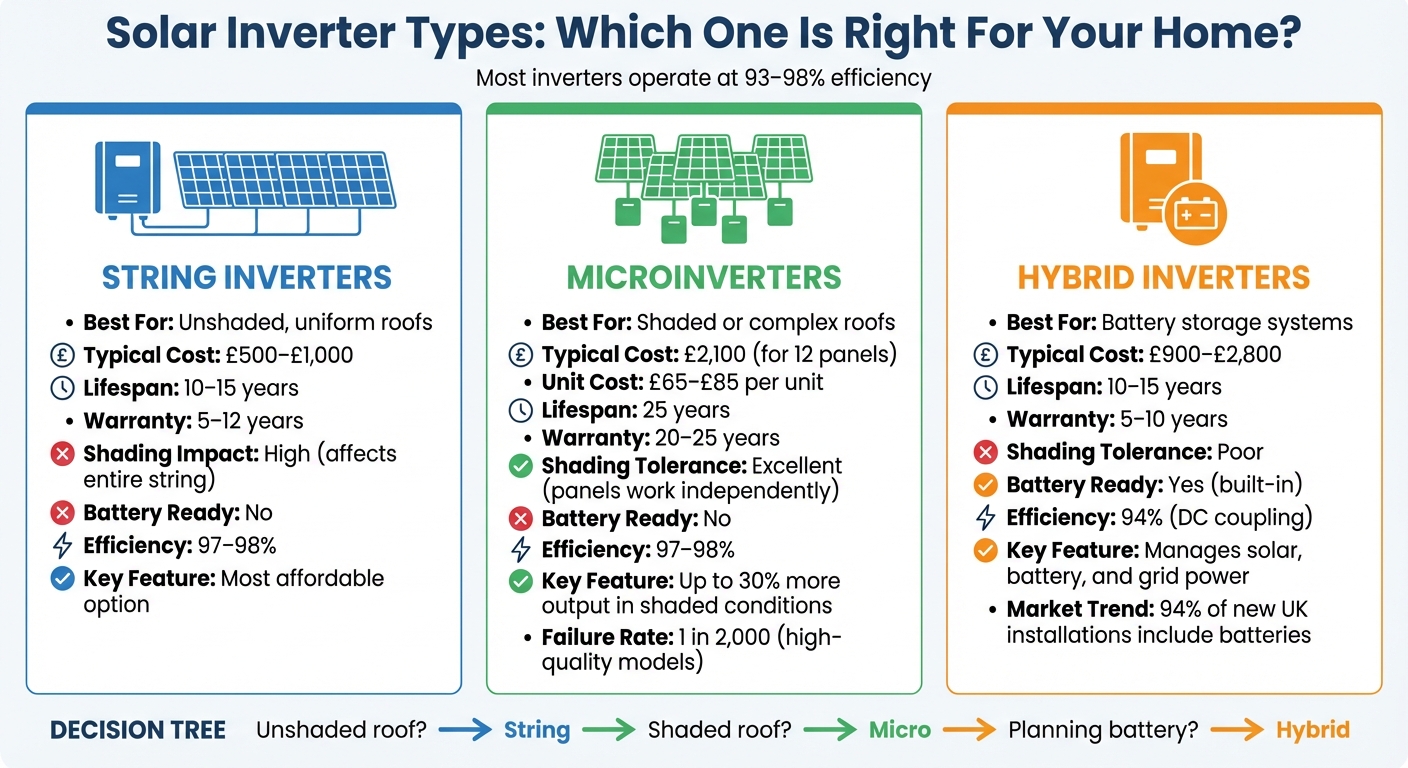
Solar Inverter Types Comparison: String vs Microinverter vs Hybrid Inverters
Choosing the right inverter depends on your roof’s layout and whether you plan to include energy storage. The three main types – string inverters, microinverters, and hybrid inverters – each cater to different needs. Understanding their benefits can help you make the best choice for your home.
String Inverters: A Budget-Friendly Option for Simple Roofs
String inverters work by connecting your solar panels in series, making them the most affordable option, typically priced between £500 and £1,000. They are ideal for roofs that face a single direction and are free from shading caused by trees, chimneys, or nearby buildings.
However, there’s a catch: if one panel in the string is shaded or dirty, the performance of the entire string drops to match the weakest panel. This limitation makes string inverters less suitable for roofs with partial shading or complex designs. They have a lifespan of 10 to 15 years, so you may need to replace them before your solar panels reach the end of their life.
| Feature | String Inverter |
|---|---|
| Best For | Unshaded, uniform roofs |
| Typical Cost | £500–£1,000 |
| Lifespan | 10–15 years |
| Shading Impact | High (affects entire string) |
| Warranty | 5–12 years |
Microinverters: Ideal for Shaded or Complex Roofs
Microinverters are installed on each individual panel, allowing them to function independently. This means that if one panel is shaded or dirty, the others continue performing at full capacity. This feature can increase energy output by up to 30% in shaded conditions, making them a great choice for homes in areas like Northern Ireland, where shadows from chimneys, gables, or trees are common.
Microinverters are also excellent for roofs with panels facing different directions – east, west, and south-facing panels can all work efficiently in the same system. However, they come at a higher cost. At £65 to £85 per unit, a typical 12-panel setup costs around £2,100, which is significantly more than a string inverter.
They have a lifespan of up to 25 years and often come with warranties of 20 to 25 years. However, as Tom Brehme, Technical Manager at Sunsave, points out:
"With a standard string inverter, if something goes wrong you’ve only got one component to fix or replace… However, if you’ve got 10 microinverters going wrong at different times, which may require multiple maintenance visits and costly scaffolding".
High-quality models like Enphase have reported failure rates as low as 1 in 2,000 units.
Hybrid Inverters: Ready for Battery Storage
Hybrid inverters combine solar conversion and battery management into one unit, managing the flow of power between your panels, battery, home, and the grid. With 94% of new UK solar installations now including a battery, hybrid inverters are becoming increasingly popular.
Their main advantage lies in DC coupling, which allows solar electricity to flow directly to the battery without unnecessary conversions, improving efficiency. If you’re planning to add battery storage, a hybrid inverter is a smart choice. Installing one from the start can save you the cost of replacing a string inverter later.
Ben Price, a Renewables Expert at Heatable, explains:
"A hybrid inverter is a perfect solution if you are planning on installing solar panels with a storage battery".
Hybrid inverters cost between £900 and £2,800, making them about twice as expensive as string inverters. Like string inverters, they typically last 10 to 15 years.
The table below highlights the main differences between these inverter types.
| Feature | String Inverter | Microinverter | Hybrid Inverter |
|---|---|---|---|
| Best For | Unshaded, uniform roofs | Shaded or complex roofs | Battery storage systems |
| Typical Cost | £500–£1,000 | £2,100 (12 panels) | £900–£2,800 |
| Lifespan | 10–15 years | 25 years | 10–15 years |
| Shading Tolerance | High (affects entire string) | Excellent | Poor |
| Battery Ready | No | No | Yes (built-in) |
| Warranty | 5–12 years | 20–25 years | 5–10 years |
Inverter Efficiency and Monitoring in Northern Ireland
When it comes to solar systems, choosing the right inverter is just the beginning. Its efficiency and monitoring features play a huge role in how well your system performs. In an EECO Energy solar setup, the inverter’s efficiency directly impacts overall output. In well-designed systems across the UK, about 80–90% of the power generated is effectively utilised. Modern inverters are impressively efficient, converting DC to AC with 97–98.4% efficiency. That means only 2–3 watts are lost for every 100 watts generated.
Northern Ireland’s mild climate works in your favour here. Thanks to natural wind cooling, efficiency losses are minimal – around 0.35–0.40% for every degree above 25°C, while cooler temperatures can even improve efficiency by 0.05% per degree. For context, a typical 4 kWp system in Northern Ireland generates around 3,100–3,600 kWh annually, with yields ranging from 850 to 900 kWh per installed kWp.
Modern inverters also come with handy monitoring tools. Using a smartphone app, you can track solar output, battery cycles, and household energy use. This makes it easier to schedule energy-heavy tasks, like running the washing machine, during times of peak production.
"Modern solar systems generate reliable electricity across the UK, including in cloudy regions, as panels produce power from daylight rather than direct sunshine alone."
Thanks to MPPT (Maximum Power Point Tracking) technology, inverters can adapt to changing conditions, ensuring you get the most from your panels. Even under heavy cloud cover, panels can still deliver 10–25% of their rated output. However, it’s crucial to ensure your inverter’s capacity matches your system’s potential. As Ben Curry, a Solar PV Expert at Electrical Innovations, points out:
"An undersized inverter can create a bottleneck on the system side, limiting the amount of power you can use even when your panels and batteries are producing plenty."
To keep things running smoothly, watch for a solid green status light on your inverter. A red light during the day signals a fault. The dashboard is also a key tool – it lets you monitor peak output and identify "clipping", which happens when production exceeds the inverter’s capacity. This data not only helps you spot underperforming panels early but also allows you to adjust your energy usage for maximum efficiency throughout the year.
sbb-itb-d2d975a
Choosing the Right Inverter for Your EECO Energy Solar Setup
When selecting the right inverter for your solar system, it’s all about balancing your roof’s characteristics, energy needs, and plans for future battery storage. If your roof is uniform and free from shading, a string inverter is a budget-friendly choice, typically costing between £500 and £1,400. However, for roofs with multiple pitches, varying orientations (like an East-West split), or shading from chimneys or trees, microinverters are worth the added expense. These usually cost around £100–£200 per unit and can increase your system’s efficiency by 5–25% in shaded conditions by allowing each panel to function independently.
Sizing your inverter correctly is just as important. Installers often recommend choosing an inverter that’s about 75–80% of your solar array’s kWp rating. This ensures it can start reliably even on cloudy days. If your home has high-demand appliances, such as an EV charger or electric radiators, a larger 5kW inverter can help reduce reliance on expensive grid electricity during peak usage. As Ben Curry from Electrical Innovations puts it:
"An inverter that’s too small will limit your solar system’s power output, while one that’s too large could be an unnecessary expense."
These considerations play a key role in designing a system that meets your energy needs.
Battery storage is another critical factor when choosing an inverter. With around 94% of new solar installations in the UK now including batteries, opting for a hybrid inverter upfront is a smart move. Hybrid inverters, which typically cost between £750 and £2,300, make it easier to add batteries later and can save you money in the long run.
Lastly, your home’s electrical supply must be factored in. Before making a decision, check your fuse box. Most homes in Northern Ireland have a single-phase supply (identified by a single fuse at the service head), which requires a single-phase inverter. Larger properties, such as farms or rural homes with three-phase supplies, will need a compatible three-phase inverter.
EECO Energy takes all these factors into account during their free survey. They’ll ensure your inverter aligns with your roof layout, electrical setup, and energy goals – whether you’re going for a cost-effective 4.5kW system priced at £3,950 or a more powerful 9kW setup for £5,900.
Conclusion: Getting the Most from Your Solar System with the Right Inverter
An inverter plays a key role in your solar system by converting the DC power generated by your panels into AC power that your home can use. Even with the most advanced solar panels, without the right inverter, that energy remains untapped.
For homes with uniform, unshaded roofs, a string inverter is a practical choice. If your panels are affected by shading, microinverters are a better option to maximise performance. Hybrid inverters are ideal if you’re planning to add battery storage in the future. Choosing the right type ensures your system is tailored to your needs and operates efficiently.
Sizing and installation are equally important, particularly in Northern Ireland, where the weather can be unpredictable. An inverter rated at about 75–80% of your solar array’s capacity ensures it can reach its startup voltage, even on overcast days. Most modern inverters operate with impressive efficiency, typically between 93% and 98%. However, the placement and ventilation of the inverter, handled by a skilled installer, are just as critical for maintaining long-term performance.
EECO Energy takes all these factors into account with their free survey, evaluating everything from your roof’s layout to your electrical supply and future plans, such as EV charging or battery storage. Whether you’re looking at their £3,950 starter system or a more comprehensive setup, you’ll receive an inverter that’s properly sized, installed in the right location, and designed to deliver reliable performance for years to come.
The inverter is more than just a converter – it ensures your solar system delivers maximum energy, even on the cloudiest days Northern Ireland has to offer.
FAQs
What should I consider when choosing between string, micro, and hybrid inverters for my solar system?
When choosing an inverter for your solar system, it’s essential to consider the size and layout of your setup. For installations that are uniform and free of shading, string inverters are a solid choice. However, if your roof has shading issues or an irregular design, microinverters are better suited. If you’re planning to add a battery for energy storage, a hybrid inverter might be the way to go.
Your budget will also play a big role. String inverters are generally the most affordable option, while microinverters tend to cost more due to their panel-level functionality. Hybrid inverters, which combine multiple features, usually fall in the middle of the price range. It’s also worth thinking about your energy monitoring needs – microinverters provide detailed data for each panel, whereas hybrid inverters typically offer insights for the entire system.
Lastly, consider the complexity of installation and the space you have available. Hybrid inverters are space-saving, as they combine multiple functions into one device. On the other hand, microinverters are installed directly onto each panel, which can be more labour-intensive. The best choice will depend on your home’s unique setup and your future energy plans.
How does an inverter’s efficiency affect the performance of my solar system?
An inverter’s efficiency is key to figuring out how much of the energy your solar panels produce can actually be used in your home. The higher the efficiency, the less energy is lost when converting electricity from direct current (DC) to alternating current (AC) – the type your appliances need to function.
Choosing a high-efficiency inverter allows you to make the most of your solar system’s output, minimising energy waste and potentially trimming down your energy bills. Just as important is selecting an inverter that matches your system’s size and design to keep everything running smoothly.
What are the advantages of pairing battery storage with a hybrid inverter?
Adding battery storage to a hybrid inverter lets you save the extra solar energy your system generates during the day. This stored energy can then be used at night or on overcast days when your solar panels aren’t producing as much. The result? Less dependence on the grid, which means lower electricity bills and greater control over your energy usage.
Another advantage of pairing a hybrid inverter with battery storage is having backup power during outages. This ensures that essential appliances, like your fridge or lights, keep running when the grid goes down. Plus, it helps maximise the efficiency of your solar setup by using the energy you produce more effectively – particularly in areas like Northern Ireland, where the weather can be unpredictable.