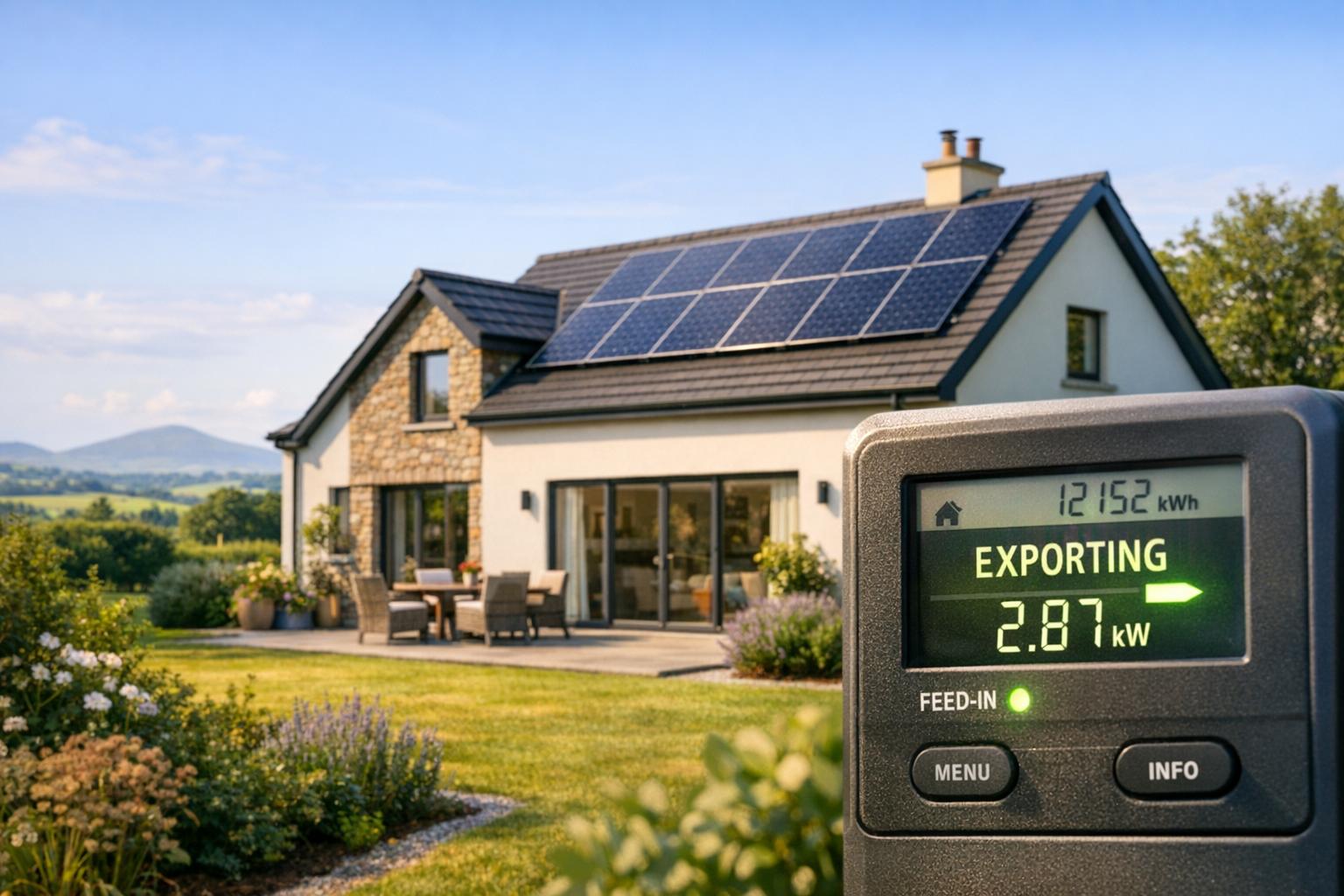
If you have solar panels in Northern Ireland, you can save on energy bills and earn extra income by selling surplus electricity back to the grid. While the Smart Export Guarantee (SEG) is officially limited to Great Britain, many energy suppliers in Northern Ireland offer similar schemes. Here’s how it works:
- Get Paid for Excess Energy: Suppliers like Energia may pay up to 18.5p per kWh for electricity you don’t use.
- Save and Earn: Households with solar panels can save up to £915 annually, combining reduced bills and export payments.
- Requirements: You’ll need an MCS-certified solar system, a smart meter that tracks half-hourly exports, and proper grid connection documentation.
- Supplier Options: Rates vary, so compare suppliers to maximise your earnings.
Adding battery storage can further boost your savings by storing energy for peak-rate exports. Even though SEG legislation doesn’t apply in Northern Ireland, local supplier schemes make solar panels a great investment for cutting costs and generating income.
What is the Smart Export Guarantee (SEG)?
The Smart Export Guarantee (SEG) is a government-backed initiative introduced on 1 January 2020. It requires licensed electricity suppliers, known as SEG Licensees, to pay small-scale renewable energy generators for the electricity they export back to the National Grid. If your solar panels produce more electricity than you use, SEG allows you to earn money for that excess energy.
This scheme replaced the older Feed-in Tariff (FiT), which closed to new applicants in April 2019. Unlike the FiT, which offered fixed government-set rates, SEG gives energy suppliers the freedom to set their own rates – provided they are above zero. This means the rates can vary widely, from as little as 3.02p per kWh to as much as 20p per kWh, depending on the supplier and your specific circumstances.
The SEG supports five types of renewable technologies: solar PV, wind, hydro, anaerobic digestion (up to 5MW capacity), and micro-combined heat and power systems (up to 50kW). To qualify, you’ll need two key things: a smart meter capable of recording half-hourly export readings and an installation certified by the Microgeneration Certification Scheme (MCS) or an equivalent.
Now, let’s explore how payments under the SEG are calculated and processed.
How SEG Works
SEG payments are straightforward. Your smart meter records the electricity you export to the grid in half-hourly intervals, and your chosen supplier pays you based on their tariff rate. For example, exporting 1,325 kWh at a rate of 12p per kWh would earn you approximately £159 annually.
One great feature of SEG is flexibility. You’re not tied to the same supplier for buying electricity and selling your exports. This means you can use one supplier for your import tariff and another for your SEG payments. By shopping around, you can choose the supplier offering the best rate for your exported electricity, helping you maximise your earnings.
Larger suppliers – those with 150,000 or more domestic customers – are legally required to offer at least one SEG tariff. Smaller suppliers can join the scheme voluntarily. Since rates vary, it’s worth comparing offers to find the most competitive option.
SEG in Northern Ireland
The SEG operates across England, Scotland, and Wales, but it works a bit differently in Northern Ireland. The legislation specifically applies to Great Britain, meaning suppliers in Northern Ireland aren’t legally obligated to participate. However, many providers in the region still offer export tariffs. So, if you have an MCS-certified solar installation and a smart meter, you can still earn money for your excess electricity, even though the legal framework differs slightly.
Who Qualifies for SEG Payments in Northern Ireland
Although the official SEG scheme doesn’t apply in Northern Ireland, many energy suppliers offer export tariffs that work in a similar way. To qualify for these export payments, homeowners in Northern Ireland need to meet specific technical and administrative criteria.
Requirements for Homeowners
MCS certification is a must. Your solar system needs to be certified by the Microgeneration Certification Scheme (MCS) or an equivalent, like Flexi-Orb. This certification guarantees that your system meets established safety and quality standards. After installation, your installer should provide you with an MCS certificate within 10 working days.
"Your system was installed by an MCS certified installer using certified products. When signing up to a SEG tariff they might ask for your MCS certificate to confirm this." – MCS (Microgeneration Certification Scheme)
A compatible meter is required. You’ll need a smart meter capable of recording half-hourly export data. Without this, suppliers won’t be able to measure the electricity you send back to the grid accurately.
Grid connection confirmation is essential. Your installer must notify the Distribution Network Operator (DNO) within 28 days of installation using a G98 or G99 notification form. This ensures your system is properly connected and operational.
Administrative details matter. You’ll need to provide proof of ownership, the MCS certificate, the DNO notification, and a UK bank account for receiving payments. Additionally, your system must meet capacity limits: up to 5MW for solar PV, wind, hydro, or anaerobic digestion systems, and up to 50kW for micro-CHP systems.
How to Check Your Eligibility
Verify your installer. Use the MCS website’s search tool to confirm that your installer and the equipment they used are certified. If you’ve lost your MCS certificate, you can request a replacement from your installer or contact the MCS helpdesk.
Ensure your meter is ready. Check with your energy supplier to confirm that your smart meter records half-hourly export data. If your current meter isn’t compatible, you’ll need to arrange for an upgrade before qualifying for export payments.
Organise your paperwork. Make sure you have your MCS certificate and the G98/G99 notification from your DNO. These documents are required when applying for export payments with your supplier.
Once you’ve confirmed your eligibility, you can move forward with registering for export payments.
How to Register for SEG Payments

How to Register for Smart Export Guarantee Payments: Step-by-Step Guide
Registration Steps
Getting registered for export payments is a straightforward process, typically taking around four weeks to complete. Here’s how you can get started:
Prepare your documents: Make sure you have everything ready, including your MCS certificate, DNO approval letter (either G98 or G99 form), smart meter serial number, system details (such as capacity, inverter make and model), proof of identity, proof of address, and your UK bank account details. If you have battery storage, include a line diagram for that as well.
Choose a supplier and apply online. You’re not restricted to your current electricity provider – you can pick any licensed supplier offering export tariffs. Submit your documents and system details through the supplier’s online application form. Once done, the supplier will register your export MPAN (Meter Point Administration Number), which uniquely identifies the electricity you send to the grid.
Monitor your payments. After registration, suppliers make quarterly payments based on your metered export data. Payments must be made within 28 days of receiving a valid export meter reading. If your smart meter isn’t sending readings automatically, you’ll need to provide manual readings every three months to ensure you’re paid. If you find a better rate with another supplier, you can switch at any time, and your new provider will take care of transferring your export MPAN.
"You’ll need to approach an electricity supplier to enter into a purchase contract to export any electricity to the grid. NIE Networks has no involvement in this step of the process, this is a contract between you and your electricity supplier." – NIE Networks
sbb-itb-d2d975a
How to Increase Your SEG Earnings
Estimating Your SEG Income
Your SEG (Smart Export Guarantee) income depends on the size of your solar panel system, how much electricity it generates, and the tariff you’re on. For example, a 4.5kW system that produces 3,380kWh annually might export 1,690kWh, earning around £150 per year at a rate of 8.9p/kWh. A larger 7.2kW system generating 6,189kWh annually could bring in approximately £275, depending on your energy consumption and tariff type.
SEG rates can vary widely. Basic fixed tariffs might start as low as 1p/kWh, while bundled tariffs – often requiring battery storage – can offer rates as high as 24p/kWh during peak periods. In fact, during 2023–24, SEG payouts totalled £30.7 million, marking a massive 327% increase compared to the previous year.
If you’re looking to maximise your earnings, adding battery storage to your system is a smart move.
Adding Battery Storage to Your System
Battery storage allows you to store surplus energy and use it or export it during peak tariff periods, increasing your export potential. In 2023–24, bundled tariffs that included battery storage averaged 13.45p/kWh – a significant jump from the 4.36p/kWh offered by unbundled tariffs.
Here are some battery options from EECO Energy to consider:
Pairing one of these batteries with your solar panels not only gives you access to higher export rates but also helps you save energy for evening use, when electricity costs are typically higher. Some smart tariffs even allow grid charging, enabling you to charge your battery during off-peak hours and export the energy during peak periods. However, before committing, check whether your supplier pays for energy stored from the grid (“brown” electricity) or only for energy generated directly by your solar panels (“green” electricity).
The size of your solar system plays a critical role in how effectively you can use battery storage and maximise SEG payments.
Selecting the Right Solar System Size
Choosing the right solar system size is all about finding a balance between upfront costs and long-term export potential. For instance:
- A 4.5kW system producing 3,380kWh annually costs £3,950 and is ideal for smaller households.
- A 7.2kW system generating 6,189kWh annually is priced at £4,850, making it a better fit for families with higher energy needs or plans to add electric vehicles.
- A 9kW system producing around 7,099kWh annually is perfect for larger homes with south-facing roofs. This system could export approximately 3,500kWh per year if half of the energy is unused.
Larger systems naturally generate more surplus energy, which means higher SEG earnings, especially during peak periods. To decide on the right size, review your electricity bills to understand your average daily usage. Also, think about future needs – installing heat pumps or EV chargers, for example, could add another 3,000kWh or more to your annual consumption. Planning ahead ensures your system can handle both current and future energy demands.
SEG Tariffs and Suppliers in Northern Ireland
To make the most of your export earnings, it’s important to understand how tariff options work. While the Smart Export Guarantee (SEG) applies across Great Britain, it doesn’t extend to Northern Ireland, which operates its own export schemes. For homeowners in Northern Ireland, this means SEG tariffs aren’t directly available. However, knowing how these schemes function in Great Britain can still be helpful when assessing local export payment options. If you’re based in Northern Ireland, reach out to your energy supplier to learn about specific export payment schemes. These often require installations certified under the Microgeneration Certification Scheme (MCS) and the use of smart meters. Exploring your local supplier options with these requirements in mind is an essential step in evaluating tariff structures and offers in your area.
Fixed vs Variable Tariffs
The type of tariff you choose can have a big impact on your export income. Fixed tariffs provide a set rate per kilowatt-hour (kWh) over a specific period, usually 12–24 months. Once this period ends, the rate typically drops to a lower standard rate.
On the other hand, variable tariffs change with market conditions. They can offer higher returns during peak times but come with the uncertainty of fluctuating rates. A specific type of variable tariff, known as a time-of-use tariff (like "Agile" or "Flux"), adjusts rates based on half-hourly intervals or during periods of high demand. These can be particularly advantageous if you have battery storage and can schedule exports to match peak demand periods.
It’s worth noting that some of the most lucrative tariffs – whether fixed or variable – are exclusive to customers who use the same supplier for both importing and exporting electricity.
Comparing Supplier Rates
In 2023–24, UK suppliers offered an average SEG rate of around 8.9p per kWh. However, rates varied significantly, ranging from as little as 1p per kWh to as much as 29.9p per kWh for specialised tariffs designed for battery-integrated systems. Premium tariffs often come with specific conditions, such as requiring a single supplier for both import and export, while standard export-only tariffs are generally lower.
"Our league table reveals which suppliers are offering the best rates. Note that the best rate may not always mean the best energy package. Solar Energy UK recommends shopping around for the best deal." – Solar Energy UK Team
When comparing tariffs, ensure your smart meter supports half-hourly readings. Also, check how often payments are made and confirm which energy types are accepted under the tariff. These details can make a big difference when selecting the right supplier for your needs.
Conclusion
Solar panels with battery storage offer a practical way for homeowners in Northern Ireland to cut energy bills, earn extra income, and reduce carbon emissions. While the Smart Export Guarantee (SEG) scheme is limited to Great Britain, residents in Northern Ireland can still explore export payment options through agreements with local energy suppliers. These opportunities pave the way for notable financial savings.
By generating your own electricity, you’ll reduce dependency on the grid and lower your bills. On top of that, export payments can offset costs, helping you recover your investment faster – potentially saving up to £1,400 annually. This can significantly speed up the payback period for your solar installation.
The environmental benefits are equally compelling. Every kilowatt-hour of renewable energy generated reduces reliance on fossil fuels, contributing to a cleaner, greener future.
To make the most of these benefits, there are a few key steps to follow. Use an MCS-certified installer to ensure quality, make sure your smart meter records half-hourly data, and shop around for the best local export tariffs. Including battery storage in your setup allows you to store surplus energy for later use, giving you more control over your energy consumption and boosting your potential savings.
With the combination of export payments, battery storage, and the decreasing cost of solar technology, investing in solar panels has never been more appealing. For homeowners in Northern Ireland ready to take control of their energy use, now is the perfect time to embrace solar power and move towards a more sustainable future.
FAQs
How can I make the most money from exporting solar energy in Northern Ireland?
To get the most out of your solar energy exports, start by ensuring your system is MCS-certified and has a smart or half-hourly export meter installed. This certification and equipment are essential for accessing the best export rates.
Next, shop around for the best SEG tariff. Licensed suppliers offer varying rates for each kilowatt-hour (kWh) of electricity you export, so switching to a provider with the highest rate can significantly boost your earnings.
You can also maximise your returns by exporting as much surplus energy as possible. Using battery storage can help here – store the electricity your panels generate during the day and export it during peak demand times when rates are typically higher. Alternatively, you could tweak your energy usage to prioritise exporting excess power. These strategies can help you make the most of your solar panel setup.
What do I need to qualify for Smart Export Guarantee payments in Northern Ireland?
To receive Smart Export Guarantee (SEG) payments in Northern Ireland, your system must meet several important criteria. Firstly, it needs to utilise approved low-carbon technology, such as solar panels (PV), wind turbines, micro-combined heat and power (micro-CHP), hydro, or anaerobic digestion. The system’s capacity must not exceed 5 MW (or 50 kW for micro-CHP systems). Additionally, the system must be certified under the Microgeneration Certification Scheme (MCS) or a comparable standard, and its connection to the grid must be authorised by your local Distribution Network Operator (DNO).
You’ll also need a smart meter or an export meter capable of recording half-hourly export data. Payments can only be made into a UK bank account, and you must be the legal owner of the system. Finally, you’ll need to register with a SEG-licensed electricity supplier, as they are required to provide a tariff to qualifying generators. Once everything is in place, you’ll earn payments for every kilowatt-hour of electricity you export back to the grid.
Do I need battery storage to get higher export rates under the Smart Export Guarantee?
No, you don’t need battery storage to take advantage of the Smart Export Guarantee (SEG). This scheme compensates you for the electricity you send back to the grid, whether or not you have a battery installed. That said, some energy suppliers might offer higher tariffs to those with battery storage, as it helps them manage energy exports more effectively.