
When investing in solar panels, warranties are your safety net against unexpected costs. They cover three main areas: product defects, performance guarantees, and workmanship issues. Here’s what you need to know:
- Product warranties: Cover manufacturing defects in panels, inverters, and mounting equipment. Panels typically last 10–25 years, while inverters have shorter coverage (5–12 years, or up to 20 with extensions).
- Performance warranties: Ensure panels maintain 80–90% output after 25 years. Premium options guarantee even slower degradation rates.
- Workmanship warranties: Protect against installation errors like wiring faults or roof leaks. UK installers certified by MCS must offer at least 2 years, but some go up to 25 years.
Exclusions: Weather damage, vandalism, and poor maintenance aren’t covered. Labour costs for replacing faulty parts, such as scaffolding or shipping, are often excluded too.
To maximise your warranty:
- Choose an MCS-certified installer.
- Maintain your system regularly (cleaning, inspections).
- Keep detailed records and follow manufacturer guidelines.
Warranties provide peace of mind, but understanding their limits and exclusions is key to protecting your investment.
3 Types of Solar Warranties
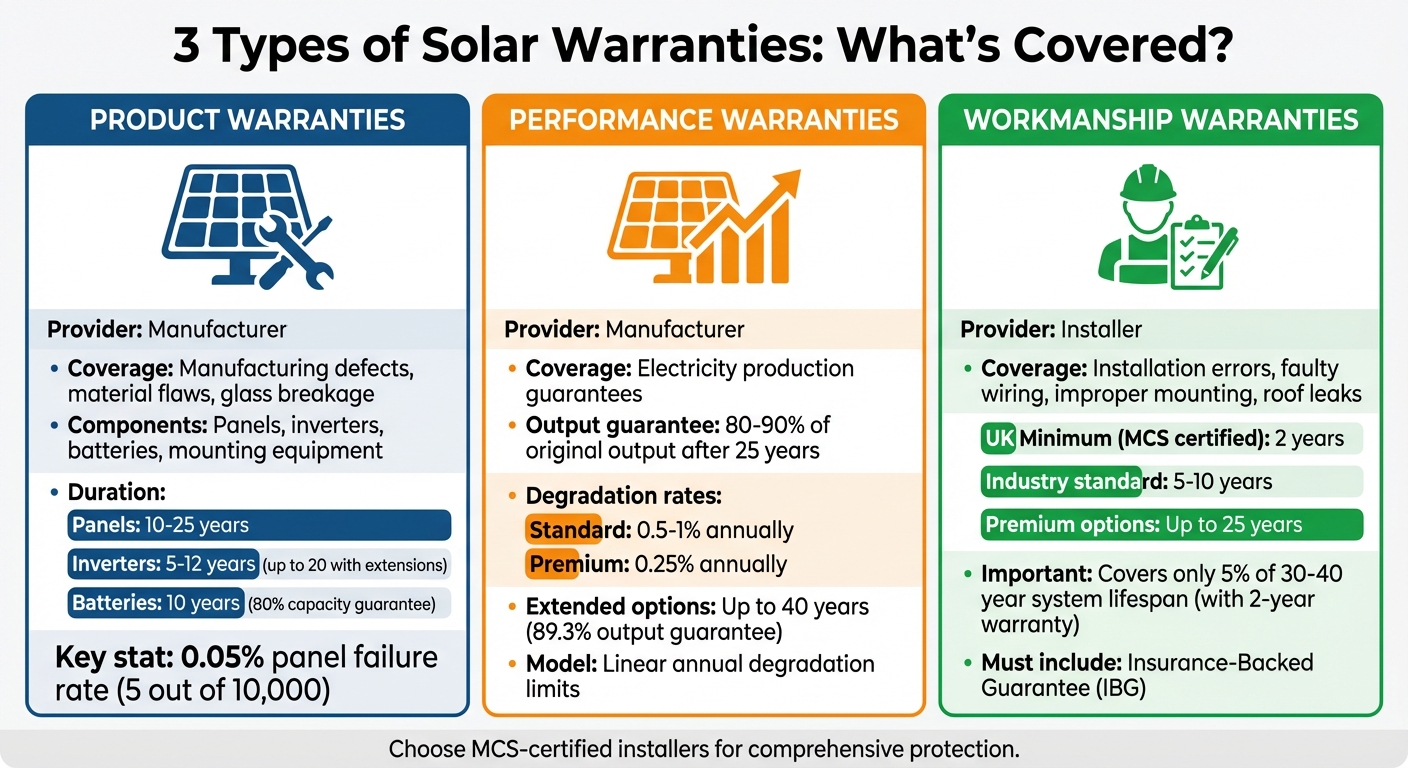
Solar Warranty Types: Coverage, Providers, and Duration Comparison
When you invest in solar panels, you’re protected by three types of warranties, each covering a different aspect of your system. Understanding what these warranties include can help you identify who to turn to if any issues arise. Here’s a closer look at what each warranty entails.
Product Warranties
Product warranties safeguard you against manufacturing defects and material flaws in your solar system’s physical components. This includes the panels themselves, as well as inverters, batteries, and mounting equipment.
Solar panels usually come with warranties ranging from 10 to 25 years. Premium manufacturers often provide the full 25 years as standard. Inverters, being more sensitive electronic components, typically have shorter warranties – usually between 5 and 12 years. Many installers suggest purchasing extended inverter warranties, which can extend coverage up to 20 years.
Performance Warranties
Performance warranties ensure your solar panels maintain a certain level of electricity production over their lifespan. While solar cells naturally degrade over time, this warranty guarantees that your system won’t fall below a specified threshold – usually 80% to 90% of its original output after 25 years.
High-quality panels degrade at a rate of about 0.5–1% annually, but some premium options offer degradation rates as low as 0.25% per year. Some manufacturers even provide 40-year warranties with an 89.3% guaranteed output by the end of the term. Many warranties now follow a linear model, specifying annual degradation limits, instead of stepped guarantees like "90% at 10 years and 80% at 25 years".
Workmanship Warranties
Workmanship warranties are offered by your installer and cover mistakes made during installation. These can include issues like faulty wiring or improper mounting that might lead to problems such as roof leaks. It’s essential to know whether the responsibility for installation-related issues lies with the installer, manufacturer, or inverter maker to ensure your investment is secure.
In the UK, installers certified by the Microgeneration Certification Scheme (MCS) are required to provide a minimum two-year workmanship warranty. However, this only covers a small portion – around 5% – of the system’s expected 30- to 40-year lifespan. Companies like EECO Energy offer extended 25-year workmanship warranties to cover installation faults. Make sure your installer includes an Insurance-Backed Guarantee (IBG) to keep your warranty valid, even if the company goes out of business.
| Warranty Type | Provider | Coverage | Typical Duration |
|---|---|---|---|
| Product | Manufacturer | Defects in materials, glass breakage | 10–25 years |
| Performance | Manufacturer | Power output and efficiency guarantees | 25–30 years |
| Workmanship | Installer | Installation errors, wiring, roof leaks | 2–10 years |
What Parts Are Covered Under Solar Warranties?
Now that we’ve gone over the main types of warranties, let’s take a closer look at what’s covered for specific components. Knowing the details of what’s protected can make all the difference if something goes wrong. Here’s a breakdown of the warranties for key components and mounting equipment.
Panels, Inverters, and Batteries
Solar panels come with two types of warranties: product and performance. Product warranties protect against manufacturing defects like cracked glass or material flaws. Solar panels are highly reliable, with a failure rate of just 0.05% (5 out of 10,000). These warranties typically last between 10 and 25 years. Performance warranties, on the other hand, ensure the panels maintain a consistent level of energy output over time.
Inverters generally have shorter warranty periods compared to panels, as they are more complex electronic devices. String inverters usually include coverage for 5 to 10 years, whereas micro-inverters, which are installed on individual panels, can come with warranties lasting up to 25 years. If you’re looking for extended protection, you can purchase additional inverter warranties for around £300, which can extend coverage to 20 years and potentially save you up to £1,000 in replacement costs.
Batteries are a little different. Their warranties are often based on "cycles" (the number of charge and discharge cycles) or "throughput" (the total energy delivered, measured in megawatt-hours). Most battery warranties promise that the unit will retain at least 80% of its original capacity after 10 years. For example, a battery that originally stored 10 kWh should still hold at least 8 kWh by the end of the warranty period.
Mounting and Support Equipment
In addition to the main electrical components, the mounting and support systems that secure your panels are also covered. This includes brackets, rails, and frames, which are protected by two types of warranties: the manufacturer’s product warranty for the hardware itself and the installer’s workmanship warranty, which covers how the equipment is fitted. This dual protection ensures both the quality of the materials and the installation process are accounted for.
Different mounting systems come with specific considerations. For instance, "on-roof" systems use brackets attached to rafters, while "in-roof" installations integrate panels directly into the roofline. Ground-mounted systems and flat roof setups have their own structural requirements. Additionally, features like bird-proofing mesh or spikes must be installed correctly to keep warranties valid. To avoid future issues, make sure your installer offers at least a five-year workmanship warranty to cover any potential mounting problems or roof damage.
Labour Coverage in Solar Warranties
Workmanship and Installation Repairs
Labour costs can quickly spiral when something goes wrong with your solar installation. A workmanship warranty steps in to cover the labour and materials required to fix issues caused by faulty installation – whether it’s wiring problems, structural damage, or even a leaky roof. In the UK, installers certified by the Microgeneration Certification Scheme (MCS) are required to provide a minimum two-year workmanship warranty, though many companies extend this to five or even ten years.
Some companies go further. For instance, EECO Energy offers a 25-year workmanship warranty, far exceeding the industry norm. This extended coverage matters because solar panels are designed to last 30 to 40 years, leaving a basic two-year warranty covering only a tiny portion of the system’s expected lifespan.
Comprehensive warranties often include coverage for removing and replacing defective parts, as well as the costs of technician visits. High-end warranties might even cover shipping costs for faulty components. And, if your installer goes out of business, an Insurance-Backed Guarantee (IBG) ensures another company can take over, addressing any workmanship defects without adding to your expenses.
What Labour Costs Are Not Covered
Despite their broad coverage, warranties don’t cover everything. Repairs caused by external factors like severe weather, vandalism, fire, or accidental damage are typically excluded. For example, if a storm damages your solar panels, you’ll need to rely on your home insurance rather than the solar warranty.
Mistakes made by the owner can also void coverage. Skipping routine maintenance, using harsh cleaning chemicals, or hiring an uncertified technician for repairs are all actions that could leave you footing the bill. It’s crucial to read the fine print carefully to understand your responsibilities and what the warranty actually covers.
Additionally, many manufacturer product warranties only cover the replacement part itself – not the labour to remove and install it. Scaffolding costs, in particular, can be hefty. Experts estimate that a typical solar and battery system will require at least three maintenance call-outs over a 20-year period. It’s also worth checking if your warranty includes diagnostic fees, sometimes referred to as "truck roll" fees, as these can add up over time.
sbb-itb-d2d975a
Common Warranty Exclusions
Weather and Environmental Damage
Solar warranties often exclude damage caused by uncontrollable events – things no one can prevent. This includes lightning strikes, floods, hail, fires, and extreme winds, which are common exclusions across the solar industry. For example, if a storm in Northern Ireland damages your panels, you’ll need to file a claim through your home insurance, not your solar warranty.
Living in coastal areas presents additional challenges. Salt exposure can speed up the degradation of solar panels unless they’re specifically designed for such conditions. Manan Shah, a Solar Expert at Solar4Good, explains:
Environmental factors such as hail, snow, or salt corrosion near coastal areas may not be covered unless explicitly stated in the policy.
This highlights the importance of updating your home insurance to cover your solar panels – it’s the only way to protect against weather-related damage.
But it’s not just about natural forces. Proper system care is equally important for keeping your warranty intact.
Maintenance and Owner Responsibility
Skipping maintenance or using improper cleaning methods can void your warranty. For instance, Solar Sky’s warranty clearly states:
This warranty will be invalidated if the customer fails to follow the maintenance schedule outlined in the owner’s manual and/or advice given.
Ignoring maintenance schedules, like failing to clean your panels correctly, can leave you unprotected. Some manufacturers even require that monitoring software stays connected – if the system stops reporting, your warranty could be voided. To stay covered, keep a dated maintenance log and always hire MCS-certified technicians to handle inspections and repairs. This ensures your system is well-maintained and your warranty remains valid.
How to Get the Most from Your Warranty with EECO Energy
Choosing a Trusted Installer
The first step to maximising your warranty benefits is choosing the right installer. EECO Energy holds MCS accreditation, which ensures all installations comply with UK building, fire, and electrical codes – an essential requirement to keep your warranty valid. Unlike many installers who rely on generic estimates, EECO Energy takes a tailored approach by creating custom power generation forecasts. These forecasts consider your roof’s slope, orientation, and shading, giving you realistic expectations about your system’s performance and helping you understand what your warranty covers. This attention to detail lays the groundwork for you to fully benefit from the warranty protections.
Additionally, EECO Energy uses premium components designed to deliver reliable, long-term performance. With their 25-year warranty and proven experience across Northern Ireland, you’re not just getting an installer – you’re partnering with a provider that offers lifetime customer support. This support extends well beyond installation, ensuring your system performs optimally throughout its lifespan.
Maintaining Your Solar System
Proper maintenance is just as important as choosing a trusted installer when it comes to keeping your warranty intact. To keep your solar panels in good condition, clean them twice a year using a soft brush and mild soap. Avoid harsh chemicals or abrasive tools, as these can scratch the glass and potentially void your warranty. If you live in areas prone to heavy pollen or near the coast, you may need to clean your panels more often.
It’s also important to schedule professional inspections every two years – or annually if your system is older. These inspections should cover wiring, mounting hardware, and inverter function. Make sure only licensed solar contractors handle maintenance and inspections. Between professional visits, conduct visual checks every few months for signs of cracks, discolouration, debris build-up, or loose wiring.
To stay on top of your system’s performance, use live monitoring software to track energy production weekly. This allows you to catch any performance issues early. Keeping a dated maintenance log of cleanings and inspections can also be a lifesaver if you need to file a warranty claim. Lastly, trim any tree branches that cast shade on your panels, as shading can strain components and lower energy output.
Conclusion
Solar warranties act as your financial safeguard for a long-term investment that can last 25 to 40 years. By understanding the three key warranty types – product, performance, and workmanship – you’ll know exactly who to turn to if something goes wrong. Many homeowners skim over the fine print, but it’s vital to determine whether the manufacturer, installer, or inverter supplier is responsible to ensure your investment is well-protected.
However, standard warranties often leave critical gaps. For instance, manufacturer warranties usually don’t cover damage caused by severe weather, theft, or vandalism. Additionally, a basic two-year workmanship warranty only covers a fraction – about 5% – of your system’s expected 40-year lifespan. Experts predict at least three major maintenance issues within the first 20 years, making comprehensive coverage a necessity rather than a luxury. These limitations highlight the importance of securing full coverage for your system’s lifespan.
This is where choosing a reliable provider becomes essential. EECO Energy offers MCS accreditation, a 25-year warranty, and lifetime customer support. Their Insurance-Backed Guarantee ensures your workmanship warranty remains valid even if the installer goes out of business. Plus, their use of high-quality components reduces the likelihood of early failures. Considering inverter replacements alone can cost between £1,000 and £2,000, having labour costs included in your coverage can save you a substantial amount.
To keep your warranty intact, regular maintenance is key. Register your system immediately after installation, maintain detailed service records, and schedule professional inspections every two years. Avoid using harsh cleaning chemicals and steer clear of DIY repairs, as unauthorised fixes can void your warranty entirely. By partnering with EECO Energy and adhering to proper maintenance routines, you’ll not only optimise your system’s performance but also ensure your warranty protection remains intact for decades to come.
FAQs
How can I make sure my solar warranty stays valid?
To ensure your solar warranty remains intact, there are a few essential steps to follow:
- Understand the warranty terms: Take time to thoroughly read through the warranty details to know exactly what’s covered and who is responsible for each part of the system.
- Keep all relevant paperwork: Hold onto purchase receipts, installation records, and any other documentation that proves you’ve met the warranty requirements.
- Use qualified professionals for installation: Make sure your solar system is installed by an authorised and certified technician.
- Stick to maintenance guidelines: Follow the manufacturer’s maintenance instructions and avoid unauthorised repairs or modifications that could void the warranty.
- Prevent avoidable damage: Protect your system from issues like extreme weather or damage caused by DIY fixes.
By sticking to these guidelines, you can maintain your warranty and enjoy long-term peace of mind with your solar system.
How can I check if my solar installer is MCS-certified, and why does it matter?
To confirm if your solar installer holds MCS certification, you can simply ask them for their MCS certificate number. Once you have it, you can cross-check this number on the official Microgeneration Certification Scheme (MCS) register online. Alternatively, you can use the MCS website to search for certified installers by entering your postcode. Many reputable installers proudly display the MCS logo on their quotes or proposals and should have no problem providing proof of their certification.
Opting for an MCS-certified installer is crucial because it guarantees that your solar system will be installed to recognised industry standards. MCS certification is the UK’s trusted quality mark for small-scale renewable energy projects. It not only assures you of a safe and reliable installation but also opens the door to government incentives and warranty protections. Plus, it helps minimise the risk of potential problems or disputes down the line.
What maintenance should I do to keep my solar warranty valid?
Regular upkeep is essential to ensure your solar warranty remains valid. Begin with a yearly visual inspection to spot any issues such as cracked panels, loose brackets, exposed wiring, or debris that could be causing shading. If the panels appear dirty, clean them carefully using water or a soft, non-abrasive brush. Steer clear of high-pressure washers or harsh chemicals, as these can harm the panels and potentially void your warranty.
It’s also important to maintain the area around your solar panels. Trim any overhanging branches and prevent new sources of shading from developing. If your roof needs work, like tile repairs, make sure the mounting equipment remains undisturbed. Always rely on accredited professionals for repairs or component replacements, as attempting DIY fixes could invalidate your warranty.
Lastly, keep detailed records of all maintenance and repairs. These documents might be essential if you need to file a warranty claim. By sticking to these straightforward steps, you can protect your investment and ensure your warranty stays intact.