The payback period for a solar panel system in Northern Ireland typically ranges from 9 to 12 years, depending on factors like your system size, electricity usage, and export income. With electricity prices at 32.9p/kWh – about 45% higher than the EU median – every unit of solar energy you use directly reduces your bills, making solar a cost-effective choice.
Key points to know:
- System Costs: A 3.5 kWp system (10 panels) costs around £5,006, while larger systems, like a 4.9 kWp setup, can go up to £7,009.
- Annual Savings: Combining self-consumption and export income can save you approximately £620 per year.
- Export Tariffs: Providers like Power NI offer rates of 17.66p/kWh, adding to your savings.
- Factors Impacting Payback: Roof orientation, shading, and daytime electricity use can shorten or extend the payback period.
Once the system pays for itself, you’ll enjoy years of free electricity and reduced bills. Over 25 years, a typical home could save around £7,841 while cutting CO₂ emissions by 0.45 tonnes annually.
For the best return on investment, maximise self-consumption by using appliances during the day or adding a battery for evening storage. EECO Energy offers competitive pricing and free surveys to help you calculate your payback period.
Factors That Affect the Payback Period in Northern Ireland
Several interconnected factors influence how quickly a solar system pays for itself. Understanding these variables can help you optimise your investment and shorten the timeline for returns.
System Cost and Size
The size and cost of your solar system are key components in determining your payback period. In Northern Ireland, a standard 3.5 kWp system (approximately 10 panels) for a typical three-bedroom house costs around £5,006. Smaller systems, like a 2.1 kWp setup (6 panels), start at £3,004, while larger installations, such as a 4.9 kWp system (14 panels), can cost up to £7,009. With solar panels averaging £500 per 350-watt unit, the total cost scales directly with system size.
Larger systems require a bigger initial investment but offer better savings over time. They produce more electricity, leading to higher bill reductions and increased export income. Additionally, homeowners in Northern Ireland benefit from 0% VAT on the supply and installation of solar panels, making the upfront costs more manageable compared to other regions. However, unlike the Republic of Ireland, there are no government grants available in Northern Ireland, so all costs must be recouped through savings and export earnings.
Optional add-ons can also influence your payback period. For example, a solar battery with a 5.1 kWh capacity costs between £1,400 and £2,500, while a hot water diverter ranges from £300 to £600. These additions increase the initial outlay but can improve returns by enabling you to use more of your self-generated electricity instead of exporting it at lower rates.
Solar Generation Potential in Northern Ireland
How much electricity your system generates annually plays a big role in how quickly you see returns. For instance, a 4 kWp system in Belfast typically produces 3,572 kWh per year. A slightly larger 4.6 kWp system on a south-facing roof can generate around 3,900 kWh annually. While Northern Ireland receives roughly 5% less sunlight compared to the UK average, modern solar panels are highly efficient at converting even diffused light into electricity.
Roof orientation is another critical factor. A south-facing roof in Belfast with no shading can produce about 50% more energy annually than an east-facing roof with some shading. This difference can reduce the payback period by over five years. Interestingly, Northern Ireland’s cooler climate also works to your advantage, as solar panels operate more efficiently in lower temperatures, avoiding the performance drop caused by overheating.
Electricity Usage and Self-Consumption
How you use your solar-generated electricity directly impacts payback speed. Every kilowatt-hour you consume yourself saves you about 33p, based on Northern Ireland’s electricity rate of 32.9 p/kWh. In contrast, exporting surplus electricity only earns you 17–18p per kWh. This 15p difference makes maximising self-consumption a key strategy for faster returns.
Simple adjustments, like running appliances during daylight hours, charging an electric vehicle, or using a hot water diverter to heat water with surplus energy, can significantly boost self-consumption. These strategies are particularly valuable in Northern Ireland, where electricity prices are around 45% higher than the EU median, making every kilowatt-hour you don’t buy from the grid more impactful.
Export Payments and Electricity Prices
Exporting surplus electricity adds to your annual savings. While the Smart Export Guarantee (SEG) doesn’t apply in Northern Ireland, voluntary schemes from providers like Power NI (17.66p per kWh) and Action Renewables offer competitive rates. According to Mark Compston, Head of Projects at Action Renewables:
This year we will be paying our clients at least 18p [per kWh].
Additionally, rising electricity prices work in your favour. As grid electricity becomes more expensive, the value of your solar-generated power increases, further shortening the payback period.
Battery Storage and Additional Factors
Adding a battery to your system increases upfront costs but can improve your overall savings by allowing you to store excess electricity for use during the evening, when demand is typically higher. A 5.1 kWh battery costs between £1,400 and £2,500, which may extend the payback period initially. However, it provides greater energy independence and better utilisation of your solar system.
If you’re not ready to invest in a battery immediately, a hybrid inverter can make future integration seamless. Maintenance costs, like replacing an inverter (£500–£1,500) after 10–15 years, are worth considering but don’t heavily influence the initial payback calculation. These factors collectively shape the financial viability of your system, helping you estimate how long it will take to break even on your investment.
sbb-itb-d2d975a
Typical Payback Periods for Domestic Solar Systems
Solar Panel System Sizes and Payback Periods in Northern Ireland
Payback Ranges for Standard Systems
For most households in Northern Ireland, the payback period for solar panel systems falls between 9 and 13 years. If conditions are ideal – think a south-facing roof with no shading and high daytime electricity use – this can drop to 7–9 years. On the other hand, an average setup generally takes 9–12 years, while more challenging installations, such as east-facing or shaded roofs or homes with low daytime energy use, may stretch the timeline to 12–15 years or longer.
Using more of the electricity you generate – known as optimising self-consumption – can significantly shorten the payback period. This is because using your own solar energy offsets electricity costs at 33p per kWh, which is far more than the lower rate you’d earn by exporting surplus energy. EECO Energy’s competitive pricing also helps speed up returns. For instance, a standard 4.5 kW system costs around £3,950, which is notably lower than the market average of £5,006.
The impact of system size on payback is worth exploring further, as it directly influences both the upfront cost and the time it takes to recoup your investment.
Comparison of System Sizes and Payback
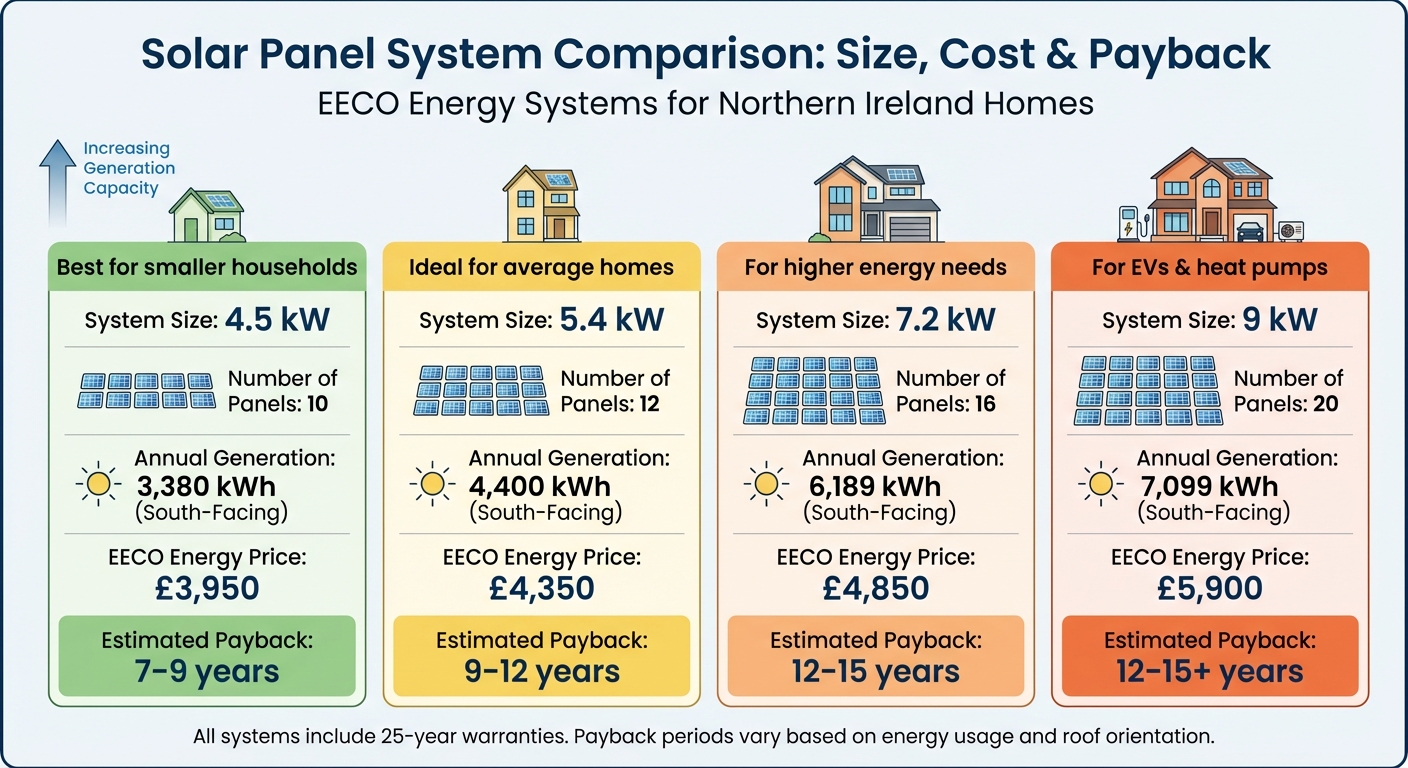
Choosing the right solar system size is key to balancing your household’s energy needs with your budget. Below is an overview of EECO Energy’s options for homes in Northern Ireland:
| System Size | Number of Panels | Annual Generation (South-Facing) | EECO Energy Price | Estimated Payback Range |
|---|---|---|---|---|
| 4.5 kW | 10 | 3,380 kWh | £3,950 | 7–9 years |
| 5.4 kW | 12 | 4,400 kWh | £4,350 | 9–12 years |
| 7.2 kW | 16 | 6,189 kWh | £4,850 | 12–15 years |
| 9 kW | 20 | 7,099 kWh | £5,900 | 12–15 years or more |
A 4.5 kW system is ideal for smaller households or those with moderate energy needs, often delivering the quickest payback, especially when daytime usage is maximised. Larger systems, like the 7.2 kW or 9 kW options, are better suited to homes with higher energy demands or plans to adopt electric vehicles or heat pumps. These systems generate more electricity, which can provide long-term savings, though the initial payback period may be longer.
Your household’s energy usage patterns also play a big role in determining payback time. For example, a Belfast household with someone home during the day and using a 3.5 kWp system might see a payback period of around 9 years. In contrast, a similar household where everyone is out until the evening could face a payback closer to 13 years. This underscores the importance of matching your system size to your actual energy consumption habits.
How to Calculate Your Own Payback Period
Step-by-Step Calculation Method
Start by figuring out your net system cost – this is the total installation price after deducting any solar panel grants in Northern Ireland or incentives. For instance, a typical 4.6 kWp solar system from EECO Energy in Belfast costs about £7,400.
Next, estimate your annual energy generation. A 4.6 kWp system in Belfast can produce roughly 3,900 kWh annually. To calculate your yearly financial benefit, combine the savings from using your own solar energy with the earnings from exporting excess power. Based on current rates, self-consumption might save you around £275 per year, while exported energy could bring in approximately £345. Together, this adds up to an estimated annual benefit of £620.
Now, calculate your payback period by dividing the net system cost by the annual benefit. For example: £7,400 ÷ £620 gives you an approximate payback period of 11 years and 11 months. In real-world scenarios, payback periods in Northern Ireland typically range from 9 to 13 years, depending on factors like household energy usage and current tariff rates.
Understanding these numbers not only helps you predict when you’ll break even but also provides insight into how you can maximise your system’s efficiency.
Factors That May Shorten or Lengthen Payback
Several factors can influence how quickly you recover your investment. Rising electricity prices are one such factor. In 2024, electricity rates in Northern Ireland reached 32.9p per kWh – about 45% higher than the EU median. This means every kilowatt-hour of solar-generated power you use offsets a higher grid electricity cost.
Adding battery storage is another way to improve your system’s efficiency. Batteries can boost self-consumption rates from around 35% to over 70%, though they come with an extra upfront cost of several thousand pounds. Additionally, export tariffs can significantly impact your earnings. While some suppliers in Northern Ireland offer around 10p per kWh for exported electricity, rates vary, so it’s worth shopping around for the best deal.
Understanding the System’s Lifetime Value
Once your solar system hits the break-even point, the benefits don’t just stop there. In fact, the value of your system keeps growing through ongoing savings, low maintenance needs, and advantages that go beyond just saving money.
Savings After Payback
After reaching payback, your solar system starts generating pure savings. Since the electricity it produces is essentially free, you could enjoy 15 or more years of net financial benefits.
For example, the average three-bedroom home in Northern Ireland could see a total profit of £7,841 over a 25-year period. This includes annual savings of £513 on electricity bills. These savings come from two main sources: the electricity you no longer need to buy from the grid and the payments you receive for exporting surplus energy. These export payments continue to pad your savings throughout the system’s life.
Additionally, your solar system acts as a safeguard against rising energy prices. As grid electricity costs climb, the value of your solar-generated power increases, giving you even greater long-term savings.
While these financial perks are impressive, it’s worth considering the future costs and upkeep that help maintain your system’s value.
Maintenance and Future Costs
Solar systems are known for being low-maintenance, but there’s one major cost to plan for: inverter replacement. Most inverters last between 10 and 15 years, so you’ll likely need to replace it once during your system’s lifespan. The cost for this ranges from £500 to £1,500[7,8].
For most homes in Northern Ireland, rainfall naturally keeps solar panels clean, provided they’re tilted at an angle of 15° or more. However, if you have ground-mounted panels, you might occasionally need to clear away debris. If your system includes a battery, it will typically last around 10 years or 6,000 cycles, with replacement costs ranging from £1,700 to £3,000[8,9].
Modern solar panels come with excellent warranties – often 25 years for the product and up to 30 years for performance. Even after three decades, most panels guarantee an output of at least 87%.
| Component | Expected Lifespan | Estimated Replacement Cost |
|---|---|---|
| Solar PV Panels | 25–30+ Years | N/A (covered by warranties) |
| Solar Inverter | 10–15 Years | £500–£1,500 |
| Solar Battery | 10+ Years (or 6,000 cycles) | £1,700–£3,000 |
| Solar Diverter | ~12 Years | ~£800 |
Additional Benefits
Solar systems don’t just save you money – they also offer a range of other benefits that make them even more worthwhile. For instance, a typical 4 kWp system in Belfast can save about 0.45 tonnes of CO₂ each year. That’s the equivalent of planting 52 trees annually! Over a 25-year period, this adds up to a 13% reduction in your carbon footprint[5,8].
Beyond environmental perks, solar panels can boost your property’s value. Homes with solar installations often sell faster and can command a 4% to 6% price premium. In fact, 65% of surveyed buyers say they would specifically look for homes with solar panels[2,5,8].
With the ability to generate clean energy for decades, solar systems don’t just pay for themselves – they keep delivering financial and environmental benefits long after you’ve recouped your initial investment.
Conclusion
In Northern Ireland, the payback period for a solar panel system typically falls between 9 and 12 years, marking the point where your investment breaks even. This timeline depends on factors like the cost of your system, how much of the solar energy you use directly in your home, and any income generated from exporting surplus energy. With electricity prices in Northern Ireland at around 32.9 p/kWh – approximately 45% higher than the EU median – every kilowatt-hour your panels produce contributes directly to your savings.
Once your system has paid for itself, it continues to provide value for at least 15 more years. For example, a typical three-bedroom home could see a net profit of about £7,841 over 25 years while also cutting its carbon footprint by roughly 13%. As electricity prices increase over time, the financial benefits of your solar panels grow, making your investment even more worthwhile.
The environmental impact is equally significant. A solar system can reduce CO₂ emissions by approximately 0.45 tonnes per year, offering a meaningful contribution to a cleaner planet.
These benefits highlight why investing in a well-planned solar panel system is a smart move. EECO Energy specialises in customised solar solutions tailored to Northern Ireland’s unique climate and energy needs. With systems starting from £3,950 for a 4.5 kW installation and backed by 25-year warranties, you can generate your own power and shield yourself from rising electricity costs. Our MCS-accredited installations ensure your system is registered with NIE Networks and optimised for maximum efficiency.
Want to know how much you could save? EECO Energy offers free surveys and quotes across Northern Ireland, helping you calculate your payback period based on your home’s energy usage and specific circumstances.
FAQs
How can I make the most of the solar energy my system generates?
To get the most out of the electricity your solar panels generate, try to shift more of your energy use to daylight hours. For instance, running energy-intensive appliances like washing machines, dishwashers, or even charging your electric vehicle during peak sunlight can make a noticeable difference. Installing smart timers or load-shifting devices can automate this process, making it even easier to align your energy usage with your system’s output.
You might also want to look into adding a solar diverter, which redirects any excess electricity to your hot water tank, or a battery storage system to store surplus energy for use after the sun goes down. Both options can help you use more of the energy you produce, cutting down on your reliance on the grid. Don’t forget the basics: keeping your panels clean and ensuring they’re positioned correctly – ideally south-facing – can also boost their efficiency.
It’s worth checking for any grants or incentives that might be available for battery storage or other energy-saving upgrades. By adopting smart habits and investing in the right equipment, you can increase how much of your solar power you use, reduce your energy bills, and potentially shorten the time it takes to recoup your investment in the system.
What are the advantages of adding a battery to my solar panel system?
Adding a battery to your solar panel system means you can store the extra electricity your panels generate during the day and use it later – like in the evening or on overcast days. This boosts your self-consumption of solar energy, cutting down your electricity bills and offering some protection against rising energy costs. Plus, it helps you get more value out of your solar investment.
A battery also gives you energy security by acting as a backup during power cuts. It keeps essential appliances running without needing a noisy generator. On top of that, with many UK energy tariffs offering "time-of-use" rates, you can charge your battery when electricity is cheaper and use it during peak times when prices are higher, saving even more.
While there’s an upfront cost to adding a battery, the reduced dependency on the grid and potential government incentives can often shorten the payback period. Over time, it’s an investment that can pay off both financially and practically.
How does the direction of my roof impact the payback period for solar panels?
The orientation of your roof is a key factor in determining how quickly your solar panels can pay for themselves. In the UK, a south-facing roof with an angle of around 30° is considered ideal. This setup captures the maximum amount of sunlight throughout the year, boosting energy generation. The result? Bigger savings on your electricity bills and a quicker payback period – typically between 6 and 8 years under optimal conditions.
If your roof faces east or west, it will receive less direct sunlight, which means energy production drops slightly. This can stretch the payback period by an extra 1 to 2 years. Meanwhile, north-facing roofs, which get the least sunlight, are generally less effective for solar panels and can lead to much longer payback times.
When planning your solar investment, it’s essential to factor in how your roof’s orientation impacts sunlight exposure and, ultimately, your energy savings.