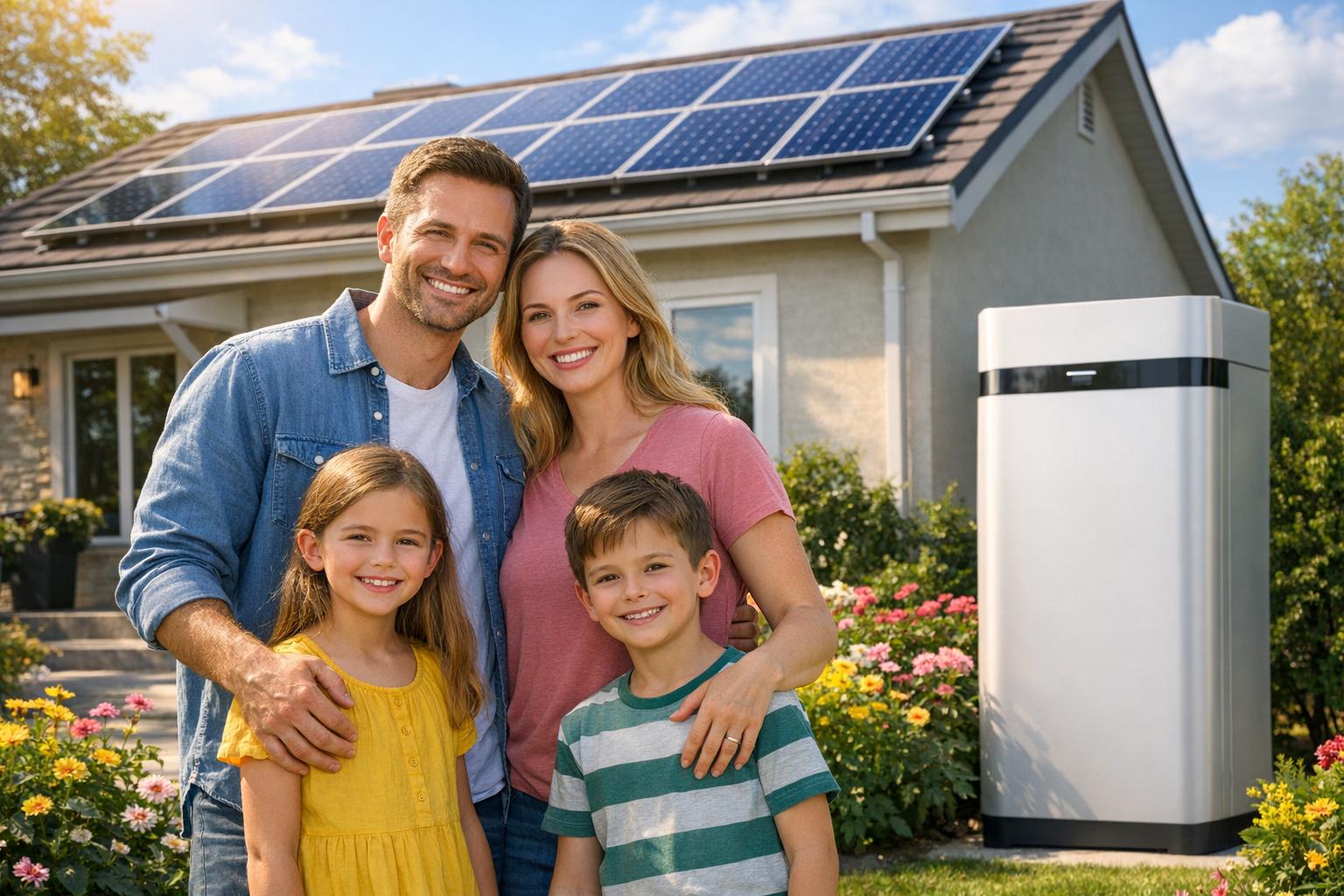
Energy independence means producing and storing your own electricity, reducing or eliminating reliance on the national grid. For families in Northern Ireland, this often involves installing solar panels with battery storage to generate and store power. This approach shields households from rising energy costs, ensures a stable power supply, and supports Northern Ireland’s goal of achieving net-zero emissions by 2050.
Key Takeaways:
- Rising Costs: Average energy bills in Northern Ireland exceed £2,000 annually, with electricity prices tied to volatile gas markets.
- Solar Savings: A 4kW solar system can generate 3,400 kWh per year, covering most household needs, saving around £514–£1,178 annually.
- Battery Storage: Adding a 10kWh battery increases energy efficiency, reducing reliance on grid power during evenings and nights.
- Incentives: Zero per cent VAT on solar installations and export payments for surplus electricity make solar systems more affordable.
- Environmental Impact: Solar systems reduce carbon emissions by up to one tonne per year, contributing to cleaner energy goals.
Next Steps: Assess your energy needs, evaluate your roof’s suitability, and explore solar and battery options. Companies like EECO Energy offer tailored solutions starting at £3,950, with systems paying for themselves in 10–13 years. For a free quote, contact EECO Energy at 028 9592 2730 or email hello@eeco.energy.
Solar Energy Savings and Benefits for Northern Ireland Families
The Problem: Rising Costs and Grid Reliance in Northern Ireland
Electricity Price Trends and Family Budgets
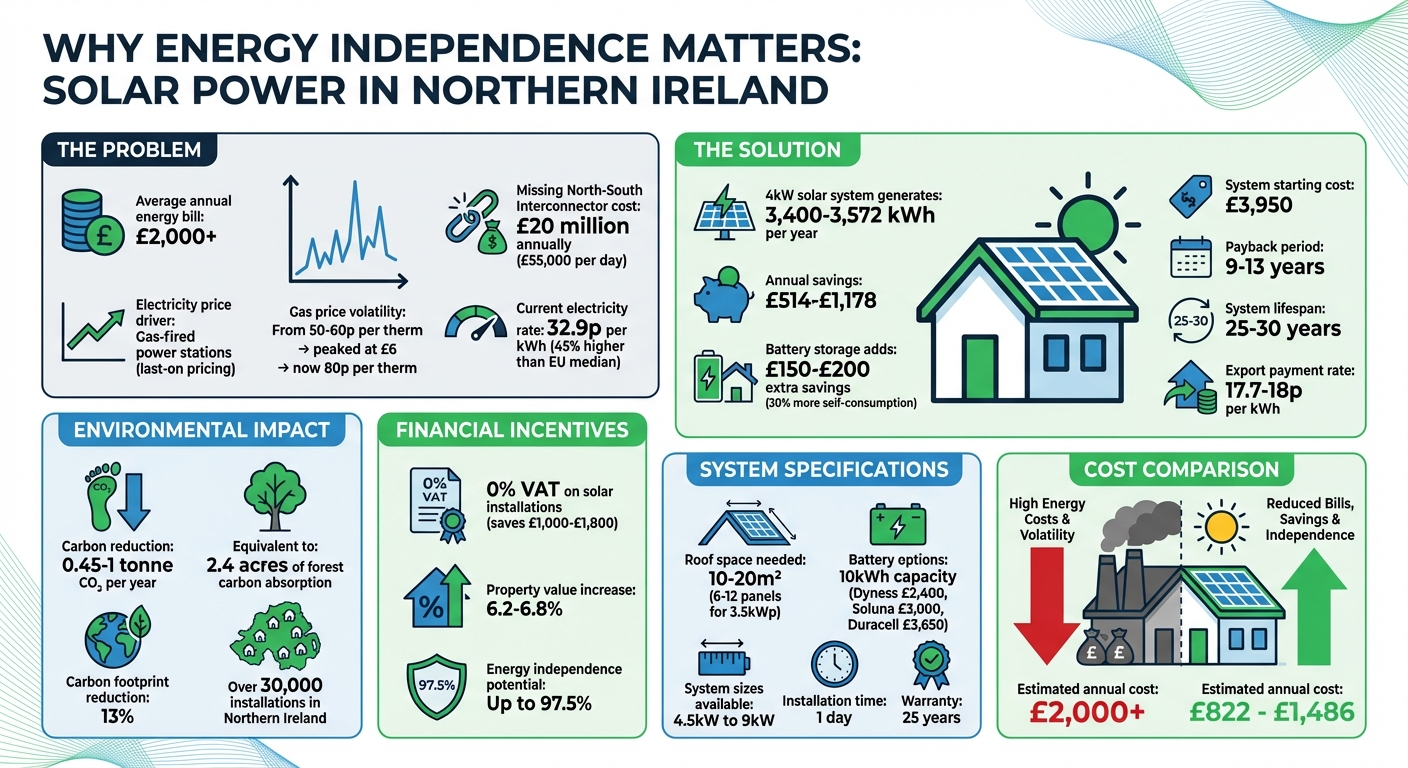
For households in Northern Ireland, energy costs are a significant burden. The average combined electricity and gas bill exceeds £2,000 annually. While electricity prices in Northern Ireland have historically been lower than those in Great Britain and the Republic of Ireland, families still face unpredictable price swings. The way electricity pricing works is a major factor. John French, Chief Executive of the Utility Regulator, explains:
It is the generating plant that is ‘last on’ that sets the price, which normally, in the all-island market, is a gas-fired power station. Therefore, it is the cost of natural gas which sets the price of electricity in Northern Ireland.
The surge in international gas prices following the invasion of Ukraine was a stark example. Prices skyrocketed from 50–60p per therm to as high as £6 per therm, sending household bills soaring. Although prices have now stabilised around 80p per therm as of early 2026, the wholesale market remains volatile due to ongoing global tensions.
Electricity bills in Northern Ireland encompass several components: wholesale generation, network transmission and distribution (including green levies), and supply costs. A drop in energy consumption can lead to higher per-unit network charges, as the Utility Regulator points out:
The total network costs do not vary by large amounts year on year, however if consumption levels fall, the network charge per unit of energy consumed will rise.
This pricing structure and market volatility highlight the challenges of relying heavily on the grid.
The Downsides of Grid Dependence
The fluctuating costs of grid electricity expose families to financial uncertainty and limit their ability to manage energy expenses. Northern Ireland’s reliance on gas-fired power stations for baseload electricity means that even when wind and solar contribute over 40% of the region’s power, the overall price is still dictated by the cost of natural gas. This leaves households vulnerable to spikes in global energy prices.
Infrastructure shortcomings exacerbate the issue. For instance, the absence of the North-South Interconnector – a project designed to enhance electricity flow between Northern Ireland and the Republic of Ireland – costs consumers over £20 million annually, equating to roughly £55,000 each day. Stability in the electricity grid currently depends on conventional power stations, which provide the inertia needed to maintain balance. Until advanced technologies like long-duration battery storage and synchronous compensators are widely implemented, families remain tied to fossil fuels and the costs that come with them. These challenges make it clear that practical alternatives are urgently needed.
Northern Ireland’s Renewable Energy Situation
There is a glimmer of hope in Northern Ireland’s renewable energy ambitions, but the benefits have yet to filter down to household budgets. The region has committed to sourcing at least 80% of its electricity from renewables by 2030. While this is an encouraging step forward, families continue to pay retail electricity prices that reflect the cost of maintaining traditional transmission infrastructure.
Even under the revised market design introduced in October 2018, which saved consumers over £200 million in capacity costs during its first year, prices are still tied to the marginal cost of gas-fired power stations. The Single Electricity Market, which operates across the island of Ireland, bases prices on the cost of the last generator needed to meet demand – typically a gas-fired station.
For families seeking control over their energy bills and greater security, generating and storing their own power presents a practical way to reduce reliance on the grid.
The Solution: Solar Panels and Battery Storage
How Solar PV and Battery Systems Work
Solar PV panels capture sunlight and convert it into DC electricity, which is then transformed into AC power by an inverter to run your household appliances. Even on cloudy days, solar panels continue to generate electricity, ensuring a steady source of energy. Typically, a 3.5kWp system will need between 10 and 20m² of roof space, consisting of 6 to 12 panels.
By storing excess energy in batteries, homeowners can save about 14p per unit when using that stored power during the night. This stored energy can also fuel integrated EV chargers, making it a versatile solution. Combining solar panels with battery storage allows households to operate more efficiently, reducing their dependence on electricity from the grid.
In Northern Ireland, all solar installations must be registered with NIE Networks, the region’s Distribution Network Operator. Solar systems require minimal upkeep – panels should remain unshaded and may need occasional cleaning to remove debris. On average, a home solar system can save approximately one tonne of carbon dioxide emissions each year.
These systems offer a practical way for households to achieve energy independence, with companies like EECO Energy providing tailored solutions to make the transition seamless.
EECO Energy‘s Solar and Battery Systems
EECO Energy specialises in MCS-accredited solar PV and battery installations throughout Northern Ireland, offering a 25-year warranty for peace of mind. Their solar PV systems range from around 4.5kW to 9kW, with compatible battery options starting at approximately £3,950. Installations are efficient, often completed within a single day. This setup helps households combat rising electricity costs while enhancing energy security.
EECO Energy also provides free surveys and quotes, making it easier for homeowners to explore their options. For those not ready to install batteries immediately, hybrid inverters are available, allowing for simple integration of storage solutions later. To maximise efficiency, solar panels should ideally be installed on south-facing pitched roofs at an angle of 30° to 40°, although east or west-facing roofs can also deliver good results.
Financial Support and Incentives
Thanks to the Windsor Framework, homeowners in Northern Ireland can take advantage of a zero per cent VAT rate on solar installations. Additionally, surplus electricity can be sold back to the grid at fixed export rates, providing an extra source of income. As nidirect explains:
Under the Windsor Framework, the VAT relief for energy-saving materials, previously available only in Britain, has been extended to Northern Ireland. This means that installations of energy-saving materials, including solar panels and heat pumps, now benefit from a zero rate of VAT.
Your installer will handle the registration of your system with NIE Networks, enabling you to receive export payments. In Belfast, the payback period for a solar system with export payments typically ranges from 9 years for households occupied during the day to 13 years for those only home in the evenings.
With these financial incentives and support systems in place, transitioning to solar energy has never been more accessible, offering families a chance to embrace a more self-sufficient energy lifestyle.
How to Transition to Energy Independence
Evaluating Your Energy Needs
Start by examining your annual electricity bills to establish your baseline energy consumption in kilowatt-hours (kWh). On average, UK households use about 3,800 kWh per year, though your actual usage will depend on factors like family size and lifestyle.
Next, take a close look at your roof’s suitability for solar panels. Ideally, a south-facing roof with a pitch between 30° and 40° will yield the best results. However, east- and west-facing roofs can still perform well. Make sure your roof is structurally sound and free from significant shading. If you’re planning for future energy needs – like an electric vehicle (EV) charger (approximately 2,000 kWh) or a heat pump (around 3,200 kWh) – factor those into your calculations.
Once you’ve assessed your energy usage and roof potential, you can determine the system size that aligns with your needs.
Selecting the Right System Size
Using your energy assessment, decide on a solar system capacity that meets both your current and future demands. For most average households, a 4kW solar PV system will cover the essentials. If you anticipate higher energy usage, such as charging an EV or running a heat pump, larger systems – ranging from 5.4kW to 9kW – may be a better option.
EECO Energy offers tailored solutions for homes in Northern Ireland, with systems sized between 4.5kW and 9kW. Battery storage is another key consideration. A 10kWh battery is typically enough to meet evening and night-time electricity needs for most homes. EECO Energy provides three battery options:
Each of these batteries has a 10kWh capacity.
To future-proof your system, install a hybrid inverter. This allows you to add battery storage later without needing to replace the entire system. Additionally, it’s often more cost-effective to maximise your roof space during the initial installation. Adding extra panels later can increase costs due to additional scaffolding and labour requirements.
Adding EV Chargers and Smart Controls
After setting up your solar and storage system, you can enhance its functionality with EV chargers and smart controls. By integrating an EV charger with your solar panels, you can power your vehicle directly from your rooftop energy. Smart controls take things further by directing surplus energy to heat your water or power high-usage appliances.
In Northern Ireland, all systems must comply with the EREC G98/NI standard and be registered with NIE Networks.
sbb-itb-d2d975a
Long-Term Benefits for Families and the Environment
Cost Savings and Payback Periods
In the UK, solar and battery systems generally pay for themselves within 12–14 years, while solar-only setups in Northern Ireland can break even in just 9.7 years. Once this payback period is over, households enjoy minimal energy costs for the remainder of the system’s 25–30-year lifespan.
For a typical 4kWp system, annual savings in Northern Ireland range from £514 to £1,178, with larger systems often exceeding £1,000. Adding a battery can increase these savings by an additional £150 to £200 per year by allowing households to use around 30% more of the energy they generate.
Given that electricity in Northern Ireland costs approximately 32.9p per kWh – about 45% higher than the EU median – generating your own power becomes an appealing way to protect your finances from future price hikes. Plus, you can earn extra income by exporting surplus energy to the grid. Providers like Power NI and Action Renewables currently pay rates of around 17.7–18p per kWh.
"The typical payback period is 10–13 years, depending on battery use. Batteries can increase savings by up to 30%."
– Ben Price, Renewables Expert & Co-Founder, Heatable
The government’s 0% VAT on solar installations, available until March 2027, offers additional savings of £1,000 to £1,800 for Northern Ireland households. On top of that, Barclays mortgage holders may qualify for a £1,000 cashback through the Greener Home Reward scheme.
Beyond these financial perks, solar and battery systems also deliver meaningful environmental benefits.
Reducing Carbon Emissions
A standard 4kWp solar system in Belfast generates around 3,572 kWh of clean electricity annually. This translates to a 13% reduction in a household’s carbon footprint, cutting 0.45–1 tonne of CO₂ emissions each year. To put that into perspective, this is roughly equivalent to the carbon absorbed by 2.4 acres of forest annually.
"Solar panels can lower your carbon footprint substantially because they deliver cleaner energy for decades."
– Ohk Energy
Northern Ireland’s push towards net-zero carbon emissions by 2050 is already supported by over 30,000 solar installations in the region. Modern solar panels are built to last, with 25-year product warranties and 30-year performance warranties. Even after 25 years, many panels retain nearly 90% of their original output. By generating renewable energy on-site, households reduce reliance on fossil fuels and contribute to a more resilient, low-emission energy system.
Benefits and Trade-Offs
While solar and battery systems offer many advantages, it’s important to weigh the benefits against the trade-offs.
| Aspect | Benefits | Trade-Offs |
|---|---|---|
| Financial | Shields against rising energy costs; free electricity after payback period; can increase property value by 6.2–6.8% | High upfront costs (£4,850–£13,000); inverter replacement every 7–12 years |
| Environmental | Reduces carbon emissions; supports NI’s 2050 net-zero goals; decreases air pollution | Energy used in manufacturing (offset within 1–3 years) |
| Practical | Improves energy security (especially with a battery); long lifespan with minimal maintenance | Weather-dependent output; lower efficiency in winter; requires adequate roof space |
| Energy Independence | Protects against tariff increases; takes advantage of cheaper night-time rates with battery storage | Still relies on the grid during low solar output periods |
Interestingly, Northern Ireland’s moderate climate actually benefits solar panels by preventing overheating, which can enhance efficiency compared to hotter regions. Despite its reputation for grey skies, the region only receives about 5% less sunshine than the UK average, making solar an effective option.
When you combine the financial savings with the environmental impact, it’s clear that solar energy offers a strong case for moving towards greater energy independence.
Conclusion: Taking the Next Step Towards Energy Independence
Energy independence isn’t just about saving money – it’s about protecting your family from unpredictable price hikes, reducing your environmental impact, and taking charge of your energy future. As Steve Golemboski-Byrne from Lackan Cottage Farm explained, "Part of our thinking was, ‘I don’t want to wake up one morning and find out our electricity bill has doubled’. I didn’t really think it would happen". Unfortunately, in early 2022, electricity suppliers in Northern Ireland raised bills by as much as 30%.
Investing in a 4kW solar system with battery storage can bring families closer to energy self-sufficiency – up to an impressive 97.5%. The Swansea Retrofit Project is a great example of what’s possible. By installing solar panels, battery storage, and improving insulation, households saw their annual energy costs plummet from £1,500–£2,000 to just £500. These numbers speak for themselves, showing how renewable energy can make a real difference.
Getting started is easier than you might think. Begin by reviewing your annual energy bills and assessing whether your roof is suitable for solar panels. Claire Golemboski-Byrne emphasises, "Simply becoming more proactive about monitoring your energy use is a key first step towards reducing it". Small changes like this can pave the way for bigger, renewable solutions.
For families in Northern Ireland, EECO Energy provides expert advice to help you find the right system for your needs. With installation costs starting at £3,950 for a 4.5kW system that produces around 3,380kWh per year, energy independence is both achievable and affordable. To take the next step, contact EECO Energy at 028 9592 2730 or email hello@eeco.energy for a free quote and start building a more secure energy future.
FAQs
How do solar panels and battery storage help lower energy bills?
Solar panels work by turning sunlight into electricity. They use photovoltaic (PV) cells to create direct current (DC), which is then converted into alternating current (AC) by an inverter to power your home. If your system generates more electricity than you need, the surplus can be stored in a battery rather than sent back to the grid.
Having a battery means you can save this extra energy and use it later, such as in the evening or during peak electricity pricing. This can help households cut energy costs and avoid the impact of rising electricity rates. For a typical UK household consuming about 3,800 kWh of electricity per year, a well-matched solar and battery system can meet a significant portion of that demand.
Even when it’s overcast, solar panels still produce some electricity. Combined with a battery, they offer a more dependable energy supply. This setup not only helps reduce energy bills but also boosts energy independence and lowers your carbon footprint, supporting a greener, more sustainable lifestyle.
What financial support is available for installing solar panels in Northern Ireland?
Families in Northern Ireland have access to several financial supports that make installing solar panels more budget-friendly. One key initiative is the Northern Ireland Sustainable Energy Programme (NISEP), which allocates funding from an annual £8 million pot. This programme provides grants for renewable energy solutions, including solar panels, specifically aimed at eligible households and low-income homeowners to help ease the upfront financial burden.
On top of this, the UK government offers a reduced VAT rate of 5% for solar panel installations, cutting down the initial costs even further. After installation, there’s also the opportunity to benefit from the Smart Export Guarantee (SEG). This scheme allows homeowners to earn money by selling any surplus electricity their solar panels generate back to the grid. Not only does this create a new income stream, but it also shortens the time it takes to recoup your investment.
These combined incentives make it more feasible for families to adopt solar energy, lower their energy bills, and shield themselves from the impact of rising electricity costs.
How can families in the UK determine if their home is suitable for solar panels?
To determine if your home is ready for solar panels, start by evaluating your roof’s orientation and shading. A south-facing roof with little to no shading is the most efficient for solar energy production. However, east- or west-facing roofs can still generate power, though at slightly reduced levels. Make sure your roof is in good shape and has enough space – typically around 20–30 m² is needed for a 4 kW system.
Next, take a look at your household’s electricity usage. Check your recent energy bills to estimate your annual consumption in kilowatt-hours (kWh). This will help you figure out the size of the solar system that fits your needs. After that, schedule a professional home survey with a certified installer. They’ll assess key factors like your roof’s structural integrity, sunlight exposure, and system compatibility.
If your roof gets plenty of sunlight, is structurally sound, and aligns with your energy requirements, you’re on track to making solar power a part of your home.