
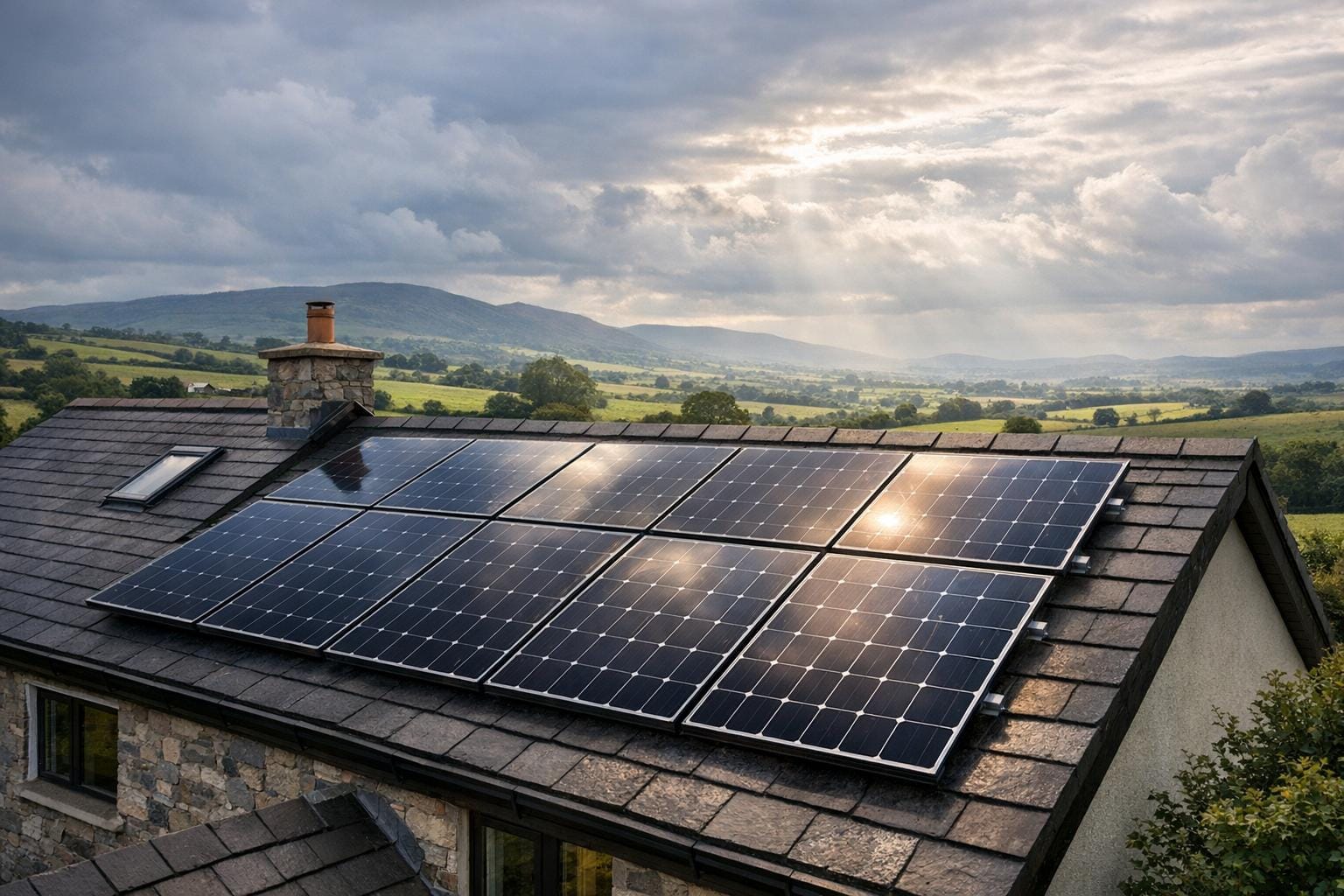
Northern Ireland may not seem like an obvious location for solar power due to its cloudy skies and frequent rain. However, the reality is different. Modern solar panels work efficiently with daylight, not just direct sunlight, making them suitable for this climate. Here’s what you need to know:
- Cloudy weather isn’t a problem: Solar panels capture diffuse light, allowing them to generate electricity even on overcast days. Performance may dip slightly, but they still produce power.
- Cooler temperatures improve efficiency: Unlike hot climates, Northern Ireland’s mild weather prevents overheating, ensuring steady energy production throughout the year.
- Winter energy generation: Solar panels continue to work during winter, producing 15%–30% of their annual output between November and February.
- Financial benefits: Households can save around £513 annually on electricity bills, with systems paying for themselves in under 10 years. Over 25 years, net savings could reach £7,841.
With over 30,000 solar installations already in place, the adoption of solar energy in Northern Ireland is steadily growing. Despite 5% less annual sunshine compared to the UK average, solar panels remain a practical and cost-effective choice for both homes and businesses.

Solar Panel Performance and Savings in Northern Ireland: Key Statistics
Myth 1: Northern Ireland is Too Cloudy for Solar Panels
One of the biggest misconceptions about solar power in Northern Ireland is that the region’s cloudy weather renders solar panels ineffective. This idea stems from the assumption that panels need constant, direct sunlight – like you’d find on a sunny beach in the Mediterranean. But here’s the truth: solar panels work with daylight, not just direct sunlight.
This distinction is key. Solar panels capture photons from daylight, which are present even when the sky is overcast. Whether it’s a bright, sunny day or a grey, cloudy one, photovoltaic cells are still hard at work converting light into electricity. Let’s break down how this works in real-world conditions.
Fact: Solar Panels Work with Diffuse Light
Clouds don’t block light entirely; instead, they scatter it. This scattered light, known as diffuse light, is still enough to power solar panels. Even on overcast days, panels can operate at 10–25% of their capacity, and on partly cloudy days, they can reach 50–80% efficiency. So, while performance may dip slightly during cloudy weather, the panels still generate meaningful electricity.
Northern Ireland’s weather even has some hidden perks for solar panels. The frequent rain naturally cleans the panels, keeping them free of dirt and debris. Plus, the cooler temperatures help prevent overheating, ensuring consistent performance. On a clear day, a single square metre of silicon panels can generate about 150W of power.
There’s also a phenomenon called the "Edge-of-Cloud Effect", where sunlight intensifies along the edges of clouds. This can temporarily boost the output of your panels, providing an unexpected energy spike.
So, while Northern Ireland may not have the sunny skies of southern Europe, its daylight – and even its weather quirks – make solar panels a practical and efficient choice.
Myth 2: Solar Panels Need Hot Weather to Work Properly
There’s a common misconception that solar panels need scorching hot weather to function well. The truth is, they rely on sunlight, not heat – and too much heat can actually reduce their efficiency.
Fact: Cooler Temperatures Improve Panel Performance
Solar panels generate electricity using photons from sunlight, not the surrounding temperature. Interestingly, cooler weather can enhance their performance. When temperatures rise, the electrical resistance in photovoltaic cells also increases, which lowers their energy output. Essentially, solar panels, like most electronic devices, perform better when they stay cool.
High heat may actually cause solar panels to work less efficiently.
Northern Ireland’s mild climate is ideal for solar panels, as it reduces the risk of overheating. While areas with hotter climates might enjoy more direct sunlight, they often face efficiency losses due to heat-induced voltage drops. In contrast, the cooler temperatures in Northern Ireland help solar panels maintain steady and efficient energy production throughout the day.
Even with about 5% less annual sunshine compared to the UK average, a typical 5.2kW solar system in Northern Ireland can still produce over 4,000 kWh of electricity annually . This demonstrates that a combination of adequate sunlight and cooler conditions ensures dependable energy generation.
Myth 3: Solar Panels Don’t Work in Winter
It’s a common belief that solar panels become practically useless during the colder months in Northern Ireland. With shorter days and overcast skies, it’s easy to assume that energy production grinds to a halt. But here’s the truth: solar panels still work during winter.
Fact: Solar Panels Generate Energy Even in Winter
Solar panels don’t rely on heat or direct sunlight to function – they depend on daylight. Modern panels, especially monocrystalline ones, are designed to capture diffuse light, which is the sunlight scattered through clouds and fog. So, even on the gloomiest December day, your panels are quietly generating electricity. Let’s dig into the numbers to see how they perform.
A standard 4kW solar system in Northern Ireland can produce between 150 and 200 kWh during December and January, increasing to 200–250 kWh by February. This offsets around 20% to 25% of a household’s energy needs during the winter months. Over the entire November-to-February period, solar panels typically deliver 15% to 30% of their annual energy output.
Interestingly, colder temperatures can actually boost solar panel efficiency. For every degree below 25°C, output increases by about 0.4% to 0.5%. On a chilly January day, with temperatures around 5°C, panels can exceed their rated output by 5–10% because lower temperatures reduce electrical resistance. Even on cloudy days, production doesn’t stop – output usually drops by only 15% to 25% compared to clear skies.
Battery storage becomes particularly valuable in winter. By charging your batteries during off-peak night-time hours and using stored energy during expensive daytime rates, you can make the most of your system. Running high-energy appliances between 10 AM and 2 PM further optimises this benefit.
So, even in the depths of winter, solar panels remain a reliable and efficient energy source.
sbb-itb-d2d975a
Financial Benefits of Solar Power in Northern Ireland
Solar power in Northern Ireland isn’t just about generating energy – it’s also about saving money. For a typical three-bedroom home, switching to solar can reduce electricity bills by around £513 per year, with the system paying for itself in roughly 9.7 years. Over a 25-year lifespan, homeowners could see a net profit of £7,841.
Thanks to Northern Ireland’s 0% VAT rate on solar installations, upfront costs are reduced by £1,000–£1,800, making solar an even more attractive investment.
Performance Data for Northern Ireland
Despite its reputation for overcast weather, Northern Ireland receives 1,000 to 1,100 kWh/m² of solar radiation annually – just 5% less than the UK average. This slight difference doesn’t significantly impact solar panel efficiency. In fact, cooler temperatures help prevent overheating, ensuring consistent performance. A standard 4kW system can generate enough electricity to cover a large portion of household energy needs.
Here’s how solar systems perform across different home sizes:
| Home Type | System Size | Annual Output | Annual Savings | Break-even Point |
|---|---|---|---|---|
| 1-2 Bedrooms | 2.1 kWp (6 panels) | ~2,100 kWh | £308 | 9.7 years |
| 3 Bedrooms | 3.5 kWp (10 panels) | ~3,500 kWh | £514 | 9.7 years |
| 4+ Bedrooms | 4.9 kWp (14 panels) | ~4,900 kWh | £719 | 9.7 years |
This data highlights the efficiency and cost-effectiveness of solar systems, even in Northern Ireland’s climate.
EECO Energy Pricing and Solutions
EECO Energy offers solar packages designed specifically for homes in Northern Ireland. Their systems come with 25-year warranties and MCS accreditation, ensuring reliability and peace of mind. Installation is quick, typically completed in just one day, and they provide free surveys and quotes anywhere in Northern Ireland.
| System Size | Number of Panels | Annual Output (kWh) | Price |
|---|---|---|---|
| 4.5 kWp | 10 | 3,380 | £3,950 |
| 5.4 kWp | 12 | 4,400 | £4,350 |
| 7.2 kWp | 16 | 6,189 | £4,850 |
| 8.1 kWp | 18 | 6,685 | £5,700 |
| 9.0 kWp | 20 | 7,099 | £5,900 |
To make the most of your solar setup, EECO Energy also offers battery storage options. These batteries store excess energy produced during the day, allowing you to use it during peak-rate hours, which helps maximise savings. Options include:
With these solutions, homeowners can enjoy greater energy independence and long-term financial benefits.
Conclusion: The Facts About Solar Energy in Northern Ireland
Despite its reputation for cloudy skies, Northern Ireland proves to be a reliable place for solar power. Thanks to modern technology, solar panels can efficiently harness diffuse light, perform well in cooler climates, and remain effective even during the winter months. In fact, Northern Ireland gets just 5% less sunshine annually compared to the UK average.
The financial advantages are equally compelling. Solar installations can lead to annual savings of around £513, benefit from 0% VAT on installation, and typically offer a payback period of less than 10 years. Over 25 years, the net profit can reach an impressive £7,841. The surge in installations – from almost none in 2016 to nearly 30,000 projected by late 2025 – shows how both homeowners and businesses are already seeing these benefits.
Solar energy isn’t just about cutting costs; it also reduces carbon emissions and has the potential to boost property value. Whether you’re looking to lower your household energy bills or seeking long-term savings for your business, the evidence makes a strong case for solar power as a worthwhile investment.
FAQs
Can solar panels still work effectively in cloudy weather in Northern Ireland?
Yes, solar panels can perform well even in cloudy conditions, making them a practical option for Northern Ireland’s famously grey skies. They work by converting light into electricity, not heat, so they’re effective even in cooler, overcast weather. Modern photovoltaic (PV) cells are built to capture both direct sunlight and the scattered light that filters through clouds, allowing them to achieve around 50–75% of their peak output on cloudy days.
In fact, cooler temperatures can actually boost solar panel efficiency by minimising energy losses in the system. Plus, rain plays a helpful role by cleaning off dust and debris that might otherwise block sunlight. So, despite Northern Ireland’s unpredictable weather, solar panels remain a dependable choice for generating electricity at home.
What are the cost-saving benefits of installing solar panels in Northern Ireland?
Installing solar panels on your home in Northern Ireland can be a smart way to cut down on electricity bills. A standard 4 kW system typically produces between 3,400 and 4,200 kWh of electricity each year, which is enough to cover around 60–80% of the energy needs for an average household. This can save you approximately £500–£900 annually. Over a span of 25 years, these savings could add up to a net profit of £7,800–£8,000, with most homeowners recouping their initial investment within 5–7 years.
Although there aren’t specific solar grants available in Northern Ireland, you can still take advantage of 0% VAT on installation costs. Additionally, schemes like the Barclays Greener Home Reward may help reduce upfront expenses. With Northern Ireland receiving about 1,600 hours of sunlight each year, solar panels not only help lower energy costs but can also boost your property’s value while contributing to renewable energy initiatives.
Do solar panels work effectively during winter in Northern Ireland?
Yes, solar panels can generate electricity even during the winter months. Although the shorter days and cloudier skies of winter mean they produce less energy compared to the summer, colder temperatures can actually make solar panels work more efficiently.
In Northern Ireland’s winter climate, solar panels are built to capture daylight rather than relying solely on direct sunlight. This means they can still produce energy on overcast days. While the output may be lower, they remain a dependable and environmentally friendly energy source throughout the year.