Thinking about solar panels in Northern Ireland? Here’s what you need to know:
- A typical 3-bedroom home can save £513 annually on energy bills, totalling £7,841 over 25 years.
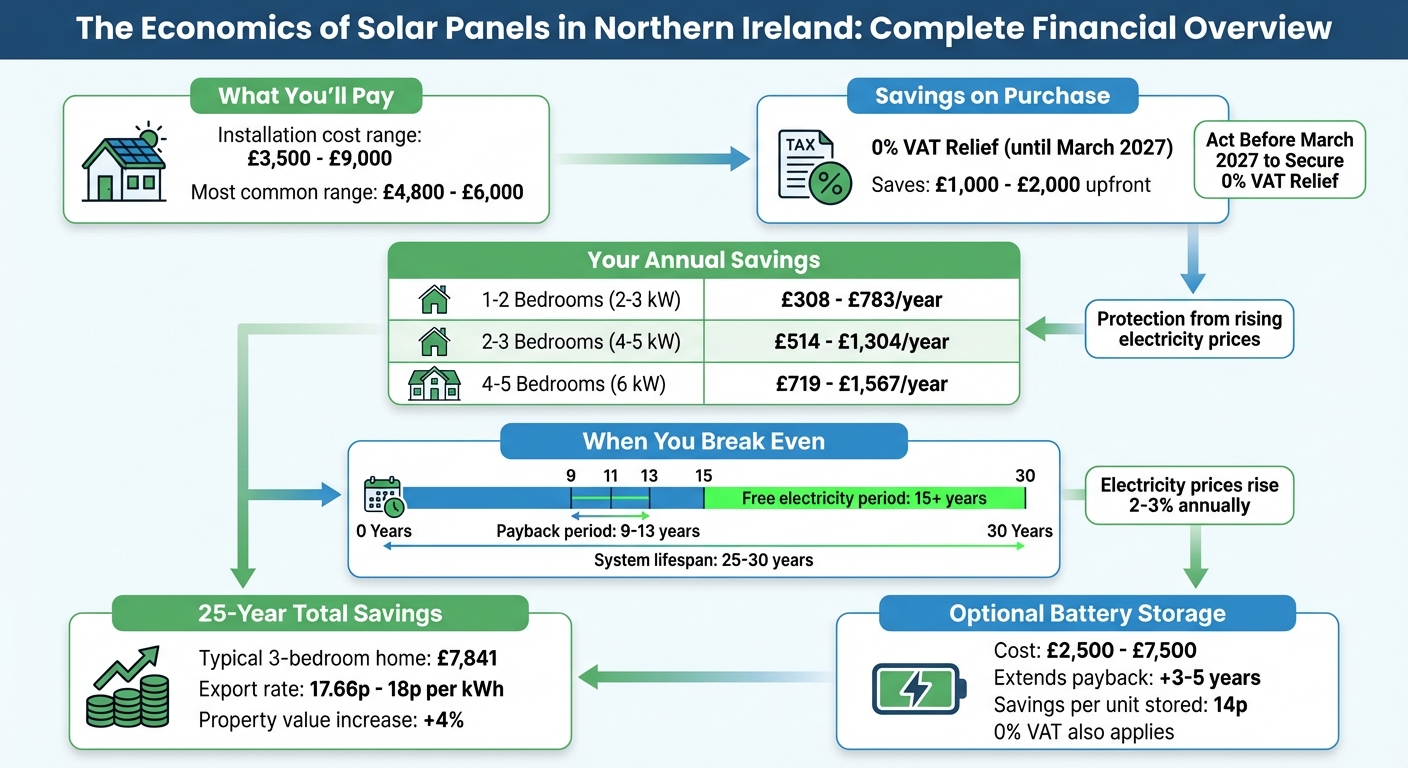
- Installation costs range from £3,500 to £9,000, with most systems priced between £4,800 and £6,000.
- 0% VAT relief on solar installations (valid until March 2027) can save homeowners £1,000–£2,000 upfront.
- Sell surplus energy back to the grid for 17.66p–18p per kWh, adding to your savings.
- The average payback period is 9–13 years, leaving 15+ years of free electricity from a system that lasts 25–30 years.
Key benefits include: reduced energy bills, protection from rising electricity prices, and the option to add battery storage for greater efficiency. Northern Ireland’s cooler climate and government incentives make solar a smart choice for long-term savings.
Solar Panel Costs and Savings for Northern Ireland Homes
Initial Costs of Solar Panel Systems
In Northern Ireland, the initial cost of installing solar panels typically ranges from £3,500 to over £9,000, depending on the system’s size and how complex the installation is. For most residential systems, the price sits between £4,800 and £6,000, with a standard 3.5kW system costing around £4,800.
Getting an accurate estimate is essential for planning your budget. The total cost is influenced by several factors, including the number of panels, the quality of the components, and how straightforward or challenging it is to install the system on your roof.
System Costs by Size
EECO Energy provides solar systems designed to suit various household needs. While the industry often uses a 3.5kW system as a baseline, EECO Energy’s offerings start at 4.5kW for smaller homes with modest energy requirements and go up to 9kW for larger properties.
| System Size | Number of Panels | Annual Output (South-Facing) | Price |
|---|---|---|---|
| 4.5 kW | 10 | 3,380 kWh | £3,950 |
| 5.4 kW | 12 | 4,400 kWh | £4,350 |
| 7.2 kW | 16 | 6,189 kWh | £4,850 |
| 8.1 kW | 18 | 6,685 kWh | £5,700 |
| 9 kW | 20 | 7,099 kWh | £5,900 |
Larger systems tend to offer better value per watt, thanks to economies of scale. For instance, upgrading from a 4.5kW system to a 9kW system increases electricity generation significantly but adds only £1,950 to the total cost.
It’s important to remember that the panels themselves are just one part of the overall expense. Installation and additional equipment can also make up a significant portion of the final price.
Installation and Additional Equipment Costs
A complete solar panel system includes more than just the panels. Key components such as the inverter (which converts DC electricity into AC for household use) and the mounting system (which secures the panels to your roof) are essential. Additional costs come from electrical connections and safety equipment needed to complete the setup.
The complexity of your roof can also impact the final price. For instance, a simple, south-facing roof with good access will keep costs lower. On the other hand, roofs with tricky angles or limited accessibility can add between £500 and £1,500 to the total. This figure includes scaffolding costs (ranging from £300 to £800) and potential electrical upgrades (also £300 to £800).
Most installations take about one to two days to complete. To save money, it’s worth comparing at least three quotes – doing so could reduce your costs by as much as £800.
sbb-itb-d2d975a
Government Incentives and VAT Relief
Residents of Northern Ireland can take advantage of financial benefits when installing solar panels, with the standout incentive being the 0% VAT rate. This tax relief is automatically applied to qualifying installations and can save homeowners between £1,000 and £2,000 on upfront costs.
0% VAT on Solar Panels
Since 1 May 2023, homeowners in Northern Ireland have been exempt from paying VAT on the supply and installation of solar panels and storage batteries, provided the same company handles both the supply and installation. This exemption is set to expire on 31 March 2027, after which VAT will increase to 5%. Acting before this deadline could save homeowners an extra £565 on a typical system costing £11,307.
This 0% VAT policy can significantly reduce the time it takes for a solar system to pay for itself, cutting the financial payback period by roughly one year. For an entry-level installation, this equates to savings of about £1,000. Additionally, as of February 2024, standalone or retrofitted batteries are also covered by this VAT relief, even if installed separately from solar panels.
Northern Ireland Sustainable Energy Programme (NISEP) Grants

Besides VAT relief, other programmes exist to support green investments, although their benefits vary depending on the sector.
The Northern Ireland Sustainable Energy Programme (NISEP) is an £8 million fund raised through a public service obligation on electricity customers. While the programme has been extended through March 2027, its grants are currently focused on businesses. Businesses in Northern Ireland can receive grants covering up to 20% of installation costs for green technologies, including solar panels. However, for domestic customers, 80% of NISEP’s funding is allocated to vulnerable households, focusing on energy efficiency measures like insulation and boiler upgrades rather than solar installations.
For residential homeowners, the 0% VAT rate remains the main financial incentive. However, low-income households or those receiving certain benefits may qualify for additional support through the UK-wide ECO4 scheme, which offers up to £10,000 in funding for energy efficiency improvements.
| System Size | Pre-Incentive Cost (20% VAT) | Post-Incentive Cost (0% VAT) | VAT Savings |
|---|---|---|---|
| 4 kW | £5,999 | £4,999 | £1,000 |
| 5 kW | £8,400 | £7,000 | £1,400 |
| 6 kW | £10,800 | £9,000 | £1,800 |
These financial incentives are a crucial factor in reducing the payback time for solar systems, as explored further in the next section on annual savings and energy bill reductions.
Annual Savings and Energy Bill Reductions
Solar panels help cut energy costs by using sunlight to power your home. The amount you save depends on factors like your energy use, the size of your solar system, and how much of the generated energy you use directly. Let’s break down how your home size and system capacity can shape these savings.
Savings by Home Size and Solar System
In Northern Ireland, annual savings from solar panels range between £308 and £1,567, depending on the size of your home and the system installed. For a typical 2-3 bedroom house with a 4-5 kW system, yearly savings fall between £514 and £1,304. Larger homes, such as those with 4-5 bedrooms and a 6 kW system, can see savings climb as high as £1,567 per year.
| Home Size | Typical System Size | Annual Generation (Est.) | Est. Annual Savings |
|---|---|---|---|
| 1-2 Bedrooms | 2 kW – 3 kW | 1,700 – 2,550 kWh | £308 – £783 |
| 2-3 Bedrooms | 4 kW – 5 kW | 3,400 – 4,250 kWh | £514 – £1,304 |
| 4-5 Bedrooms | 6 kW | 5,100 kWh | £719 – £1,567 |
Additionally, any excess energy you produce but don’t use can be sold back to the grid at rates between 17.66p and 18p per kWh. To maximise your savings, consider running energy-intensive appliances like washing machines or dishwashers during daylight hours, ideally between 10 a.m. and 4 p.m..
Protection from Rising Electricity Prices
Solar panels offer more than just immediate savings – they also help shield you from the rising costs of electricity. Once installed, your system effectively locks in a fixed electricity rate based on its initial cost. With electricity prices historically increasing by 2-3% annually, this means your savings will grow over time.
In Northern Ireland, electricity prices are closely tied to global fossil fuel markets, which can be volatile. Solar energy eliminates this uncertainty. With systems lasting over 25 years, you can expect around 15 years of nearly free electricity once the system has paid for itself. This makes solar panels worth it in Northern Ireland as a long-term safeguard against future price hikes, turning your investment into a reliable buffer against unpredictable energy costs.
Battery Storage Options and Additional Costs
A battery system allows you to store any extra solar energy your panels generate, so you can use it later when your system isn’t producing as much power. In Northern Ireland, the cost of solar batteries generally ranges between £2,500 and £7,500, depending on the size of the system. However, it’s worth noting that installing a battery can extend the payback period of your solar setup by an additional 3–5 years.
The upside is clear: each unit of electricity stored and used from a battery instead of buying it from the grid saves you around 14p. As of February 2024, residential solar batteries in Northern Ireland benefit from 0% VAT relief, making them a more attractive option. Most modern batteries are designed to last 10 to 15 years, about half the lifespan of solar panels. While adding a battery is a financial commitment, it can significantly enhance the effectiveness of your solar system.
Battery Prices and Benefits Comparison
EECO Energy provides three battery options specifically designed for Northern Ireland households. The Dyness 10kW battery, priced at £2,400, offers an affordable starting point. For a mid-range option, the Soluna 10kW battery is available for £3,000, striking a balance between cost and performance. At the higher end, the Duracell 10kW battery costs £3,650, catering to those seeking a premium-quality solution.
If you opt for a bundled installation, you can reduce your overall costs. While lithium-ion batteries are more expensive – costing roughly £4,000 compared to £2,000 for lead-acid batteries with a 4kWh capacity – they offer significant advantages. These include a higher depth of discharge (up to 90%) and a longer lifespan, with over 4,000 cycles.
How Batteries Work with Solar Systems
Adding a battery to your solar system increases self-consumption by allowing you to use the energy your panels generate during the day at night or during peak demand times. Without a battery, any excess energy is sent back to the grid, but with one, you can store that energy for when you need it most. This is especially useful in Northern Ireland, where solar panels typically produce only 10% to 25% of their usual output on cloudy days.
Batteries also provide backup power during outages. If your energy provider offers time-of-use tariffs, you can maximise savings by charging the battery during off-peak hours and using the stored energy during peak times. To get the most out of your battery, it’s essential to choose a size that aligns with your energy needs. A battery that’s too large might not be used to its full capacity, while one that’s too small may fall short of meeting your requirements.
Payback Periods and Long-Term ROI
When considering solar panels, it’s not just about the upfront costs and savings. It’s also about understanding how quickly your investment starts paying you back. In Northern Ireland, the typical payback period for solar panels ranges from 9 to 13 years, depending on factors like the system size, your energy usage, and whether you opt for battery storage. Once you hit this break-even point, your solar system effectively generates electricity at no additional cost for the rest of its lifespan, which is typically 25 to 30 years. That means you could enjoy at least 15 years of free energy after recouping your initial outlay.
Payback Period by System Size
Let’s break it down further with examples based on system size:
- A 3.5 kWp system (about 10 panels) costs roughly £5,006 and saves around £514 annually, meaning it pays for itself in about 9.7 years.
- For a 3-bedroom home, a 4.5 kW system saves approximately £883 per year, with a payback period of 11.1 years.
- A 2-bedroom property with a 3.0 kW system sees annual savings of around £747, breaking even in 10 years.
- Smaller systems, like a 1.5 kW setup, take longer to pay off – about 13 years – because they lack the cost efficiency of larger systems.
Once you reach the break-even point, your savings keep growing, adding up significantly over the system’s lifetime.
Long-Term Financial Benefits
After the payback period, the financial advantages really start to shine. Of course, you’ll need to budget for occasional maintenance, such as replacing the inverter every 10 to 15 years, which typically costs between £500 and £1,500.
There’s also an opportunity to earn additional income by selling surplus energy back to the grid. As Mark Compston, Head of Projects at Action Renewables, explains:
This year we will be paying our clients at least 18p [per kWh]
On top of that, solar panels and batteries can boost your property’s market value by an estimated 4%. These long-term benefits make solar not just a smart environmental choice but also a sound financial investment.
Conclusion: Is Solar Worth the Investment in Northern Ireland?
Solar panels make a strong case as a financial investment. With installation costs ranging from £3,004 to £12,200, most households see a return on their investment within 6 to 13 years. After that, they can enjoy 15–20 years of electricity with minimal costs. For an average three-bedroom home, this translates into a potential net gain of £7,841 over 25 years.
Beyond the numbers, there are additional reasons why solar energy is an appealing choice. Government incentives, such as VAT relief and export rates as high as 18p per kWh, significantly improve the financial benefits. Solar panels also offer a buffer against fluctuating electricity prices. Furthermore, Northern Ireland’s legal commitment to sourcing 80% of its electricity from renewable energy by 2030 highlights the region’s dedication to a greener future.
Even with approximately 1,600 hours of sunlight annually, solar panels remain highly effective. They harness UV rays and often perform better in cooler temperatures, ensuring reliable energy production even on cloudy days. The growing number of installations across Northern Ireland is a testament to their efficiency and practicality.
FAQs
Can solar panels work effectively in Northern Ireland’s cloudy and cooler climate?
Yes, solar panels work effectively in Northern Ireland, even with its cooler temperatures and frequent cloudy skies. Modern solar panels are designed to harness not just direct sunlight but also diffuse daylight, allowing them to generate electricity even on overcast days – which are quite common in the region.
Northern Ireland typically receives about 1,000 to 1,100 hours of UV light each year. A standard 4 kW solar panel system can produce between 3,400 kWh and 4,200 kWh annually. This output can cover approximately 60–80% of a household’s electricity needs. While the region may not enjoy as much sunshine as other parts of the UK, advancements in solar technology make it a practical and cost-saving solution for reducing energy bills and achieving long-term savings.
What financial support is available for installing solar panels in Northern Ireland?
There are several government-backed incentives in Northern Ireland designed to make installing solar panels more affordable and increase the value of your investment.
One major advantage is the 0% VAT relief on solar panel installations. Unlike the usual 20% VAT, this exemption can save the average household roughly £1,000, effectively reducing the payback period by around a year. For those eligible, the Energy Company Obligation (ECO4) scheme offers funding of up to £10,000 to improve energy efficiency, including the installation of solar panels. This is particularly beneficial for households receiving specific benefits.
Another opportunity is the Smart Export Guarantee (SEG), which pays homeowners for any surplus electricity they send back to the grid. This can provide a steady source of additional income. Local councils may also offer guidance, planning assistance, or occasional grants. For businesses, schemes like the Northern Ireland Sustainable Energy Programme can cover up to 20% of system costs, though this is limited to commercial installations.
These initiatives significantly reduce the financial barriers, making solar panels an appealing choice for many households and businesses in Northern Ireland.
How does adding battery storage improve the performance of a solar system?
Adding battery storage to your solar PV system lets you save excess electricity generated during the day for later use – like in the evening or on cloudy days. This means you’ll rely less on the grid, make better use of your solar power, and cut down on energy bills. Plus, tapping into stored energy during peak-rate times can help you dodge those higher electricity charges.
Now, while batteries aren’t perfectly efficient – they typically achieve round-trip efficiencies of about 80–90% – the ability to store and use solar energy that would otherwise go to waste usually outweighs these small losses. For instance, if you have a 4 kW system producing 3,400–4,200 kWh annually, adding a battery allows you to use more of that energy at home. This not only boosts your savings but also shortens the system’s payback period. On top of that, it gives your home a greater level of energy independence.