
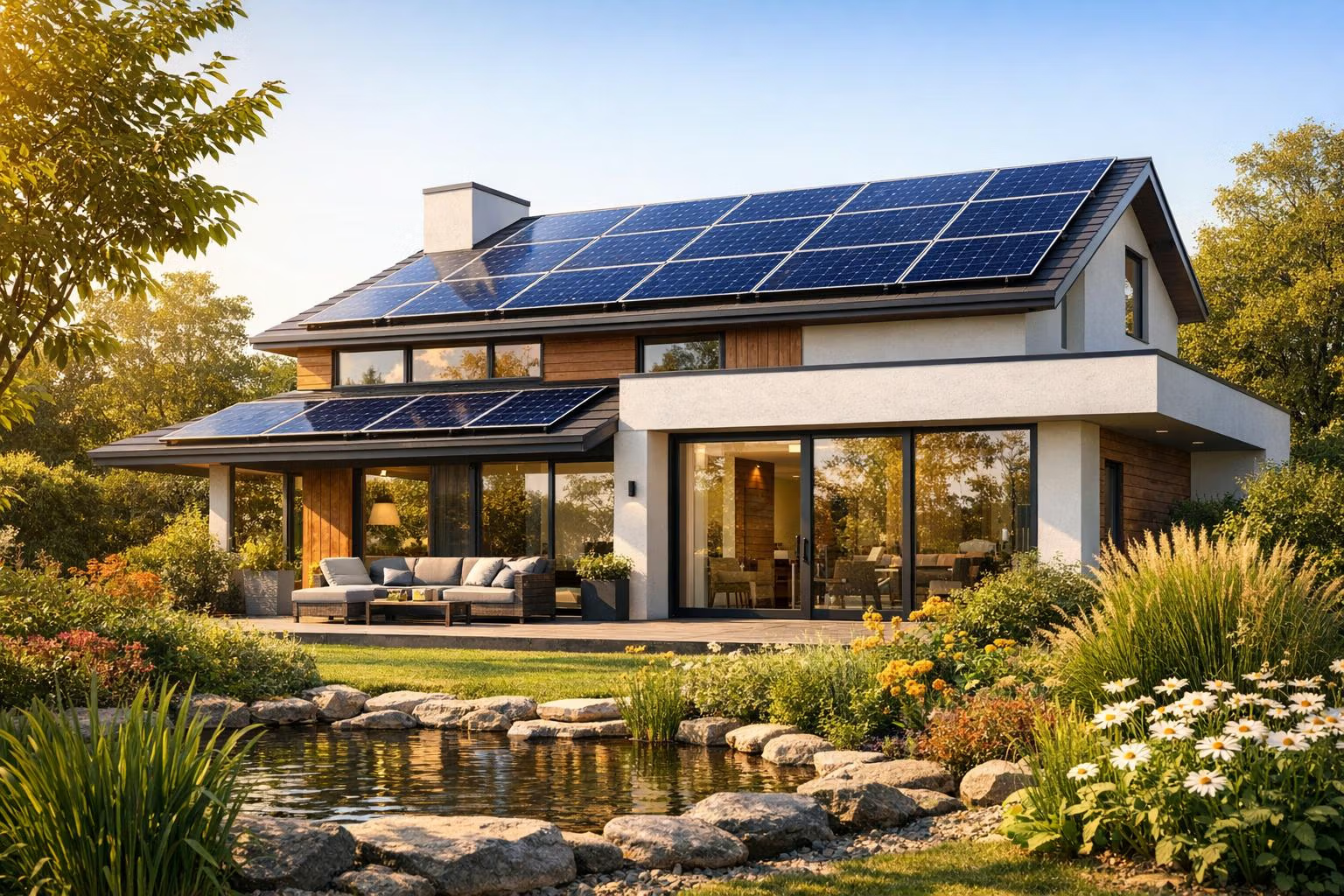
Switching to solar power at home offers a direct way to cut energy costs and reduce reliance on fossil fuels. In Northern Ireland, where only 44.2% of electricity comes from renewables, solar panels can significantly lower carbon emissions and help meet the 2030 target of 80% renewable energy. A typical 3kW solar system can cover 40% of an average home’s electricity needs, saving over 60% on bills. While manufacturing solar panels has some environmental costs, their long-term benefits far outweigh these, with a carbon payback period of around six years in Northern Ireland’s climate. Combining solar with battery storage can further boost efficiency, allowing households to store and use surplus energy later. By installing solar panels, you’re not just saving money – you’re contributing to a cleaner energy future.
The Problems with Conventional Electricity
Carbon Emissions and Climate Change
Electricity generation is a major contributor to global CO₂ emissions, accounting for over 40% of energy-related emissions. Fossil fuel combustion alone releases an enormous 34 billion tonnes of CO₂ into the atmosphere annually. Breaking this down, coal is responsible for 45% of these emissions, oil contributes 35%, and natural gas accounts for the remaining 20%.
These emissions don’t just fuel global warming – they also harm local air quality and public health. The US National Academy of Sciences has cautioned that "the primary limiting factor on energy production from fossil fuels over the next few centuries may turn out to be the climatic effects of the release of carbon dioxide". Despite ongoing efforts to reduce carbon emissions, electricity generation from fossil fuels has risen by 50% in the past 20 years. This highlights just how deeply entrenched these energy sources remain.
Air and Water Pollution from Power Plants
Fossil fuel power plants are not just carbon emitters – they’re also significant sources of local pollution. These plants release harmful substances like particulate matter, nitrogen oxides, sulphur dioxide, and volatile organic compounds, all of which have serious consequences for human health and the environment. For instance, coal-fired power plants are particularly lethal, causing 25 early deaths for every terawatt-hour (TWh) of electricity they generate – a mortality rate roughly 1,000 times higher than that of solar or nuclear energy.
The damage doesn’t stop with the air. Coal plants also produce solid waste, such as fly ash and sludge, which can contaminate water and soil. Additionally, conventional power plants consume staggering amounts of water – about 73,000 litres more per megawatt-hour than solar power systems. If the environmental and health costs of fossil fuels were fully accounted for, the price of coal and oil-based electricity would double.
Why Small Efficiency Improvements Aren’t Enough
Tweaking fossil fuel plants for better efficiency might sound like a step in the right direction, but it doesn’t solve the core issue: burning these fuels inherently releases carbon. To put things into perspective, a typical home solar panel system in the UK saves around one tonne of CO₂ annually. That’s the same as avoiding 3,600 miles of car travel. If all 13.7 million solar-ready homes in the UK installed panels, carbon emissions could drop by 14.8 million tonnes each year – equivalent to taking a massive number of petrol cars off the roads.
The reality is that small efficiency gains in fossil fuel plants can’t offset the scale of the climate crisis. A complete change in how we generate electricity is needed. Solar panels, for example, produce zero air pollutants or CO₂ during their operation. This makes them a far cleaner alternative compared to even the most efficient fossil fuel plants. These facts underline why moving to solar isn’t just an option – it’s a necessity. The systemic flaws in conventional electricity generation make the case for cleaner, solar-powered solutions impossible to ignore.
How Solar Energy Reduces Carbon Emissions and Resource Use
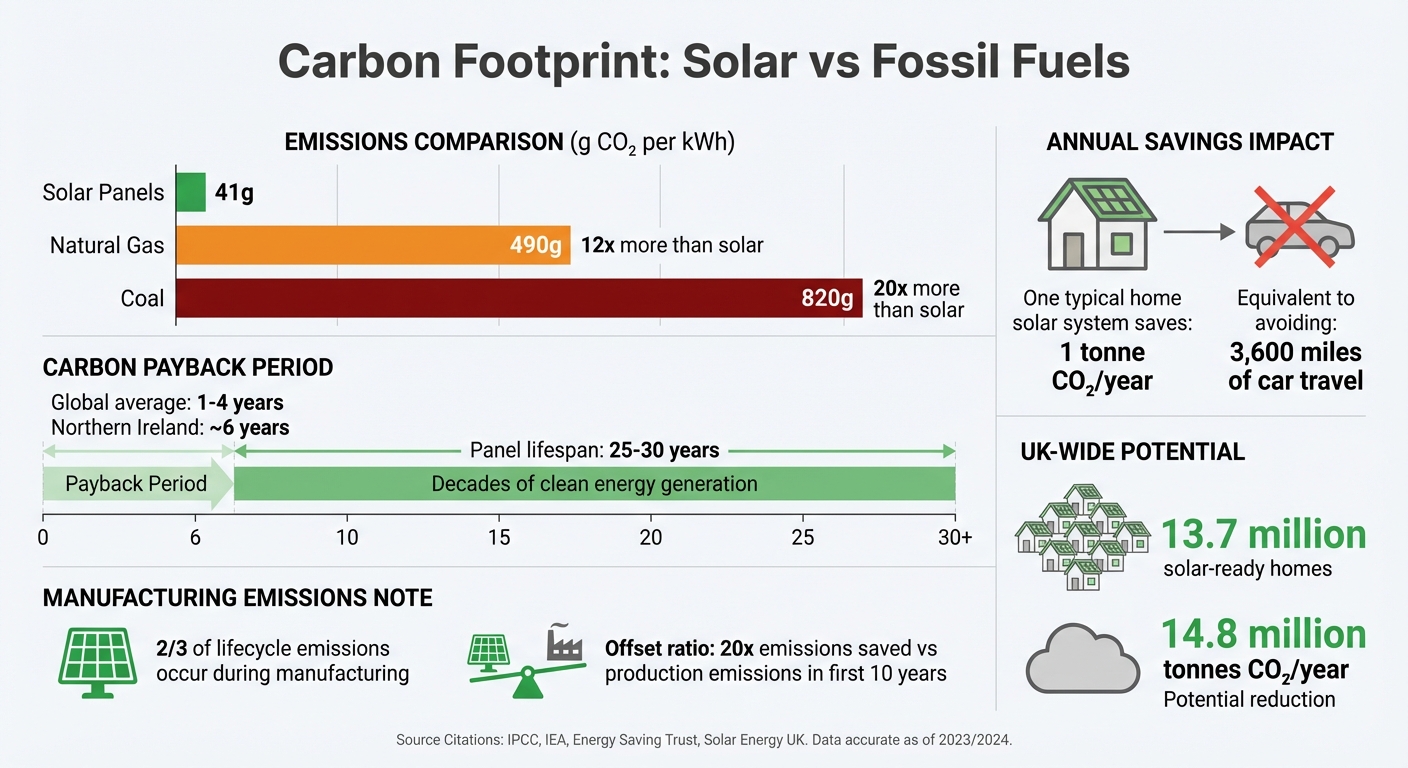
Carbon Emissions Comparison: Solar vs Fossil Fuels Per kWh
The Carbon Footprint of Solar Panels Over Their Lifetime
Solar panels produce electricity without releasing carbon during use, although their manufacturing process does leave a footprint. Over their entire lifecycle, residential solar panels emit about 41 grams of CO₂ equivalent per kilowatt-hour of electricity generated. To put this in perspective, natural gas produces approximately 490 grams per kWh – around 12 times more – and coal generates about 820 grams per kWh, making it nearly 20 times more carbon-intensive.
The majority of a solar panel’s emissions – around two-thirds – occur during manufacturing, with polysilicon production accounting for half of this. However, the "carbon payback period", or the time it takes for a panel to offset its production emissions by generating clean energy, is relatively short. Globally, this ranges from one to four years, while in Northern Ireland’s less sunny climate, it may extend to around six years. Given that solar panels typically last 25 to 30 years, their long-term environmental benefits are substantial. In fact, within just the first decade of use, a solar panel can offset over 20 times the emissions generated during its production. These savings directly reduce dependency on fossil fuels.
Reducing the Need for Fossil Fuels
Every kilowatt-hour generated by solar panels means one less kilowatt-hour sourced from the grid, which reduces the need for extracting, transporting, and burning fossil fuels. Solar panels can power household appliances directly, and when combined with tools like heat pumps or solar diverters, they can even provide heating and hot water without relying on oil or gas.
For instance, a solar diverter, which costs roughly £800, redirects surplus solar energy to an immersion heater, cutting out the need for a boiler and making energy use more efficient. With over 1.3 million solar installations in UK homes as of late 2025, the collective reduction in fossil fuel consumption is already significant. If all 13.7 million solar-ready homes across the UK installed panels, annual carbon emissions could decrease by an impressive 14.8 million tonnes.
Lower Water Use and Efficient Space Utilisation
Unlike conventional thermal power plants, which require large amounts of water for cooling, solar photovoltaic systems operate with minimal water use. This is a critical advantage given the growing concerns over water scarcity.
Solar panels are also an efficient use of space. A standard 3.5 kilowatt peak (kWp) system typically needs only 10 to 20 square metres of roof area. In Northern Ireland, approximately 397,800 homes are eligible for solar installations. By using existing rooftops, solar energy avoids the land clearing and environmental disruption often associated with fossil fuel extraction or the construction of large power stations. Moreover, panels installed at a tilt of 15 degrees or more benefit from natural rainfall to keep them clean, ensuring they maintain their efficiency over time.
These practical advantages highlight the role of solar energy in building a cleaner and more resource-efficient future for Northern Ireland and beyond.
Understanding the Trade-offs of Solar Panel Production
Energy and Materials Used in Manufacturing
Solar panels are celebrated for their ability to reduce carbon emissions, but the process of manufacturing them comes with its own set of challenges. Producing solar panels requires significant resources. For instance, glass makes up about 75% of their total weight, while other key materials include silicon, silver, and small amounts of heavy metals like lead and cadmium. These heavy metals can classify the waste as hazardous. Additionally, the manufacturing process relies on complex global supply chains. The UK government is actively reviewing these supply chains to address concerns such as forced labour in polysilicon mining.
That said, the environmental cost of production is quickly outweighed by the benefits. A standard 3.5 kWp solar panel system can save around one tonne of CO₂ each year, adding up to over 25 tonnes of savings during its 25-year lifespan.
Recycling and End-of-Life Options
In the UK and EU, solar panel disposal is regulated by the WEEE (Waste Electrical and Electronic Equipment) Directive, which makes manufacturers responsible for collecting and recycling old panels. Typically, solar panels last around 25 years, though their inverters often need replacing after about 12 years.
Recycling solar panels, however, isn’t cheap. It costs between £16 and £24 per panel, compared to just £0.80 to £1.60 for landfill disposal. This higher cost is due to the specialised labour required to separate tightly bonded materials. Despite this, there’s a silver lining – recoverable materials from recycled panels could be worth an estimated £12 billion globally by 2050, according to the International Renewable Energy Agency (IRENA).
The industry also faces a growing waste issue due to "early replacement" trends. Many consumers upgrade to newer, more efficient models around the 15-year mark, which could cause waste volumes to soar – potentially up to 50 times more than current projections. These factors highlight the importance of balancing innovation with sustainable disposal practices.
Visual Impact and Space Considerations
Rooftop solar systems offer a practical way to generate clean energy without taking up additional land. By using existing rooftops, homeowners avoid the land-use debates often associated with ground-mounted solar farms. For context, meeting the UK’s 2030 solar energy targets could require up to 0.4% of the country’s land. Rooftop systems help sidestep this issue, allowing energy generation without competing with agriculture or disturbing natural habitats.
These trade-offs are an essential part of the conversation as Northern Ireland and other regions transition to cleaner energy solutions.
sbb-itb-d2d975a
Getting the Most from Solar in Northern Ireland
Building on the environmental benefits and energy production factors discussed earlier, here’s how you can maximise solar power performance in Northern Ireland.
How Solar Panels Perform in Northern Ireland’s Climate
Solar panels work by converting daylight into electricity, and they don’t need constant sunshine to do so. Even on overcast days, they can generate power. Interestingly, Northern Ireland’s mild climate offers an advantage – cooler temperatures help prevent panels from overheating, which can otherwise lower efficiency in hotter regions.
With over 30,000 solar installations already in place across the region, the technology has shown it’s well-suited to local conditions. For instance, a standard 4kW solar panel system installed on a south-facing roof can produce around 3,380 kWh of electricity per year. If your roof faces east or west, the output typically decreases by just 15–20% compared to a south-facing setup. For homes with shaded areas or less-than-ideal roof angles, microinverter systems can step in to optimise each panel individually.
Why Professional Installation Matters
A professional installation isn’t just about getting panels on your roof – it’s about getting the most out of them. Accredited installers evaluate factors like sunlight exposure, shading, and roof orientation to improve energy output by 15–20%.
In Northern Ireland, EECO Energy offers MCS-accredited installations that meet industry standards and adhere to EREC G98/NI requirements for grid connection. They also take care of registering your system with NIE Networks, which is crucial if you want to earn about 13.4p per kWh for any surplus electricity you send back to the grid. Skimping on proper installation can be costly – fixing poor-quality work could set you back over £3,000. Starting with certified professionals is a smart investment.
Combining Solar with Battery Storage and Other Technologies
Adding battery storage to your solar setup can make a big difference. Batteries store excess energy generated during the day for use later, increasing your solar energy usage at home from 15% to as much as 25%. In winter, when solar production is lower, batteries can charge during cheaper off-peak hours and discharge during pricier daytime periods. This approach can save a typical 3-bedroom home with a 4.5kW system and a 3kWh battery about £883 annually.
For even more efficiency, you can combine your solar system with devices like the MyEnergi Eddi, which redirects surplus energy into heating your water, or EV chargers that power your electric car using your self-generated electricity. These technologies work together to help you get the most out of your solar investment.
Conclusion: Solar Energy for a Cleaner Future in Northern Ireland
Main Points to Remember
Installing solar panels at home isn’t just about cutting energy bills – it’s a direct way to reduce emissions and pollution from traditional power generation. For instance, a typical residential solar system can save roughly one tonne of carbon dioxide each year. To put that into perspective, it’s like avoiding 3,600 miles of driving. Northern Ireland has made impressive strides, growing its solar capacity from just 2 megawatts in 2011 to an incredible 352 megawatts by 2022. Over 30,000 installations prove that solar energy is effective, even with our often-cloudy skies.
What makes solar panels so impactful? They generate electricity without emitting greenhouse gases or air pollutants, directly replacing fossil fuel-based power. Plus, every household that switches to solar helps ease the strain on the national grid, bringing Northern Ireland closer to its net zero emissions goal.
The financial benefits are just as compelling. For example, a 3-bedroom home fitted with a 4.5kW system could save around £883 per year on energy costs. These systems usually pay for themselves within 9 to 13 years, especially with the added perk of 0% VAT, which can reduce upfront costs by £1,000–£1,800.
These advantages make solar energy a smart choice for both the environment and your wallet.
Next Steps
Ready to reduce your carbon footprint and cut down on energy costs? The key is a professional installation process. EECO Energy, for example, offers MCS-accredited solar panel installations throughout Northern Ireland. Their systems start at £3,950 for a 4.5kW setup, and they handle everything – from the initial survey to registering with NIE Networks. They’ll also ensure your system complies with EREC G98/NI standards.
Want to maximise your solar potential? Consider adding battery storage. This upgrade allows you to store surplus energy for later use, increasing your solar energy consumption at home from 15% to as much as 25%. By combining expert installation with cutting-edge technology, you’ll not only enjoy decades of clean, affordable energy but also play a vital role in Northern Ireland’s renewable energy goals.
FAQs
How long does it take for solar panels to offset their carbon footprint compared to their lifespan?
Solar panels generally balance out the carbon emissions from their manufacturing process within just 1 to 4 years of operation. Given their typical lifespan of 25 to 30 years, this means they deliver decades of clean, renewable energy well beyond their initial environmental cost.
By choosing solar power, you’re not just cutting down your home’s carbon footprint – you’re also playing a part in addressing climate change and supporting a more sustainable future.
What is the environmental impact of producing solar panels?
The production of solar panels does come with some environmental challenges. Manufacturing involves energy-heavy processes, such as producing silicon wafers, aluminium frames, and glass. These often depend on electricity generated from fossil fuels, leading to CO₂ emissions. The extraction and refining of materials like quartz (used for silicon), copper, and silver can also disrupt natural habitats and risk contaminating soil and water supplies.
There’s also the issue of hazardous chemicals, such as hydrofluoric acid and lead-based solders, which are used during manufacturing. These substances require careful management to protect both workers and the surrounding environment. On top of that, the production process can consume large amounts of water, especially for cleaning and cooling.
However, progress is being made. Cleaner production technologies, recycling efforts, and stricter environmental regulations are gradually helping to minimise these impacts. And once installed, solar panels provide clean, renewable energy, eventually offsetting the environmental costs of their production over their years of use.
How does adding battery storage improve the efficiency of a home solar system?
Battery storage lets you save extra electricity generated by your solar panels during sunny spells, so you can use it later – like in the evening or on overcast days when your home needs it most. This means you rely less on exporting energy to the grid, which often provides little to no financial benefit, and instead increase your self-consumption of solar power from about 30–40% to as much as 70–80%. By making better use of the clean energy your panels produce, you can cut down on fossil-fuel electricity and shrink your household’s carbon footprint.
Batteries also help stabilise the unpredictable nature of solar power. They can be set to release energy during times when electricity prices spike, helping to reduce your bills. Plus, they ease the strain on the national grid during high-demand periods. For households in Northern Ireland and across the UK, pairing a battery with solar panels creates a more efficient and resilient energy system. It’s a step towards reducing your environmental impact while contributing to the country’s net-zero emissions target.