
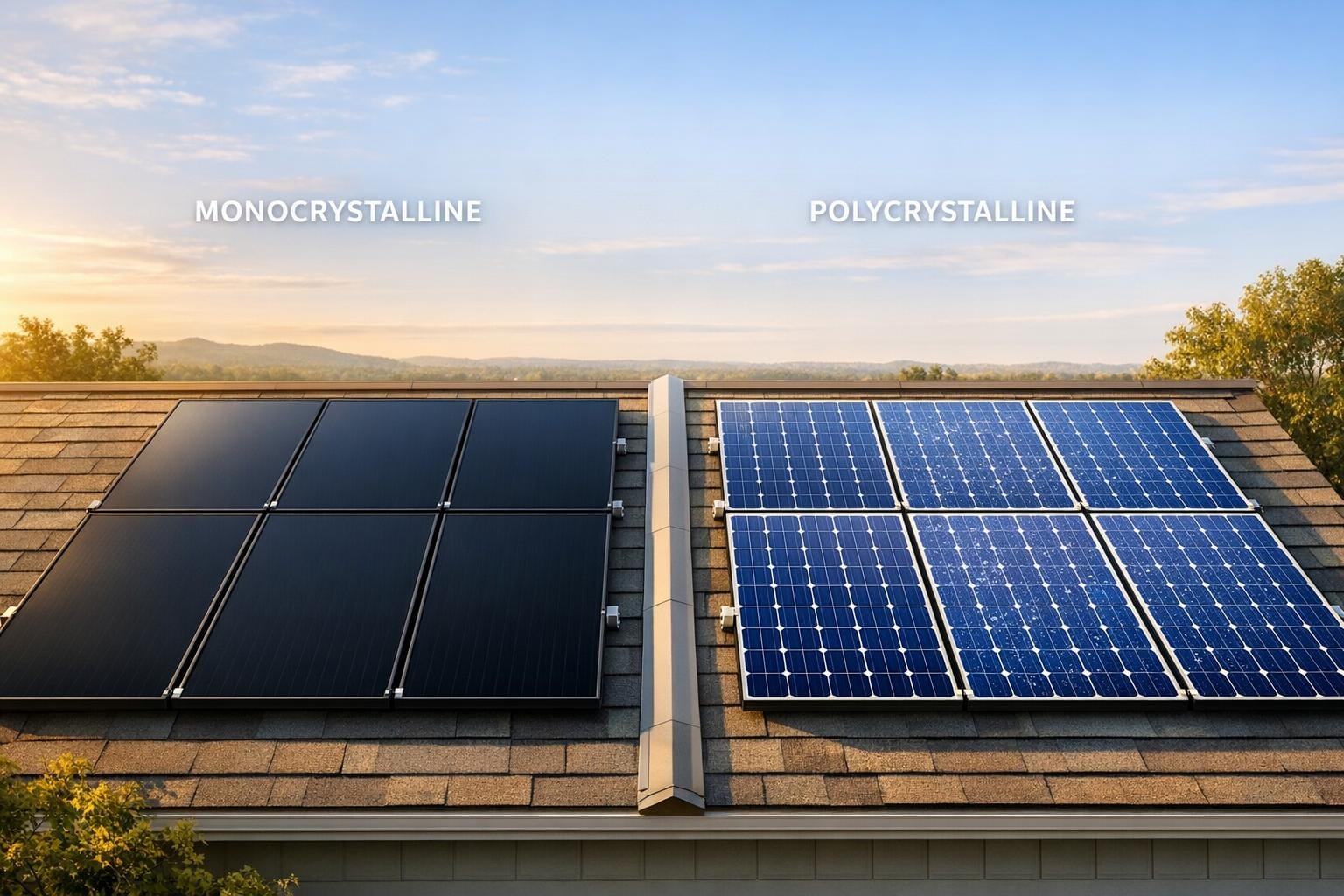
When choosing between monocrystalline and polycrystalline solar panels, the decision depends on your budget, roof space, and energy needs. Here’s the key takeaway:
- Monocrystalline panels are more efficient (18–24%), perform better in low-light conditions, and require less space. They cost more upfront (£350/m²) but last longer (30–40 years) and degrade more slowly (0.3% per year). Ideal for smaller roofs and areas with frequent overcast skies, like Northern Ireland.
- Polycrystalline panels are less efficient (13–16%) but cheaper (£280/m²). They are suitable for larger roofs and tighter budgets, with a lifespan of 25–35 years and a higher degradation rate (0.5–0.8% per year).
Quick Comparison
| Feature | Monocrystalline | Polycrystalline |
|---|---|---|
| Efficiency | 18–24% | 13–16% |
| Cost per m² | £350 | £280 |
| Lifespan | 30–40 years | 25–35 years |
| Degradation Rate | 0.3% per year | 0.5–0.8% per year |
| Appearance | Sleek black finish | Blue speckled look |
| Performance in Clouds | Better | Moderate |
| Space Needed (5kW) | 20–25 m² | 30–35 m² |
Monocrystalline panels are better for maximising energy output in limited spaces, while polycrystalline panels are a cost-effective choice for larger roofs. For Northern Ireland’s cloudy climate, monocrystalline panels provide more reliable energy production year-round. Choose based on your property’s needs and long-term savings goals.
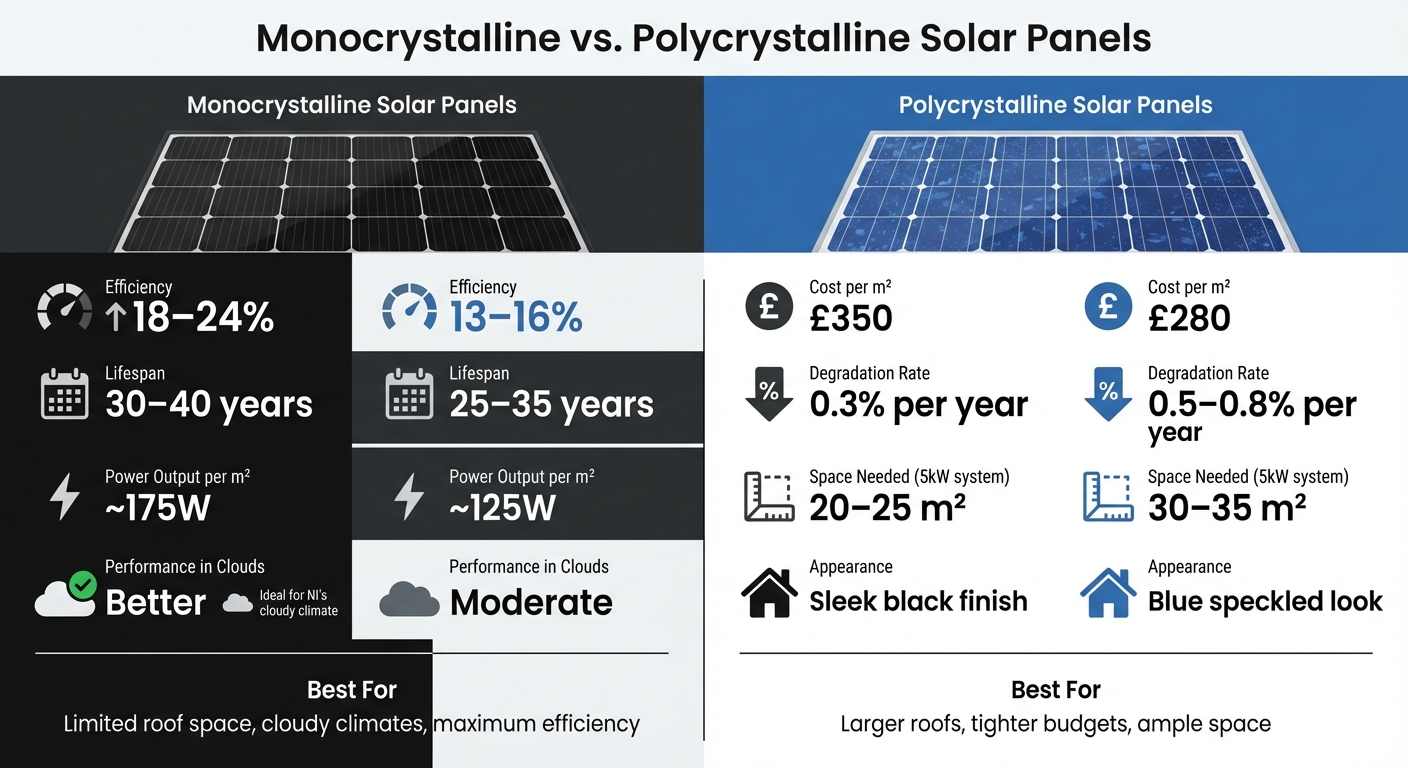
Monocrystalline vs Polycrystalline Solar Panels Comparison Chart
What Are Monocrystalline Solar Panels?
Monocrystalline panels are built using a single, continuous silicon crystal. This is achieved through a manufacturing process known as the Czochralski method. Here’s how it works: refined silicon is heated to around 1,425°C, and a seed crystal is carefully pulled from the molten silicon to form a cylindrical ingot. This ingot is then sliced into thin wafers, which are used to create the solar cells you see on the panels.
This uniform crystal structure enhances electron flow, making these panels highly efficient, with rates typically ranging from 20% to 25%. Some newer models expected in 2025 could even reach 27% efficiency. The single-crystal design also gives these panels their sleek black appearance, achieved through chemical etching and anti-reflective coatings that create a smooth, dark finish.
However, this precision comes at a cost. Monocrystalline panels are about 20% more expensive than other types, priced roughly at £350 per m² compared to £280 per m². The process of slicing the cylindrical ingot into square wafers also generates more silicon waste, further driving up costs. Despite this, these panels offer unmatched durability, with a lifespan typically ranging from 30 to 40 years. They degrade at a slow rate of just 0.3% per year, meaning they retain about 92% of their original output after 25 years.
Main Features of Monocrystalline Panels
The advanced manufacturing process of monocrystalline panels brings several notable benefits. One of the most striking is their space efficiency. These panels can produce approximately 175W per m², compared to 125W per m² for polycrystalline panels. This means you’ll need around 25% fewer panels to generate the same amount of electricity, which is a major advantage if your roof space is limited.
Their performance in low-light conditions is another highlight. Thanks to their pure silicon structure, monocrystalline panels are better at capturing photons, particularly at the blue end of the light spectrum, which is more prominent on cloudy days. Over a 25-year period, these panels generate 8–12% more total energy simply because they degrade at a slower rate.
Temperature tolerance is also worth mentioning. Monocrystalline panels lose about 0.3% efficiency for every degree Celsius above 25°C, whereas polycrystalline panels lose around 0.5%. While Northern Ireland’s mild climate makes this difference less critical, it still contributes to consistent energy output throughout the year.
How Monocrystalline Panels Perform in Northern Ireland
Northern Ireland’s often overcast weather makes monocrystalline panels an excellent choice for the region. These panels don’t rely on direct sunlight to produce electricity – they only need daylight. Even on cloudy days, they can capture about two-thirds of the light they would receive on a sunny day.
The Energy Saving Trust conducted a monitoring study that revealed some compelling results: homeowners with monocrystalline panels experienced 23 fewer ‘zero export’ days per year. These are days when the system fails to meet basic household energy demands due to insufficient light. For homes with limited roof space, this consistent performance is especially important. Fewer panels are needed to meet energy requirements, even during the darker winter months in Northern Ireland.
Aesthetics also play a role in their appeal. With their sleek black finish, monocrystalline panels blend seamlessly with modern roof designs. When paired with black frames and backsheets, they are far less noticeable than the blue, speckled look of polycrystalline panels.
Next, we’ll compare these advantages directly with those of polycrystalline panels.
What Are Polycrystalline Solar Panels?
Polycrystalline solar panels are made using a different process compared to their monocrystalline counterparts. Instead of forming from a single, pure silicon crystal, these panels are created by melting silicon fragments and casting them into a mould. This method is simpler and less expensive, which reduces both manufacturing time and costs when compared to the more complex process used for monocrystalline panels.
The differences in production are striking. Monocrystalline manufacturing consumes 2.3 times more energy and generates 8–12% silicon waste, while polycrystalline panels produce only 3–5% waste. Additionally, up to 5% recycled silicon can be mixed into polycrystalline batches, whereas monocrystalline panels require highly pure silicon granules. These production differences directly affect the performance and cost of the panels.
Polycrystalline panels are easy to identify by their blue, speckled appearance, square-shaped cells, and defined edges. While they are more affordable, their efficiency rates – usually between 13% and 17% – are lower due to the non-uniform crystal structure, which hampers electron movement. This lower efficiency means you’ll need more panels (and more roof space) to achieve the same energy output as a monocrystalline system. However, with a cost of around £280 per m² – roughly 20% less than monocrystalline panels – they remain an attractive option for budget-conscious buyers.
Main Features of Polycrystalline Panels
The simpler manufacturing process of polycrystalline panels comes with several practical benefits. One of the biggest advantages is affordability. A typical 350W polycrystalline panel costs about £562, and a 3.5kWp system is priced between £5,000 and £6,500. These panels are also built to last, with a lifespan of 25 to 35 years, and they degrade at a relatively slow rate of 0.5% to 0.8% per year. Additionally, their production process is less wasteful and uses fewer resources, making it a more environmentally conscious choice.
However, they do have some drawbacks. Polycrystalline panels are less efficient in warmer conditions, with temperature coefficients ranging from -0.3% to -1% per °C. They also generate less power per square metre, making them more suitable for properties with larger, unshaded roof areas. These characteristics are especially important to consider for installations in Northern Ireland.
How Polycrystalline Panels Perform in Northern Ireland
Northern Ireland’s cooler climate is well-suited for polycrystalline panels. Since local temperatures rarely exceed 25°C, the panels’ higher temperature coefficient becomes less of an issue, resulting in minimal efficiency loss due to heat. Their affordability and efficiency make them a practical choice for properties with large, unobstructed roof spaces. These panels are particularly ideal for rural homes or properties with expansive, south-facing roofs free from shading. While more panels are required to meet energy needs, the lower upfront cost helps balance the overall investment.
For homeowners working within tighter budgets, polycrystalline panels provide an affordable way to adopt solar energy. Although their lower efficiency may slightly reduce long-term savings, the reduced initial cost can make solar installation more accessible. Some experts also note that polycrystalline panels perform reasonably well under Northern Ireland’s often cloudy skies, as their less uniform cell structure can capture diffused light effectively. That said, they still fall short of the low-light performance offered by monocrystalline panels, which may lead to reduced energy output during the darker winter months.
As of June 2024, around 1.4 million homes in the UK have solar panels installed, with polycrystalline systems remaining a popular choice for those balancing roof space and budget considerations. Ultimately, selecting the right type of panel depends on matching your property’s characteristics and financial goals with the strengths of the available technologies.
Efficiency Comparison: Monocrystalline vs. Polycrystalline
When deciding between monocrystalline and polycrystalline solar panels, efficiency plays a key role in determining how much electricity you can produce from your available roof space. The structural differences – monocrystalline made from single-crystal silicon and polycrystalline from multi-crystal silicon – lead to notable variations in performance, especially relevant in Northern Ireland’s weather conditions.
On average, monocrystalline panels are 36% more efficient than polycrystalline panels. This efficiency advantage comes from their single-crystal structure, which allows electrons to move more freely, reducing internal resistance. For a typical 4kW system, monocrystalline panels can generate between 3,600 and 4,800 kWh annually, compared to 3,120 to 3,840 kWh from polycrystalline panels. The table below highlights the key performance differences between the two.
Efficiency Numbers Side by Side
| Feature | Monocrystalline Panels | Polycrystalline Panels |
|---|---|---|
| Peak Efficiency | 18%–24% | 13%–16% |
| Power Output (per m²) | ~175 W | ~125 W |
| Space Needed (for 5kW system) | 20–25 m² | 30–35 m² |
| Temperature Coefficient | -0.25% to -0.35% / °C | -0.35% to -0.45% / °C |
| Typical Lifespan | 25–40 years | 25–35 years |
These differences make monocrystalline panels particularly well-suited to Northern Ireland’s cloudy climate. They perform better as temperatures rise and outperform in low-light conditions, offering a 5% to 15% daily energy yield advantage during overcast weather and early mornings. At cloudy irradiance levels of 400 W/m², monocrystalline panels operate at around 78% of their rated power, compared to 72% for polycrystalline panels.
Performance on Cloudy Days
Given Northern Ireland’s frequent overcast skies, low-light performance becomes a critical factor when selecting solar panels. Monocrystalline panels excel here, thanks to their single-crystal structure, which allows electrons to flow with minimal resistance, even in low-photon conditions. In contrast, polycrystalline panels face challenges with internal crystal boundaries that impede electron movement, especially under diffused light.
"Monocrystalline panels are superior due to their higher efficiency (typically 20-24%). They generate more power from indirect or cloudy sunlight compared to polycrystalline panels, making them ideal for areas with frequent overcast weather." – Tongwei Co., Ltd.
On cloudy days, solar panels generally produce only 10% to 25% of their rated output. However, monocrystalline panels consistently generate more power under these conditions. For homeowners in Northern Ireland, this means more reliable energy production year-round, particularly during the darker winter months when every watt matters. With their higher efficiency and better low-light performance, monocrystalline panels are the preferred choice for maximising energy output and return on investment in the region’s climate.
Cost and Return on Investment
Monocrystalline panels typically come with a higher upfront cost – around 20% more than polycrystalline options. As of early 2026, monocrystalline panels are priced between £1.60 and £2.00 per watt, whereas polycrystalline panels range from £1.20 to £1.60 per watt. For a 4kW system, this translates to an estimated cost of £6,400 to £8,000 for monocrystalline panels, compared to £4,800 to £6,400 for polycrystalline panels.
The higher efficiency of monocrystalline panels means a 350W panel costs about £703 installed, while a similar polycrystalline panel would be approximately £562 – resulting in a £141 difference per panel. Additionally, fewer monocrystalline panels are needed to achieve the same energy output, which can lower installation and racking costs. These upfront cost differences play a significant role in determining the overall return on investment.
Initial Costs vs. Long-Term Savings
Payback periods show where the financial benefits become evident. Monocrystalline systems usually recoup costs within 6 to 8 years, while polycrystalline systems take slightly longer, around 7 to 9 years. In Northern Ireland, this gap becomes even more pronounced. Monocrystalline panels can deliver an additional £800 to £1,200 in lifetime value for a typical residential system, thanks to better performance in low-light conditions and a slower degradation rate – 0.4% annually compared to 0.6% for polycrystalline panels. These features are particularly valuable in Northern Ireland’s climate, where maximising energy output is essential.
Residents in Northern Ireland also benefit from competitive export rates for excess energy, ranging from 17.66p to 18p per kWh. For a typical three-bedroom home, this translates into annual energy savings of about £513, adding up to roughly £7,841 over 25 years. Additionally, the region’s cooler climate helps enhance panel efficiency by reducing the risk of overheating, even though it receives about 5% less sunshine than the UK average.
EECO Energy Pricing Examples
EECO Energy provides detailed pricing for various system sizes, making it easier to understand potential costs and outputs. The table below breaks down system sizes, the number of panels, estimated annual output, and EECO Energy’s pricing for south-facing installations:
| System Size | Number of Panels | Annual Output (kWh) | EECO Energy Price |
|---|---|---|---|
| 4.5kW | 10 | 3,380 | £3,950 |
| 5.4kW | 12 | 4,400 | £4,350 |
| 7.2kW | 16 | 6,189 | £4,850 |
| 8.1kW | 18 | 6,685 | £5,700 |
| 9.0kW | 20 | 7,099 | £5,900 |
For homes with limited roof space, monocrystalline panels are an excellent choice as they maximise energy output per square metre. On the other hand, if roof space is ample and minimising upfront costs is the priority, polycrystalline panels offer a more affordable alternative. Keep in mind that maintenance costs typically range from £100 to £200 annually, with inverter replacements costing £500 to £1,500 every 10–15 years.
sbb-itb-d2d975a
Durability in Northern Ireland’s Weather
Weather Resistance and Lifespan
Northern Ireland’s weather, marked by frequent rainfall, offers a natural cleaning mechanism for solar panels, helping them maintain 95–98% light transmission. Among panel types, monocrystalline panels stand out for their ability to withstand the region’s damp conditions and fluctuating temperatures. Their single-crystal structure, combined with premium features like copper foundations, helps prevent issues like microcracks and snail trails.
The cooler climate in Northern Ireland also works to the advantage of solar systems. Panels operating at around 5°C can achieve up to 8% higher efficiency than their rated performance, which helps counterbalance the region’s lower light levels. Additionally, the thermal mass of traditional slate and tile roofs, common in Northern Ireland, reduces temperature swings, minimising thermal cycling stress that can wear out components over time.
For properties near the coast, salt-laden air presents a unique challenge. This humid, salty environment can reduce panel efficiency by 2–3% and speed up corrosion unless the panels are specifically designed for maritime conditions. Monocrystalline panels with enhanced corrosion resistance are the ideal choice in such areas. Regular inspections of mounting equipment are also essential to spot and address rust, especially in persistently damp settings.
Monocrystalline panels also outperform polycrystalline ones when it comes to temperature stability. Their temperature coefficient ranges from −0.25% to −0.35% per °C, compared to the broader and less stable −0.3% to −1.0% per °C for polycrystalline panels. These characteristics underline why monocrystalline panels are better suited to Northern Ireland’s variable climate and set the stage for understanding warranties and degradation rates.
Warranties and Degradation Rates
The longevity and efficiency of solar panels often come down to the type of panel you choose. Monocrystalline panels typically offer warranties spanning 25 to 30 years, while polycrystalline panels sometimes provide shorter coverage, with warranties as low as 12 to 15 years in some cases. The rate of annual efficiency loss further highlights the difference: monocrystalline panels degrade at a slower rate of 0.3% to 0.5% per year, compared to 0.5% to 0.8% per year for polycrystalline panels.
| Feature | Monocrystalline Panels | Polycrystalline Panels |
|---|---|---|
| Annual Efficiency Loss | 0.3%–0.5% | 0.5%–0.8% |
| Typical Warranty | 25–30 Years | 12–25 Years |
| Temperature Coefficient | −0.25% to −0.35% / °C | −0.3% to −1.0% / °C |
| Functional Lifespan | 30–40 Years | 25–35 Years |
In Northern Ireland’s maritime climate, the annual degradation rate for monocrystalline panels averages around 0.4%, compared to 0.6% for polycrystalline panels. Over a 25-year period, this difference can result in significantly higher energy output for monocrystalline systems. With proper maintenance, solar systems in the region can achieve performance ratios of 75% to 85% of their laboratory-rated specifications.
Appearance, Space Needs, and Installation
Visual Appearance on Your Roof
Monocrystalline panels feature a sleek, black finish that seamlessly blends with darker roofs, such as those made from slate or traditional dark tiles.
In contrast, polycrystalline panels have a distinctive blue hue with a speckled pattern and square-shaped cells, making them more visually prominent on rooftops.
For homeowners prioritising kerb appeal, monocrystalline panels are a popular choice. Their understated design helps preserve the overall look of properties, especially those with classic architectural styles. This aesthetic appeal is an added bonus, particularly for installations where roof space is at a premium.
Space Requirements and Installation Process
The design of solar panels doesn’t just affect how your home looks – it also plays a critical role in installation and energy efficiency. For terraced or semi-detached homes with limited roof space, space efficiency becomes a key consideration. As noted earlier, monocrystalline panels are more efficient in terms of energy generation per square metre. This means fewer panels are needed, simplifying the installation process.
Companies like EECO Energy offer quick installation services, often completing the work in just a day. When paired with monocrystalline panels, this process becomes even more efficient. EECO Energy’s MCS accreditation ensures installations meet high industry standards, which is essential for homeowners looking to access schemes like the Smart Export Guarantee.
"For many Northern Ireland homes with limited roof space, the high efficiency of monocrystalline panels makes them the optimal choice." – Adam Raw, Writer, Dwellow
In Northern Ireland, where urban homes often have compact or irregularly shaped roofs, getting the most energy from a small area is essential. Monocrystalline panels are ideal for maximising energy output in such settings. However, for homes with more roof space and tighter budgets, polycrystalline panels can still be a practical option – though it’s worth considering their lower long-term energy returns.
Choosing the Right Panels for Your Property
What to Consider When Deciding
Selecting the right solar panels depends on factors like your roof space, budget, and energy needs.
If your roof space is limited – a common issue with terraced homes or properties with intricate roof designs – monocrystalline panels are a smart option. These panels produce around 175W per m² compared to the 125W per m² output of polycrystalline panels, making them better suited for smaller areas.
While polycrystalline panels are cheaper initially, monocrystalline panels last longer, with lifespans of up to 40 years compared to 35 years for polycrystalline ones. They’re also more efficient, offering better savings over time.
In areas like Northern Ireland, where low-light conditions are frequent, monocrystalline panels perform better than their polycrystalline counterparts.
If you’re thinking about adding an electric vehicle or heat pump in the future, investing in high-efficiency monocrystalline panels is a wise move. They maximise energy production, especially when roof space is at a premium.
These factors highlight the importance of seeking expert advice tailored to your specific needs.
EECO Energy’s Services and Support
Considering these factors, EECO Energy provides solutions designed to optimise both efficiency and savings. They offer free surveys and quotes to help you determine the best system size and panel type for your home. Their experts will assess your roof’s orientation, shading, and energy demands to deliver personalised recommendations.
As an MCS-accredited installer, EECO Energy ensures your system meets the requirements for programmes like the Smart Export Guarantee. Installations are typically completed in a single day, and all systems come with a 25-year warranty for added peace of mind.
To take the next step, reach out to EECO Energy at 028 9592 2730 or email hello@eeco.energy to book your free site survey. Their team will guide you in choosing between monocrystalline and polycrystalline panels, ensuring the solution is tailored to your property and budget.
Conclusion
When selecting solar panels, consider your roof space, budget, and energy needs. For Northern Ireland’s often overcast skies, monocrystalline panels stand out with their higher efficiency (18%–24%) and longer lifespan of up to 40 years. However, they do come at a higher cost (£350/m² compared to £280/m² for polycrystalline panels).
In terms of climate suitability, monocrystalline panels perform better in low-light conditions and degrade more slowly – at a rate of 0.3%–0.5% annually compared to 0.5%–0.8% for polycrystalline options. While monocrystalline panels offer superior efficiency and durability, polycrystalline panels are a practical choice for properties with ample roof space and tighter budgets.
Ultimately, the decision comes down to your property’s unique conditions. A professional assessment is crucial to ensure you invest in the most suitable system. EECO Energy’s MCS-accredited team can help by evaluating your roof’s orientation, shading, and energy requirements during a free site survey. Call 028 9592 2730 or email hello@eeco.energy to find the best solar solution for your home or business.
FAQs
What should I consider when choosing between monocrystalline and polycrystalline solar panels?
When choosing between monocrystalline and polycrystalline solar panels, it’s important to weigh factors like efficiency, cost, and appearance.
Monocrystalline panels are known for their higher efficiency – reaching up to 23% – making them a great choice for smaller roofs or locations with frequent cloud cover, such as Northern Ireland. On the other hand, polycrystalline panels are slightly less efficient, with rates between 14% and 19%, but they’re more budget-friendly and work well if you’ve got plenty of roof space.
In terms of aesthetics, monocrystalline panels feature a sleek black finish that many find visually appealing, while polycrystalline panels have a distinct blue tint. Both options usually come with warranties of around 25 years, so durability isn’t a deciding factor here.
For the UK’s often overcast weather, monocrystalline panels may have an edge in low-light performance. However, if cost is a primary concern, polycrystalline panels remain a dependable and economical alternative.
Are monocrystalline solar panels suitable for Northern Ireland’s weather?
Monocrystalline solar panels are a fantastic option for Northern Ireland’s weather. With an efficiency rate typically around 22–23%, they can generate a significant amount of electricity per square metre, even on cloudy days when sunlight is scarce. This makes them especially effective in regions with frequent overcast skies and shorter daylight periods.
These panels are built to last, often boasting a lifespan of 25 years or more, which means they can handle Northern Ireland’s wet and windy conditions with ease. Plus, their ability to maintain efficiency in cooler temperatures ensures reliable performance throughout the year. If your home has limited or uneven roof space, monocrystalline panels are a smart choice, as they deliver more power from a compact area, helping you make the most of the local climate.
Are monocrystalline solar panels worth the higher cost compared to polycrystalline panels?
Monocrystalline panels come with a higher upfront cost – about 20% more than polycrystalline panels – but they deliver better efficiency and perform well in compact or shaded spaces. Thanks to their efficiency, you’ll need fewer panels to produce the same amount of electricity, which is a big advantage if your roof space is limited or partially shaded. They’re also slightly more effective in Northern Ireland’s cooler, cloudier weather.
Although the initial expense is greater, monocrystalline panels often pay off in the long run. You’ll save on installation labour, require fewer panels, and enjoy higher energy output over the system’s lifespan. On the other hand, if you’re on a tighter budget and have ample roof space, polycrystalline panels can still be a sensible option.