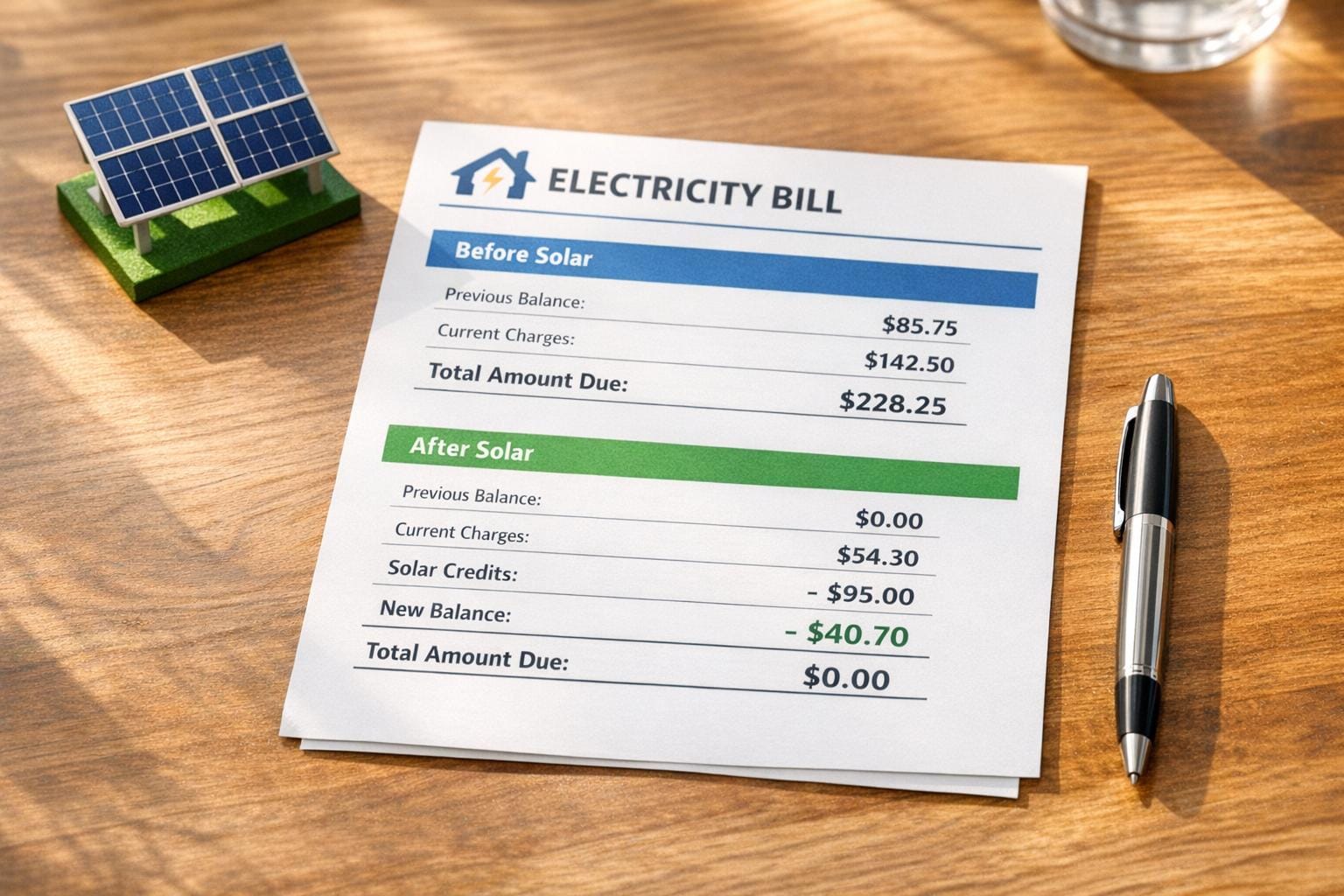
Switching to solar panels changes how your electricity bill looks, but it can be confusing. Here’s what you need to know:
- Before Solar: Your bill includes charges for electricity used (measured in kWh), a daily standing charge, and 5% VAT. Costs depend on how much grid electricity you consume.
- After Solar: Your grid electricity use drops as your panels generate power. You may also earn credits under the Smart Export Guarantee (SEG) for surplus energy sent back to the grid. However, your bill only shows imported electricity and SEG credits – not the energy your panels generate.
- Standing Charges: These fixed daily fees remain unchanged, even with solar.
- Savings: Solar reduces your electricity costs by lowering grid reliance. With a battery, savings increase as more solar energy is stored and used later.
Understanding your bill helps you track savings, monitor solar performance, and adjust habits to maximise benefits. SEG payments and reduced grid imports are key indicators of savings.
Understanding Your Electricity Bill: The Basics
Main Parts of a UK Electricity Bill
Your electricity bill is made up of several key components. The unit rate is the amount you pay for each kilowatt-hour (kWh) of electricity you use. For April–June 2025, the average unit rate for customers paying by Direct Debit is 27.03p per kWh.
Another important part is the standing charge, a daily fixed fee that covers the costs of maintaining the electricity network and ensuring your power supply. Currently, this averages 53.80p per day, which works out to about £16.14 for a 30-day billing period. Additionally, VAT is charged at a rate of 5% for domestic electricity use.
Your bill also reflects other costs, including the wholesale price of energy (what your supplier pays to generators), network maintenance, and contributions to government schemes supporting renewable energy and vulnerable households. Here’s a breakdown of where your money goes:
| Bill Component | Approximate Percentage | Description |
|---|---|---|
| Wholesale Costs | ~33% | The cost of purchasing energy from generators |
| Network Costs | ~25% | Maintenance of cables and infrastructure |
| Environmental/Social | ~25% | Funding green initiatives and social policies |
| Operating Costs | ~16% | Supplier costs for customer service and admin |
| VAT | 5% | Government tax on domestic energy |
How Electricity Usage is Measured
Electricity usage is measured in kilowatt-hours (kWh). A single kWh represents the energy consumed by a 1,000-watt appliance running for one hour. Your bill is calculated using this formula:
(Total kWh × Unit Rate) + (Daily Standing Charge × Number of days) + 5% VAT.
If you want to calculate the running cost of a specific appliance, use this formula:
(Wattage ÷ 1,000) × Hours Used × Unit Rate.
It’s also important to check whether your bill is based on an Actual or Estimated reading. If it’s marked as "Estimated" (‘E’), it’s a good idea to submit a manual reading to your supplier so you’re only billed for the energy you’ve actually used. If you have a smart meter, it automatically sends accurate readings to your supplier, eliminating the need for estimates and allowing you to monitor your usage in real time.
Why You Should Understand Your Bill
Understanding your electricity bill can help you identify ways to cut costs. For instance, by knowing which appliances use the most energy, you can make changes to reduce your consumption. It’s also easier to compare tariffs or evaluate the potential savings from installing solar panels when you understand the difference between unit rates and standing charges.
Paying by Direct Debit typically offers the lowest rates compared to prepayment meters or paying on receipt of a bill. Additionally, tracking your usage in kWh, rather than focusing solely on the total cost in pounds, helps you see how seasonal changes affect your consumption, regardless of price fluctuations.
Your Electricity Bill Before Solar Panels
Standing Charges and Unit Rates
Before adding solar panels to your home, your electricity bill consists of two main parts: a fixed standing charge and a variable unit rate. The standing charge, which is a daily fee, averages around 53.80p per day (about £16.14 over 30 days). This fee covers the cost of keeping your property connected to the grid, maintaining the network infrastructure, and managing your meter. On top of this, there’s the unit rate, which is the price you pay for the electricity you actually use. For customers paying by Direct Debit (April–June 2025), the unit rate is 27.03p per kWh.
To calculate your total bill, the formula looks like this:
(Total kWh Used × Unit Rate) + (Number of Days × Standing Charge) + 5% VAT.
Other Charges and Costs
Your electricity bill isn’t just about the standing charge and unit rate. There are other costs that make up the total:
- Wholesale costs: These are what your energy supplier pays to purchase electricity from generators, and they account for about 33% of your bill. These costs can vary depending on factors like gas prices, market trends, and seasonal demand.
- Network costs: Making up just under 25% of your bill, these include charges for maintaining and operating the electricity network. For example, Distribution Use of System (DUoS) charges typically represent around 15% of a domestic bill, while Transmission Network Use of System (TNUoS) charges and a small Balancing Services charge (BSUoS) make up the rest. The BSUoS charge, which accounts for around 2% of the average bill, helps cover the cost of matching electricity supply with demand in real-time.
- Environmental and social obligations: These government-mandated costs fund renewable energy initiatives, energy efficiency schemes, and support for vulnerable households. Together, they make up roughly 25% of your bill.
- Operating costs: This includes customer service, billing, and your supplier’s profit margins, which collectively account for about 16% of your bill.
Finally, 5% VAT is added to the total.
Example of a Pre-Solar Bill
To put it simply, a typical pre-solar electricity bill breaks down like this: 33% wholesale costs, 25% network costs, 25% environmental/social obligations, 16% operating costs, and 5% VAT.
This breakdown highlights an important point: solar panels primarily help reduce your unit rate costs by allowing you to generate your own electricity. However, fixed charges like the standing charge and many of the network and policy fees will still apply, even after you go solar. This knowledge is key to understanding how solar panels can reshape your electricity bill, a topic explored further in the next section.
How Solar Panels Change Your Electricity Bill

Electricity Bill Breakdown Before and After Solar Panel Installation
Lower Consumption Charges
Solar panels generate electricity right at your home, which means you rely less on energy from the grid. Because the energy produced and used directly by your household doesn’t pass through your import meter, it’s not recorded by your energy supplier.
For a typical three-bedroom home with a 3.5 kWp solar system, around 50% of the solar energy is used directly without battery storage. With a battery, this can increase to about 80%, translating to annual savings of approximately 70% to 86% on electricity bills. Every unit of solar energy you use saves you the full retail electricity rate, which is currently about 24.5p per kWh.
To get the most out of your system, try running energy-heavy appliances, like dishwashers or washing machines, during the day when your panels are producing energy. Beyond cutting down on what you take from the grid, any extra electricity your system generates can also bring in additional income, as explained below.
SEG Payments Explained
Reducing your energy consumption is just one part of the benefit – solar panels can also earn you money through SEG payments for any surplus electricity exported back to the grid.
The Smart Export Guarantee (SEG) scheme is available in England, Scotland, and Wales but not in Northern Ireland. Homeowners in Northern Ireland typically rely on alternative export payment arrangements through local suppliers.
For those eligible, SEG allows you to earn credits for unused solar energy. Rates vary from 1p to 15p per kWh, though some suppliers offer higher rates. For example, British Gas pays 15.1p per kWh to its electricity customers, while OVO Energy offers up to 20p per kWh for customers who had their solar panels and batteries installed by OVO. Between April 2023 and March 2024, SEG generators across the UK received £30.7 million in payments.
If your electricity supplier also manages your SEG payments, your bill will show a specific credit for exported energy. If you use a separate SEG provider, you’ll receive a statement or a direct payment into your bank account. Opting for an SEG tariff can increase a household’s solar savings by around 16%.
Standing Charges and Fixed Costs
While solar panels can significantly lower your energy usage costs, standing charges – fixed daily fees for maintaining grid access – remain unchanged. These charges, currently about 53.80p per day, cover grid connection and network maintenance.
It’s important to note that solar panels primarily reduce the variable costs of electricity usage, not these fixed charges. Understanding this difference is key to accurately estimating your savings and interpreting your electricity bill.
"Even with solar, most households still pay standing charges as well for any extra electricity used from the grid. These fixed costs keep your bill from dropping to zero".
sbb-itb-d2d975a
Reading Your Post-Solar Electricity Bill
Comparing Grid Electricity and Solar Generation
After installing solar panels, your electricity bill will typically show a noticeable drop in the amount of electricity you purchase from the grid. This reduction reflects the energy your solar panels now generate and supply directly to your home. However, don’t expect your bill to detail how much solar energy you’ve generated or consumed. As Josh Jackman from The Eco Experts points out:
"Your electricity supplier won’t tell you how much solar energy you’ve used in any given month – displaying only grid imports".
To get a complete picture of your solar energy production and usage, you’ll need to use the monitoring app provided by your inverter manufacturer. Brands like Fox, Tesla, and Enphase typically offer apps for this purpose. For example, a household with a 3.5 kWp system in a three-bedroom home might see their annual grid electricity usage fall from around 2,700 kWh to about 800 kWh or less.
After reviewing your imported electricity, the next step is to check how your SEG credits and export data are reflected on your bill.
Finding SEG Payments and Credits
If you’ve signed up for a Smart Export Guarantee (SEG) tariff, your bill will include a new section showing credits for the surplus energy you’ve exported back to the grid. This will appear as a line item or credit, often linked to an Export MPAN (a unique meter point reference number).
Make sure your bill includes both Import and Export MPANs. If the Export MPAN is missing, it could indicate an issue with linking your account to your smart meter. Your smart meter records exported energy every 30 minutes, and this data will appear on your bill under terms like "Total Act Export" or "Cumulative Export".
SEG payments are typically credited to your account or transferred directly to you. On average, UK households can earn around £343 per year by exporting their excess solar energy.
Using a Comparison Table
Here’s a quick summary of how your electricity bill changes after going solar:
| Bill Section | Pre-Solar Bill | Post-Solar Bill |
|---|---|---|
| Imported Units (kWh) | High; reflects total household consumption | Lower; covers only what solar panels or batteries couldn’t supply |
| SEG Payments/Credits | Not applicable | New credit showing earnings for exported energy |
| MPAN | Single 13-digit Import MPAN | Two MPANs: one for Import and one for Export |
| Standing Charges | Standard daily fixed fee | Remains unchanged |
| Total Balance | Typically a debit (amount owed) | Lower debit or possibly a growing credit balance |
If your direct debit remains unchanged, you might notice a credit balance building up due to these savings. In such cases, you can contact your supplier to reduce your direct debit or request a refund for any excess credit. Also, keep an eye out for an "E" next to your meter reading – this indicates an estimated reading rather than an actual one, which might mean your bill doesn’t fully reflect the savings from your solar panels.
Tracking and Increasing Savings with EECO Energy
Using Example Bills to Track Savings
Keeping tabs on your savings is key to getting the most out of your solar system from EECO Energy. Start by comparing your electricity usage before and after installing solar panels. Look at your pre-solar average monthly grid imports, then subtract your current post-solar imports. Multiply the difference by your current electricity rate, which usually falls between £0.25 and £0.30 per kWh.
For instance, a typical home equipped with a 4.4 kWp solar system and battery storage can save around £914 annually. The formula is straightforward: Total savings = (Reduction in grid use × unit rate) + SEG income. EECO Energy’s monitoring app simplifies this process by offering real-time data to verify your savings. It’s worth noting that while your grid usage may drop significantly, standing charges remain fixed, so your bill won’t hit zero.
If you’re looking to stretch these savings further, adding battery storage can make a big difference.
How Battery Storage Affects Your Bill
Adding a battery, often with a capacity of around 10 kW, can significantly increase your savings. Without a battery, most homes only use about 30–50% of the solar energy they generate, exporting the rest at lower SEG rates while still buying electricity from the grid during peak hours. With a battery in place, self-consumption can jump to about 80%. This increased efficiency can raise total bill savings from approximately 64% with solar alone to nearly 85% when paired with battery storage. Households in the UK that combine solar with battery storage typically save an extra £375 per year compared to those with solar panels alone.
Long-Term Benefits of Solar with EECO Energy
Beyond the immediate savings, combining solar panels with battery storage offers lasting financial and environmental advantages. EECO Energy’s solar panels come with a 25-year warranty and are expected to perform for 30–40 years, while batteries generally need replacement every 10–15 years. For most combined solar and battery systems, the average break-even point is about eight years. After that, the savings essentially turn into profit. Over its lifetime, a typical household in Northern Ireland could cut CO₂ emissions by roughly 14 tonnes and save thousands of pounds.
Additionally, homeowners can benefit from a 0% VAT rate on domestic battery installations until March 2027. By using EECO Energy’s monitoring app alongside your electricity bill, you can track your solar generation in real-time, spot energy-hungry appliances, and shift your usage to daylight hours. This approach helps you make the most of your "free" electricity and speeds up your return on investment.
Conclusion: Understanding Your Solar-Optimised Electricity Bill
Key Changes in Your Bill After Installing Solar Panels
Once your solar panels are up and running, you’ll notice some clear changes in your electricity bill. One major shift is the significant drop in grid imports – your home starts using the free solar energy you generate first. On average, this can reduce your grid imports by as much as 64% with solar panels alone. Another addition you’ll see is SEG (Smart Export Guarantee) credits, which reflect the surplus energy your system exports back to the grid. These credits can earn you between £200 and £400 annually. Standing charges, however, remain fixed.
"Solar panels reduce your bill by generating free electricity, so you import less power from the grid."
Make sure to review your post-solar bill carefully. Look out for the Export MPAN, SEG credits, and the lower grid import figures. Since your bill only tracks grid imports, using EECO Energy’s monitoring app alongside it can provide a fuller picture of your energy usage and savings.
Achieving Energy Independence with EECO Energy
These changes to your bill are just the beginning. EECO Energy takes it further by helping you work towards energy independence. Their solar systems, which come with a 25-year warranty, offer both immediate savings and long-term value. For example, a typical three-bedroom home with a 3.5 kWp solar system could see energy savings of around 70%. If you add battery storage, those savings can climb to an impressive 86% to 90%. Beyond the financial advantages, you’re also replacing grid electricity – often generated from fossil fuels – with clean, renewable energy straight from your roof.
The environmental impact is equally important. By shifting energy-intensive tasks to daylight hours and increasing your self-consumption, you reduce your reliance on the grid and lower your carbon footprint. EECO Energy’s real-time monitoring tools make it easy to track your solar production, pinpoint energy-hungry appliances, and make smarter decisions. This not only speeds up your return on investment but also helps you build genuine energy independence. With EECO Energy, you’re not just saving money – you’re investing in a sustainable future.
FAQs
Will solar panels affect the standing charge on my electricity bill?
No, adding solar panels to your home won’t affect the standing charge on your electricity bill. This charge is a fixed daily fee, usually listed in pence per day, that covers the cost of keeping your home connected to the energy grid. It doesn’t change, no matter how much energy you produce or use.
What will change is the consumption charge – the part of your bill tied to the electricity you use from the grid, measured in kilowatt-hours (kWh). By generating your own electricity, you’ll rely less on grid power, which lowers this variable cost. If your system produces more energy than you need and you send the surplus back to the grid, you might earn credits. These credits reduce your consumption charge but don’t impact the standing charge.
Even after installing solar panels, the standing charge will remain on your bill. However, your overall costs should drop because of the reduced charges for imported electricity. Checking your bills before and after installation is a good way to see how much you’re saving.
What is the Smart Export Guarantee (SEG), and how can it help me save money?
The Smart Export Guarantee (SEG) is a UK government scheme designed to reward households for the renewable electricity they send back to the grid. If you’ve got solar panels, this means you can earn money or get credits on your energy bill for any extra power your system produces but doesn’t use.
By exporting this surplus electricity, the SEG can help lower your energy costs, making your solar panels an even better investment. Payment rates differ between energy suppliers, so it’s a good idea to compare options to get the best deal and maximise your savings.
How can I monitor my solar energy usage if it’s not shown on my electricity bill?
If your electricity bill doesn’t show details about your solar energy generation, don’t worry – you can still keep track of it using your system’s data. Many modern inverters come with a monitoring platform that tracks key metrics such as daily energy generation (measured in kWh), the amount exported to the grid, and performance at different times of the day. By checking your inverter’s dashboard regularly, you can compare these figures with your household’s energy consumption.
Another useful tool is your smart meter. In the UK, smart meters often provide half-hourly data on your energy usage and, in some cases, the amount of energy sent back to the grid. By combining this data with the generation information from your inverter, you can estimate how much of your household’s energy needs are being met by solar power. If you don’t have a smart meter, installing an energy monitor or sub-meter could be a good alternative for tracking exported energy.
For a straightforward way to monitor trends over time, consider logging monthly figures for energy generation, export, and total consumption in a spreadsheet. This habit can help you identify patterns, track savings, and ensure you’re receiving any expected credits for exported energy.