
Solar batteries let you store excess energy from your solar panels for later use, reducing reliance on the grid and saving on electricity bills. In Northern Ireland, where electricity costs are high and tariffs like Economy 7 offer cheaper night rates, batteries can maximise your savings. Here’s what you need to know:
- How They Work: Solar panels generate energy, and any surplus charges the battery. This stored energy can be used at night or during cloudy days.
- Cost and Savings: Battery prices range from £3,000 to £7,000 depending on capacity. Savings can reach up to £883 per year, with payback periods of 10–15 years.
- Best Fit: Ideal for homes with high evening energy use, electric vehicles, or frequent power outages. Not suitable for those who use most electricity during the day or have small solar systems.
Solar batteries can cut bills by up to 86% while offering backup power and better energy independence. If you’re in Northern Ireland, now is a great time to consider them, especially with VAT at 0% until 2027.
How Solar Batteries Work
Energy Flow in Solar PV and Battery Systems
Solar panels generate direct current (DC) electricity by harnessing sunlight through photovoltaic cells. This DC power is then converted into alternating current (AC) by an inverter, making it suitable for your home appliances. When your solar panels produce more electricity than you need, the excess energy is stored in a battery system instead of being sent straight to the grid. Later, when sunlight is limited, the system taps into this stored energy. If both solar and battery power fall short, the grid steps in to provide electricity .
There are two main ways to connect batteries to solar panels. DC coupling links the battery and panels to a single hybrid inverter, which handles both energy generation and storage. On the other hand, AC coupling uses a separate inverter for the battery, often making it a better option for retrofitting storage to an existing solar setup . DC-coupled systems can achieve efficiency levels as high as 97.5%, while AC-coupled systems typically operate at 85–90% efficiency. However, it’s worth noting that energy storage is never 100% efficient due to conversion losses . Understanding this energy flow is crucial as we dive into battery types and technical details.
Battery Chemistry and Technical Terms
Lithium-ion batteries dominate the market, with two primary types available: Lithium Iron Phosphate (LFP) and Nickel Manganese Cobalt (NMC). LFP batteries are known for their excellent safety and durability, often lasting over 2,000 cycles. Meanwhile, NMC batteries are more compact but typically offer between 500 and 1,000 cycles. LFP batteries have become increasingly popular due to their cobalt-free composition, reduced risk of thermal runaway, and extended lifespan .
Here are some key technical terms to understand:
- Capacity (kWh): The total energy a battery can store.
- Power output (kW): The amount of electricity the battery can deliver at a given moment.
- Depth of discharge (DoD): The percentage of the battery’s capacity that can be used, often ranging from 80% to 98% for lithium-ion batteries.
- Cycle life: The number of charge and discharge cycles a battery can go through before its capacity significantly decreases.
Safety and Standards in Northern Ireland
Safety is a top priority when installing solar batteries in Northern Ireland. All systems must comply with EREC G98/NI regulations for small-scale generation. It’s also essential to hire an installer certified by the Microgeneration Certification Scheme (MCS). This certification ensures that the installation meets strict quality and safety standards and may qualify you for export payments.
LFP batteries are widely regarded as a safer choice due to their minimal risk of thermal runaway . When installed by MCS-certified professionals, a lithium-ion battery system is expected to operate safely and efficiently for 10–15 years.
Solar Batteries in Northern Ireland: What to Know
Northern Ireland’s Solar Generation Potential
Northern Ireland’s climate is surprisingly well-suited for solar energy. A typical 5.2 kW solar system here can produce over 4,000 kWh per year, with sunlight levels comparable to regions in France or Spain. However, seasonal variation is a key factor: about 60–65% of this energy is generated between May and August, while the darker winter months (November to February) account for just 15–20%.
This uneven seasonal output makes solar batteries especially useful in summer, as they store excess energy for evening use. Even on cloudy days, panels still manage to generate 20–40% of their usual output under clear skies. Interestingly, Northern Ireland’s cooler weather can improve panel performance, as efficiency drops by roughly 0.4% for every degree Celsius above 25°C. Frequent rain also helps by naturally cleaning the panels, reducing the need for manual maintenance. These conditions highlight the importance of understanding how local energy tariffs and geographic factors influence battery performance.
Electricity Tariffs and Seasonal Patterns
Electricity tariffs, particularly Economy 7 plans, can make battery storage even more cost-effective during months with lower solar output. Economy 7 offers overnight rates that are up to 50% cheaper than daytime energy costs. Between September and March, when solar production dips, many homeowners charge their batteries overnight using these cheaper rates, ensuring they’re not sitting idle.
"As more and more people move over to electric cars and cheap overnight rates, batteries are really coming into their own… our customers will wake up every morning with full batteries of half-price electricity." – Peter McCarty, Director at First Class Solar
This regular charge-discharge cycle also prevents batteries from entering ‘sleep mode’. By March, as the days grow longer and solar generation picks up, most households can stop relying on grid charging and switch to using their solar surplus exclusively.
The financial benefits are clear: exporting surplus energy earns around 10.32p per kWh, but buying that same energy back costs about 30p per unit. Using a battery to store and consume your own energy is nearly three times more cost-efficient than exporting it to the grid. Beyond tariffs, where you live – urban or rural – also affects how beneficial a solar battery can be.
Urban vs Rural Energy Needs
Local circumstances, such as whether you live in an urban or rural area, significantly influence the practicality of solar batteries. In rural areas, backup power is often a top priority due to more frequent grid outages and equipment failures.
"Incorporating batteries into a renewable energy system can increase reliability by providing a backup power source in case of an outage or equipment failure." – Future Renewables
However, not all batteries are designed for backup power or "island mode", so rural homeowners should confirm this feature before investing.
Urban households, on the other hand, often face space constraints. Installing inverters and batteries can be challenging in smaller homes, such as terraced properties. Fortunately, IP65-rated batteries are suitable for outdoor installation, which helps address these space limitations. With over 24,000 solar panel systems already installed across Northern Ireland, and domestic solar installations exempt from VAT until at least 2027, both urban and rural homeowners are increasingly recognising the value of adding batteries to their systems.
Costs, Savings, and Payback Periods
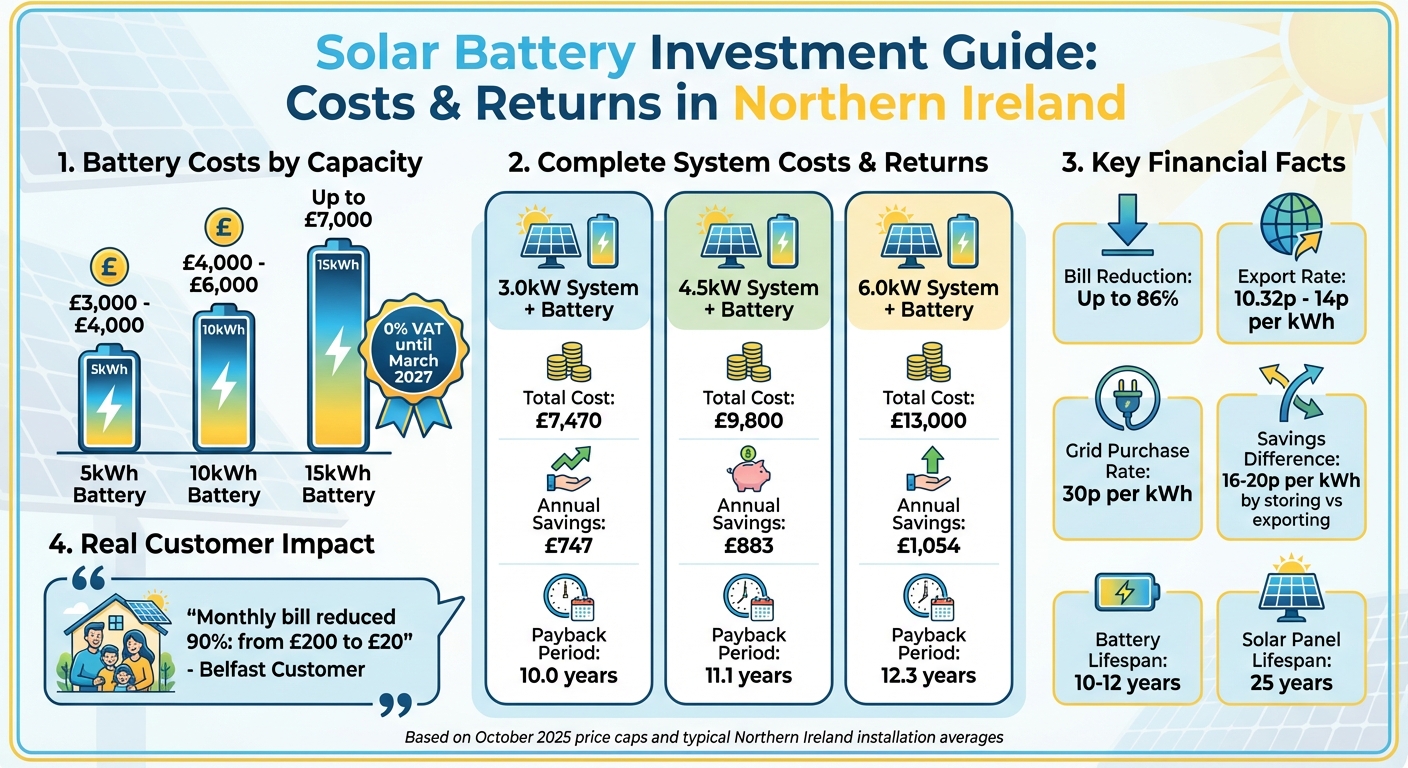
Solar Battery Cost vs Savings Comparison for Northern Ireland Homes
Battery Costs in Northern Ireland
When considering solar potential and tariff structures, it’s essential to factor in the costs and savings of battery storage. The price of a solar battery largely depends on its capacity and whether it’s installed alongside new solar panels or retrofitted to an existing system. Here’s a general idea of costs:
- A 5kWh battery typically ranges from £3,000 to £4,000.
- A 10kWh unit costs between £4,000 and £6,000.
- A 15kWh system can go up to £7,000.
For instance, EECO Energy offers several options, such as the Dyness 10kW battery for £2,400, the Soluna 10kW for £3,000, and the Duracell 10kW for £3,650. However, retrofitting a battery can be more expensive due to the need for inverter replacements and additional labour.
One advantage is that standalone batteries currently benefit from a 0% VAT rate, which will remain in place until March 2027. After that, the rate is expected to increase to 5%. The growing popularity of battery storage is clear – between June 2024 and May 2025, 94% of solar installations in the UK included a battery.
Now, let’s explore how these batteries can lead to real savings on your energy bills.
How Solar Batteries Can Save You Money
Solar batteries allow you to store the excess energy generated during the day, making it available for use in the evening. This reduces your reliance on grid electricity, which is especially beneficial given the current costs. In Northern Ireland, grid electricity is priced at about 30p per kWh, while exporting surplus solar energy earns between 10.32p and 14p per kWh. By using stored energy, you save the difference – roughly 16–20p per kWh.
For example, a typical 3-bedroom home equipped with a 4.5kW solar system and a 3kWh battery can save approximately £883 annually. Adding battery storage can increase monthly savings by 20–50% compared to solar panels alone. During winter, you can maximise savings by charging your battery overnight at cheaper off-peak rates.
"My monthly bill is down 90% from ~£200 per month to £20 per month. It’s had a huge impact on our family." – Lynsey, Belfast Customer, EECO Energy
Payback Period and Return on Investment
In Northern Ireland, most solar-and-battery systems achieve payback within 10–15 years. For instance, a 4kW solar system might cost around £7,000, breaking even in about 12.1 years. Adding a 5kWh battery increases the total cost to £10,500, extending the payback period to 14.6 years. However, the battery boosts annual savings from roughly £580 to £720.
Several factors can affect how quickly you recover your investment. Homes with lower daytime energy usage benefit most from batteries, as excess solar energy can be stored instead of being exported at lower rates. If electricity prices rise above 35p per kWh, payback periods could shorten significantly. The removal of VAT in May 2023 has already reduced payback times by 12–18 months.
Most lithium-ion batteries last between 10 and 12 years, so you might need to replace the battery once during the 25-year lifespan of your solar panels.
Here’s a breakdown of typical system costs, savings, and payback periods in Northern Ireland:
| System Size | Estimated Cost (with Battery) | Annual Savings | Payback Period |
|---|---|---|---|
| 3.0kW + Battery | ~£7,470 | £747 | 10.0 Years |
| 4.5kW + Battery | ~£9,800 | £883 | 11.1 Years |
| 6.0kW + Battery | ~£13,000 | £1,054 | 12.3 Years |
Based on October 2025 price caps and typical Northern Ireland installation averages.
What to Look for When Choosing a Solar Battery
Technical Specifications
When selecting a solar battery, pay close attention to its capacity, usable capacity, round-trip efficiency, and cycle life. These factors determine how well the battery will meet your energy needs. Capacity, measured in kilowatt-hours (kWh), indicates how much energy the battery can store. For instance, a 10kWh battery could power a typical home for about 10 hours. However, what truly matters is the usable capacity, which is usually 80–95% of the total capacity [51,53].
Round-trip efficiency measures how much energy you can retrieve compared to what you put in. Lithium-ion batteries generally offer 80–90% efficiency, while older lead-acid models lag behind at around 50%. Cycle life, another key factor, tells you how many charge and discharge cycles the battery can handle before its performance starts to decline. Lithium-ion batteries typically last for about 4,000 cycles, whereas lead-acid alternatives manage only around 1,000. For a 4kW solar system, an 8–9kWh battery is usually a good match to ensure efficient charging without energy loss.
Once you’ve reviewed these technical specs, the next step is to ensure the battery integrates seamlessly with your solar setup.
Compatibility with Solar Systems
Your current inverter setup plays a significant role in how your battery will fit into your system. Hybrid inverters can handle both solar panels and battery storage directly. However, if you have a standard string inverter, you’ll need either a separate storage inverter (AC-coupled) or an upgrade to a hybrid model [6,59]. AC-coupled systems are ideal for retrofitting, as the battery connects independently to your home’s wiring. On the other hand, DC-coupled systems are more efficient but require compatible equipment.
It’s also crucial to ensure that your battery and inverter operate at the same voltage for smooth performance. Be aware that some manufacturers design their batteries to work exclusively with their own inverters, which could limit your options. Additionally, your installer must notify the Distribution Network Operator (DNO) to ensure grid compliance. If your solar system is over 5–10 years old, you may need to upgrade your inverter to support modern battery technology [54,59].
After compatibility, focus on installation practices and warranty details to protect your investment.
Installation and Warranty Considerations
To safeguard your investment, opt for MCS-certified products and installers. Ensure warranties cover both the battery’s capacity retention and any installation-related issues. According to the new PAS 63100:2024 guidelines, batteries should not be installed in lofts, bedrooms, or under stairs. Instead, they should be placed in well-ventilated areas like garages, utility rooms, or purpose-built external enclosures with an IP65 rating [54,56].
Most solar batteries come with 10-year warranties that cover defects and guarantee a minimum of 70% capacity retention at the end of the warranty period [61,65]. To validate your warranty, register the product within 30 days of purchase. Also, check if the warranty transfers to a new owner if you sell your home.
"Workmanship warranties are only good if your installer stays in business to service your warranty. So, it’s imperative to choose a reliable installer." – Enphase
Keep the battery in an environment with temperatures between 15–21°C to maintain warranty coverage [62,65]. Extreme heat or exposure to salt air could void the warranty, as would damage caused by natural disasters or crime. Keeping detailed records of inspections and maintenance can also help support any future warranty claims [62,65].
sbb-itb-d2d975a
Is a Solar Battery Right for You?
Households That Benefit Most
Solar batteries are especially useful for households where people are out during the day and consume most of their electricity after 5:00 PM. By storing solar energy generated during the day for evening use, these homes can significantly cut costs by using energy during cheaper periods. In Northern Ireland, for instance, the average export rate is about 14p per unit, while grid electricity costs hover around 30p per unit – making this strategy particularly economical.
"Home storage batteries are invaluable for homes that are empty during daytime hours when solar panels are actively generating power." – Solarfix
This highlights the importance of matching your energy use to your solar generation profile. If you’re on a Time-of-Use tariff (like day/night or "Eco 7" rates), you can save even more. These tariffs allow you to charge your battery with low-cost electricity overnight and use it during pricier daytime hours, a practice known as "peak shaving". This method is especially handy during Northern Ireland’s darker winter months when solar output drops significantly.
For rural households in areas with unreliable grids or frequent outages, batteries with backup gateway functions provide peace of mind. A 10kWh battery can power essentials – like lights, Wi-Fi, and a fridge – for up to 24 hours during a power cut. Homes with electric vehicles or heat pumps also benefit, as batteries help manage high energy demands and increase the use of solar energy. Even those with older solar systems under the Northern Ireland ROCs scheme can retrofit batteries to improve self-consumption without losing incentive payments.
Now, let’s look at cases where a battery might not be the best choice.
When a Battery May Not Be Worth It
If you’re home during the day and can use energy as it’s generated, or if your solar array is small and produces little surplus energy, a battery may not make financial sense. Directly using electricity from your panels is more efficient, as storing energy involves conversion losses. With Northern Ireland receiving about 1,600 hours of sunlight annually, sizing your system correctly is key.
The cost of installing a battery – ranging from £1,500 to £10,000 – should also be weighed against its lifespan and your system’s performance. If you’re on a flat-rate tariff without time-of-use pricing, the potential savings shrink even further. Standalone batteries without solar panels generally don’t pay for themselves over their lifetime, saving only about £375 per year.
To decide if a battery is right for you, it’s important to carefully analyse your energy usage patterns. The framework below can help guide your decision.
Decision Framework
Here’s a quick comparison of factors to consider when deciding if a solar battery suits your needs:
| Factor | Ideal for a Battery | Less Suitable for a Battery |
|---|---|---|
| Occupancy | Home is empty during the day | Someone is home using appliances all day |
| Usage Pattern | High evening/night electricity demand | High daytime electricity demand |
| Tariff | Smart/ToU or Day-Night tariff | Standard flat-rate tariff |
| Grid Reliability | Frequent outages (Rural NI) | Very stable grid (Urban areas) |
| Budget | Long-term investment focus | Seeking lowest upfront cost |
| Other Tech | Owns an EV or heat pump | No high-energy devices or vehicles |
Before making a decision, monitor your energy usage for at least a month to identify when your peak consumption occurs and whether it aligns with your solar generation. If you work from home or are retired and use most electricity during daylight hours, alternatives like a hot water diverter or selling excess energy back to the grid might be more effective. However, for households with higher evening energy needs, pairing a battery with the right tariff could save around £883 annually. Compare your energy habits with these factors to determine your next steps.
Working with EECO Energy for Solar and Battery Systems

EECO Energy’s Services
EECO Energy offers a range of solar and battery storage solutions designed to meet various energy needs. These include Duracell-approved battery installations, off-grid systems, and EV charging stations. Their solar systems range from a 4.5kW setup (10 panels, producing approximately 3,380kWh annually, priced at £3,950) to a 9kW system (20 panels, generating about 7,099kWh annually, priced at £5,900). For battery storage, customers can choose from options like the Dyness 10kWh unit (£2,400), Soluna 10kWh (£3,000), or Duracell 10kWh (£3,650). Every installation comes with a 25-year warranty and adheres to Northern Ireland’s strict regulatory and licensing standards as set by the Utility Regulator.
EECO Energy ensures that these solutions are tailored to individual needs during the design and installation process, offering a reliable and efficient way to manage energy consumption.
System Design and Installation Process
EECO Energy takes a personalised approach to system design, considering factors like typical daily energy usage (around 9.3kWh) and local conditions. Their designs are crafted to optimise time-of-use tariffs, enabling batteries to charge during cheaper, off-peak hours (typically midnight to 5:00 AM) and discharge during peak times, which helps to maximise cost savings. For new installations, they recommend DC-coupled systems, which integrate directly with the inverter, reducing power conversions and minimising energy loss.
The installation process is efficient, usually completed within a single day. Once installed, monitoring equipment is set up to track system performance and schedule maintenance as needed. These thoughtful customisations ensure reliable operation and help customers save more on their energy bills.
Why Choose EECO Energy
EECO Energy’s combination of expertise, customisation, and credentials makes them a standout choice for solar and battery installations. Their MCS accreditation assures customers that all installations meet safety standards and are eligible for warranties. This is particularly important as the demand for MCS-certified battery systems in the UK has skyrocketed – from just 34 installations per month in 2022 to over 1,100 in 2024.
The company’s deep understanding of Northern Ireland’s unique planning rules and Utility Regulator licensing ensures full compliance with local regulations. Customers can also benefit from a 0% VAT rate on installations until 31 March 2027, and systems designed to increase self-consumption from 30% to 80%, slashing electricity bills by as much as 86%.
EECO Energy makes it easy to explore these benefits with free surveys and quotes, helping you determine if a solar or battery system is the right fit for your energy needs.
Conclusion
Solar batteries are transforming how renewable energy is used in Northern Ireland. By storing surplus energy for use during evenings or peak-rate periods, households can increase their energy self-sufficiency and potentially reduce bills by as much as 86%. But the benefits go beyond just saving money – they also provide energy independence, serve as a backup during power outages, and contribute to the UK’s ambitious net zero goals.
Deciding whether to invest in a solar battery system depends on your unique energy needs. Households with higher energy use in the evenings, electric vehicles, or heat pumps are often the best candidates. With battery prices decreasing and a 0% VAT rate available until 31 March 2027, these systems can pay for themselves in about six years, offering substantial savings over time.
EECO Energy makes it easy to take advantage of these benefits. From the initial assessment to installation and ongoing support, they handle the entire process seamlessly. Their certified solutions, backed by 25-year warranties, ensure your system is designed and installed safely and efficiently.
Whether you’re upgrading an existing solar setup or starting from scratch, EECO Energy offers free surveys and quotes to help you find the perfect solution for your home.
FAQs
How can solar batteries impact your energy bills in Northern Ireland?
Solar batteries can be a smart way to cut down on your energy bills over time. By storing the extra electricity generated by your solar panels, you can use it later instead of drawing power from the grid. While the initial cost of a solar battery typically falls between £1,500 and £4,000, they could save you about £340 a year, depending on your energy consumption and tariff rates.
Although adding a solar battery might increase the time it takes to see a return on your solar system investment, the long-term advantages are hard to ignore. These include greater energy independence, shielding yourself from rising electricity prices, and having backup power during blackouts. Plus, if electricity prices climb above 35p per kWh, the savings you could achieve with a solar battery become even more appealing.
What affects the efficiency of a solar battery system?
The performance of a solar battery system hinges on several important factors. First, sunlight exposure plays a major role – more direct sunlight means better energy generation. Similarly, temperature can affect efficiency, with cooler conditions often yielding better results. The orientation and tilt of the panels are also crucial, as they should be adjusted to capture the maximum amount of sunlight throughout the day.
Other elements, like shading and dirt or debris on the panels, can reduce efficiency, so keeping them clean and free from obstructions is essential. The quality of the panels themselves is another important consideration, as higher-quality panels tend to perform more reliably over time.
Weather can also influence performance. For example, rain or snow may temporarily affect energy production. Additionally, the inverter’s efficiency, which converts the solar energy into usable electricity, plays a significant role in overall system output. Regular maintenance and ensuring that your solar panels and battery are fully compatible will help you maximise your system’s potential.
Are solar batteries a good option for homes that use less energy during the day?
Yes, solar batteries can be an excellent choice for households with lower energy usage during the day. They let you store the extra energy your solar panels produce and use it later – like in the evening or on overcast days. This can cut down your dependence on the grid and help you save on electricity costs.
Even smaller batteries can work well for homes with modest energy needs. They’re particularly handy if you want backup power during outages or to avoid paying higher electricity rates during peak hours. By storing and using the energy your solar panels generate, you can make your system more efficient and economical.