

Winter solar energy in Northern Ireland faces challenges like shorter days, low sun angles, and frequent cloud cover, reducing panel efficiency to 10–25%. However, colder temperatures can improve panel performance by up to 10%.
Here’s how you can optimise your system for winter:
- Panel Positioning: Face panels south with a steeper tilt (35°–45° or latitude + 15°) to catch low-angle sunlight. For fixed systems, a 30°–35° tilt balances year-round performance.
- Maintenance: Clean panels regularly to remove dirt, debris, and snow. Use soft tools and avoid harsh chemicals to prevent damage.
- Technology Choices: Monocrystalline panels and PERC technology work well in low-light conditions. Pair with MPPT or hybrid inverters for consistent performance on cloudy days.
- Battery Storage: Store excess energy to use during evenings or cloudy days. Night charging with Economy 7 tariffs can lower energy costs by up to 50%.
With proper setup and care, solar panels can still deliver reliable energy and reduce costs during the colder months.
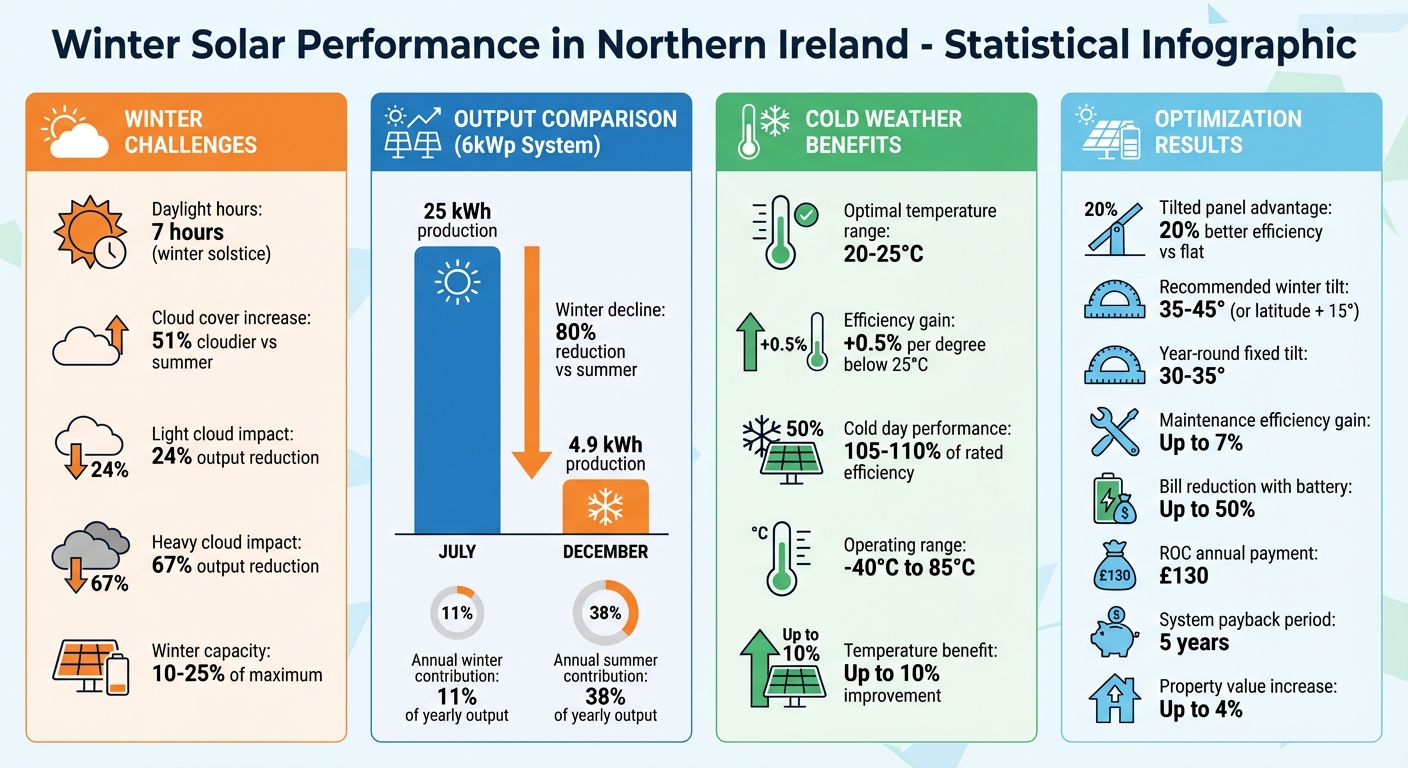
Solar Panel Performance in Northern Ireland Winter: Key Statistics and Efficiency Data
How Winter Weather Affects Solar Panels in Northern Ireland
Winter in Northern Ireland brings a unique set of challenges for solar energy production. With daylight lasting only about 7 hours during the winter solstice and skies being 51% cloudier compared to summer, the amount of sunlight reaching solar panels is significantly reduced. This decrease in light intensity directly impacts the energy output of solar systems.
However, solar panels don’t stop working during winter. Even under cloudy skies, they continue to generate electricity. For instance, light cloud cover typically lowers output by around 24%, while heavy cloud cover can reduce it by as much as 67%. During these colder months, panels often operate at just 10–25% of their maximum capacity.
Solar Output During Shorter Winter Days
The shorter days of winter have a noticeable effect on daily energy production. With less daylight, overall energy yields drop considerably. For example, a 6kWp solar system might produce 25kWh in July but only 4.9kWh in December. Across the UK, winter months contribute only about 11% of the annual solar energy output, compared to approximately 38% during summer. This represents a decline of around 80% when compared to the summer months. Despite these limitations, modern solar panels are designed to capture scattered light effectively, even when the sun is lower in the sky.
How Cold Weather Improves Panel Efficiency
Interestingly, colder temperatures can actually enhance the efficiency of solar panels. While shorter days limit the total energy produced, the cold weather itself provides a technical advantage. Solar panels perform best at temperatures between 20°C and 25°C, but when temperatures drop below 25°C, efficiency can increase by up to 0.5% for every degree below that threshold. On clear, cold winter days, panels can even operate at 105% to 110% of their rated efficiency. Additionally, modern panels are built to endure extreme conditions, functioning reliably in temperatures ranging from -40°C to 85°C. This durability makes them well-suited to handle the demands of Northern Ireland’s winter climate.
Positioning Solar Panels for Winter Performance
Getting the positioning right plays a big role in maximising energy production during winter. With the sun hanging much lower in the sky during Northern Ireland’s colder months, the angle and direction of your solar panels become critical for soaking up as much sunlight as possible.
Setting the Right Tilt and Orientation
For optimal winter performance, solar panels should face south to follow the sun’s path from east to west. Since the sun sits lower from October to March, a steeper tilt is essential to capture sunlight effectively.
If you have adjustable mounts, increase the tilt by about 30° during winter. This means aiming for an angle between 35° and 45° relative to the ground. Alternatively, you can use the formula "latitude + 15°" to determine the best tilt. With Northern Ireland’s latitude at roughly 54.5°N, this suggests a winter tilt of around 70° for maximum exposure. For fixed systems, a tilt between 30° and 35° strikes a good balance for year-round energy capture. Tilted panels, in fact, can deliver up to 20% better efficiency compared to flat installations.
"A steeper angle in winter captures the low sun, whereas a shallower angle in summer is optimal for the higher sun." – Joe Brennan, Founder, Going Solar
How Location and Elevation Affect Winter Output
Winter brings longer shadows due to the low sun angle, so a shading analysis is essential. Structures like trees or buildings that may not block sunlight in summer could cast significant shadows in December. A winter-specific shading audit can help uncover these potential issues.
Elevation and local geography also play a part. In areas that experience snow, particularly at higher altitudes, steep angles (around 60° or more) can help snow slide off naturally while also taking advantage of light reflected off snowy surfaces. Fresh snow, with a reflectivity of 0.8 to 0.9, can enhance energy capture through the albedo effect, especially for steeply tilted or vertical panels. For ground-mounted systems, ensure they’re elevated enough to stay clear of snow drifts or low vegetation that could block sunlight.
Beyond these adjustments, proper airflow is another factor that can boost your system’s winter efficiency.
Maintaining Airflow Around Panels
Cooler winter temperatures naturally improve panel efficiency, but ensuring good airflow is still important. While the cold helps, solar panels generate internal heat that needs to be released.
"The machinery and electronics of your system actually function better in colder temperatures." – Missouri Wind and Solar
Panels mounted at an angle allow air to circulate behind them, which helps with heat dissipation and prevents overheating. Ground-mounted systems generally offer better airflow, while roof-mounted panels should have enough space between them and the roof to encourage natural ventilation. It’s also important to make sure that nearby objects or debris don’t obstruct airflow around the panels.
Winter Maintenance for Solar Panels
Taking care of your solar panels during the winter doesn’t take much effort, but a few simple steps can help maximise your energy output. Regular upkeep can improve efficiency by up to 7%, even during the shorter days and reduced sunlight of the season. Paired with proper positioning, maintenance ensures your panels perform well despite the challenges of winter.
Cleaning Panels to Remove Dirt and Debris
Before starting, always switch off your solar system to ensure safety for both you and the equipment. To clean the panels, use a garden hose with a spray attachment to rinse off loose dirt. For tougher grime, gently scrub with a soft-bristle brush or squeegee, using plain water or a mild biodegradable detergent. Steer clear of harsh chemicals like bleach, ammonia, or Windex, as these can damage the cells. Also, avoid using water that is significantly hotter or colder than the panels to prevent cracking.
If your panels are hard to reach or the roof is slippery, consider hiring professional cleaners, which typically costs around £250. Always clean from the ground using an extension pole to minimise risks.
"Washing them off with the hose is sufficient if you notice any sort of thick layer of dust, pollen, dander, or ashes. Other than that, they’re virtually maintenance free." – Guy Gabay, Solar Energy Contractor
Keeping your panels clean is just one part of winter maintenance; managing snow buildup is equally important.
Dealing with Snow on Panels
In most cases, light snow clears itself naturally. Solar panels generate some heat during energy production, which helps melt frost and thin snow layers [8, 19]. Modern panels are also designed to function under up to 15cm of snow, and many come with hydrophobic or anti-reflective coatings that help snow and ice slide off more easily.
For heavier snow, use a specialised snow rake with a soft foam head to gently clear the surface. A leaf blower can also work well for light, powdery snow. Always clear snow from ground level using an extension pole – climbing onto an icy roof is dangerous. Avoid using metal tools, chemical de-icers, or salt, as these can corrode the frames and damage the panels’ protective coating. Never try to chip away at frozen ice with hard tools, as this can cause permanent damage and may void your warranty.
sbb-itb-d2d975a
Selecting Solar Technology for Low-Light Conditions
After ensuring optimal positioning and regular maintenance, the next step is choosing the right solar technology to keep your system running efficiently during Northern Ireland’s cloudy winters. Not all solar panels or inverters perform well under low-light, overcast conditions. To get the most out of your setup, it’s essential to select equipment designed to handle diffused light, rather than systems tailored for sunnier climates.
Panel Types for Diffused Light Performance
For Northern Ireland’s grey and overcast winters, monocrystalline panels stand out as the best option. These panels use high-quality silicon and advanced light-trapping technology to maintain energy production, even when sunlight is scarce. Unlike older panel designs, modern solar panels generate electricity using UV light from daylight, not heat, which means they continue to work effectively on cloudy days. Interestingly, colder weather can actually improve panel efficiency, as mentioned earlier.
When shopping for panels, look for Tier 1 PV solar panels. These are built for durability and are specifically designed to handle the unpredictable weather conditions typical of Northern Ireland. Panels equipped with PERC (Passive Emitter and Rear Cell) technology offer an extra edge by capturing reflected light on the back of the cell, boosting overall efficiency in low-light situations. Pairing these with the right inverter technology ensures the energy captured is converted efficiently, even when light levels vary.
Inverter Technology for Variable Weather
High-quality panels need equally capable inverters to maximise energy output. Modern inverters with Maximum Power Point Tracking (MPPT) technology are ideal for Northern Ireland’s winter weather. These inverters constantly adjust voltage and current to extract the most power possible from the fluctuating light levels caused by moving clouds. This adaptability ensures consistent performance, even when conditions are less than ideal.
For an even smarter solution, hybrid inverters offer advanced energy management. Using AI, these systems prioritise your household’s electricity needs first, then direct any surplus energy to battery storage, water heating, or even EV charging. This approach helps maximise self-consumption during the shorter daylight hours of winter. Additionally, real-time performance tracking through Energy Management Systems (EMS) lets you monitor how well your system is operating, ensuring it meets expectations despite the weather. When choosing solar technology for Northern Ireland, focus on equipment optimised for low-light conditions and temperature stability, rather than systems designed for high-sunlight environments.
Using Battery Storage to Maintain Winter Energy Supply
Adding battery storage to your winter solar setup turns it into a more consistent energy source. Batteries help bridge the gap between the 7–8 hours of daylight in winter and your evening energy needs by storing surplus power for later use. Even though a 4kW system might only generate 3–6 kWh per day during the winter months, batteries ensure every watt is utilised efficiently. This approach not only smooths the transition from day to night but also boosts the overall reliability of your system during the colder season.
Storing Energy for Cloudy Days
Battery systems are particularly useful on overcast days, capturing energy from shorter daylight hours to cover times of low production. Even under cloudy skies, solar panels can still produce between 20% and 40% of their usual output, which is often enough to partially charge a battery. For homes with fossil fuel heating, a 5kWh battery can generally cover evening energy needs. However, properties using heat pumps or electric heating typically require a larger capacity, around 9kWh, to meet their higher winter demands.
When solar output isn’t enough, night charging becomes a practical solution. By taking advantage of off-peak tariffs like Economy 7, you can charge your battery overnight at a lower cost, ensuring it’s ready to power your home throughout the day. Regular charging cycles also help maintain battery health and prevent it from entering ‘sleep mode’.
Lowering Winter Energy Bills
Pairing solar panels with battery storage can lead to noticeable savings during winter, when energy prices are often at their peak. For example, storing off-peak electricity at 10–15p per kWh and using it during peak times, when rates exceed 30p per kWh, can significantly reduce your electricity costs. Some users have reported cutting their bills by nearly 50%. Over the typical 10–12 year lifespan of a battery, these daily savings can add up considerably.
In Northern Ireland, homeowners can also take advantage of Renewables Obligation Certificate (ROC) payments, which provide around £130 annually for solar generation. When combined with battery storage, which maximises the use of self-generated energy, these payments further enhance your savings. To get the most out of your system, schedule high-energy appliances like washing machines and dishwashers to run during peak solar generation hours or when your battery is discharging stored off-peak energy, rather than relying on costly grid electricity.
Backup Power During Peak Demand
Battery storage offers more than just cost savings – it also provides peace of mind by acting as a backup power source during outages. Winter storms and increased grid demand can lead to power cuts in Northern Ireland, but a battery system ensures you have reliable energy for essential appliances when you need it most. Many systems allow you to set a reserve level via an inverter app, keeping power available for critical needs during outages.
Additionally, battery storage reduces your reliance on the grid during peak evening hours, when demand and costs are at their highest. While solar systems alone rarely meet 100% of a home’s winter energy needs in Northern Ireland, adding a battery significantly lowers grid dependence during these critical periods. However, it’s important to monitor the internal temperature of your battery, not just the ambient room temperature. Lithium-ion batteries may experience reduced performance or slower charging if their internal temperature drops below 12.5°C. Fortunately, most modern systems come equipped with Battery Management Systems (BMS) that adjust charge rates to safeguard the battery’s health during temperature changes.
Conclusion
Getting the most out of your solar panels during Northern Ireland’s winter months doesn’t have to be complicated. A few practical steps, like ensuring the panels are correctly positioned and scheduling regular cleaning and inspections, can keep your system running smoothly and efficiently. Even small actions, such as trimming nearby branches to reduce shading, can make a noticeable difference during the shorter days of winter.
Modern solar technology is designed to handle winter challenges effectively. Cooler temperatures can actually improve panel efficiency, and when combined with smart inverters and battery storage, your system can still provide value even on overcast days. To make the most of this, consider shifting energy-heavy tasks to midday when sunlight is strongest and taking advantage of off-peak night charging to maintain a steady energy supply.
The benefits of solar don’t stop with winter performance. Financially, solar systems often pay for themselves within five years and can even boost your property value by up to 4%. By integrating solar generation with battery storage and smart tariff strategies, you can achieve greater energy independence, cutting down on reliance on grid electricity during costly peak times.
FAQs
How can I maximise the efficiency of my solar panels during cloudy winter days in Northern Ireland?
To keep your solar panels working effectively during Northern Ireland’s cloudy winters, make sure they’re positioned to catch the lower winter sun. Regular cleaning is essential to remove dirt, debris, or any snow that might settle on them. If there are trees nearby, trimming them can reduce shading and maximise sunlight exposure. You might also want to look into anti-reflective coatings to help your panels absorb more light.
Interestingly, cooler temperatures can boost the performance of solar panels. To make the most of this, keep your system well-maintained. Adding a battery storage system is another smart move – it allows you to store any surplus energy produced during brighter spells, so you’ll still have power on those grey, overcast days.
Which solar panels work best in low-light conditions?
Solar panels with high efficiency are particularly well-suited for low-light conditions, such as the overcast winter days often experienced in Northern Ireland. Monocrystalline panels are a popular option because they tend to produce more energy even when the weather is less favourable. That said, their actual performance also hinges on a few key factors: correct positioning, regular upkeep, and keeping the panels free from dirt or debris.
To make the most of your solar setup in low-light conditions, it’s worth looking into a battery storage system. This lets you save any surplus energy generated during sunnier times, giving you a steady energy supply throughout the day – even when sunlight is scarce.
How can battery storage improve solar energy use during winter in Northern Ireland?
Battery storage lets you save the solar energy produced during those shorter, cloudier winter days and use it whenever you need it – like in the evenings or overnight. This means you can rely less on the electricity grid and enjoy a steadier energy supply at home.
It also offers another perk: you can make the most of cheaper off-peak electricity rates. By storing energy during times of lower demand, you can use it during peak hours, which can boost efficiency and help cut down your energy bills.