
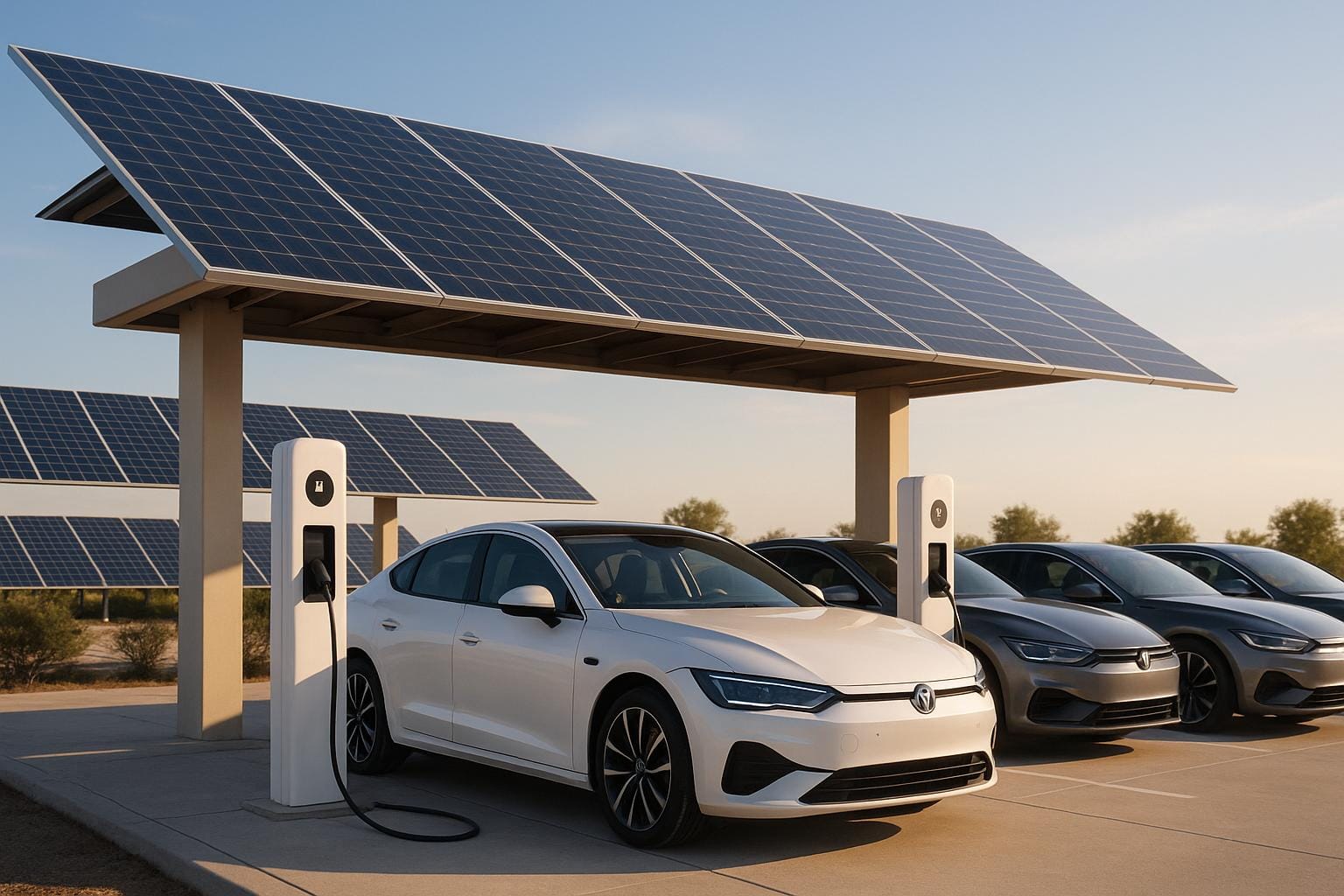
The mismatch between EV charging habits and solar energy production is creating challenges for the UK’s electricity grid. While solar panels generate power during the day, most EV owners charge their vehicles in the evening or overnight, leading to increased grid strain and reliance on fossil fuels during peak hours.
To address this, integrating battery storage systems, smart charging technologies, and workplace charging infrastructure can help align solar energy production with EV charging demand. For example:
- Battery storage: Stores daytime solar energy for evening use, reducing grid dependency.
- Smart charging: Encourages charging during solar peak hours, aided by time-of-use tariffs.
- Workplace charging: Aligns EV charging with midday solar energy generation.
In Northern Ireland, companies like EECO Energy are already installing solar and battery systems to help homes and businesses use more renewable energy, cut costs, and reduce grid pressure. These solutions are vital as EV adoption continues to grow, with battery electric vehicles now accounting for 23.7% of new car sales in the UK as of January 2025.
The key takeaway? Synchronising EV charging with solar production not only reduces costs but also supports a cleaner, more efficient energy system.
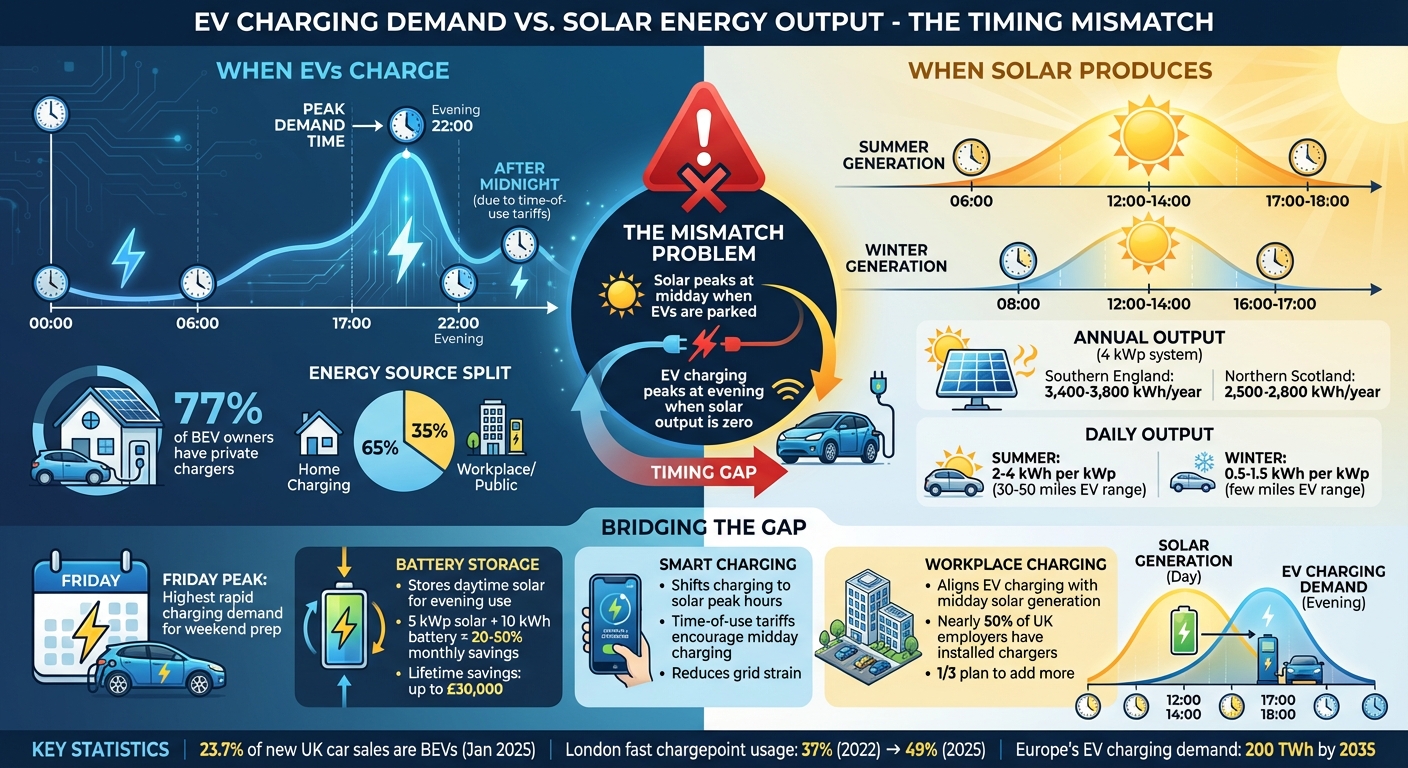
EV Charging Demand vs Solar Energy Output: Daily Timing Mismatch
1. EV Charging Demand Patterns
Demand Timing
Charging electric vehicles at home continues to be the most common practice, with 77% of BEV (Battery Electric Vehicle) owners having private chargers and 12% relying on semi-private options. However, even with this widespread home access, only about 65% of the total energy used for charging comes from home setups. The remaining 35% is split between workplaces and public charging points.
The introduction of time-of-use tariffs has influenced many EV owners to begin charging after midnight, creating a noticeable surge in electricity demand during late-night and early-morning hours. This shift in behaviour is reshaping how and when the grid experiences pressure, concentrating loads within specific time windows.
These evolving patterns are also reshaping the needs for charging infrastructure.
Infrastructure Requirements
Fridays see the highest demand for rapid charging, as drivers prepare for weekend journeys by topping up their batteries. In London, the utilisation of fast chargepoints has jumped significantly – from 37% in 2022 to 49% by 2025 – even as the network expanded to include roughly 25,500 charging points. This increased usage during peak times is putting added strain on the already stretched infrastructure, highlighting the growing challenge of meeting demand.
2. Solar Energy Output Cycles
Supply Timing
Solar energy production in the UK follows a clear daily pattern. During summer, solar panels start generating power around 06:00–07:00, while in winter, this shifts to roughly 08:00–09:00. Peak production typically occurs between 12:00 and 14:00, tapering off by 17:00–18:00 in summer and 16:00–17:00 in winter. This natural rhythm doesn’t align well with the demand for EV charging, which tends to peak in the evening and overnight when solar supply is at its lowest.
A 4 kWp solar system installed in southern England can produce about 3,400–3,800 kWh annually. In contrast, the same system in northern Scotland generates less, around 2,500–2,800 kWh per year. Daily output varies widely: in summer, it ranges from 2–4 kWh per kWp, while in winter, it drops significantly to just 0.5–1.5 kWh per kWp. To put this into perspective, winter solar generation might only provide enough energy for a few miles of EV travel, whereas summer output on a clear day could support 30–50 miles. This mismatch between when energy is produced and when it’s needed highlights the importance of efficient energy management strategies.
Integration Solutions
To address these mismatches, smart integration technologies are essential. Battery storage systems are particularly valuable, allowing excess solar energy generated during the day to be stored and used for EV charging in the evening. For example, pairing a 5 kWp solar array with a 10 kWh battery can significantly cut grid reliance, increase monthly savings by 20–50%, and achieve lifetime savings of up to £30,000.
Smart charging systems further optimise usage by enabling EVs to charge during peak solar production hours, easing pressure on the grid. Time-of-use tariffs also support this by offering cheaper electricity rates during midday, encouraging users to charge their vehicles when renewable energy supply is at its highest. For businesses, solar canopies over car parks are a practical solution, providing direct power for fleet vehicles during the day while also reducing operational costs and grid demand.
In Northern Ireland, companies like EECO Energy (https://eeco.energy) are helping homes and businesses make the most of solar power. By providing solar panels and battery systems, they enable users to align their EV charging with periods of high solar output, making energy consumption both more efficient and more affordable.
sbb-itb-d2d975a
Pros and Cons
Below is a comparison of the strengths and weaknesses of current EV charging patterns and solar energy output cycles.
| Aspect | EV Charging Demand Patterns | Solar Energy Output Cycles |
|---|---|---|
| Timing | Pros: Evening charging benefits from off-peak tariffs (often after 23:00), lowering costs and easing grid stress. Charging at home or work provides flexibility. Cons: Evening peaks (17:00–22:00) add pressure to the grid and increase costs. | Pros: Midday solar peaks are consistent. Once installed, solar panels generate electricity automatically without additional fuel costs. Cons: Solar output is highest when most EVs aren’t being used. |
| Flexibility | Pros: EV charging is adaptable as vehicles are parked for extended periods. Smart chargers and time-of-use tariffs optimise schedules, while Vehicle-to-Grid (V2G) technology can return power to the grid. Cons: Rapid charging spikes, especially on motorways, strain infrastructure. For instance, London’s fast chargepoints saw usage increase from 37% in 2022 to 49% in 2025, highlighting concentrated peak-time demand that’s hard to shift. | Pros: Solar installations operate at zero marginal cost and increase output with available sunlight. Distributed rooftop systems can reduce daytime grid demand locally. Cons: Solar output depends on sunlight, which can’t be controlled. Weather and seasonal changes create variability, requiring backup systems, storage, or flexible loads for consistent EV charging. |
| Integration | Pros: Smart charging allows EVs to use surplus renewable energy and support grid services. Workplace charging aligns better with solar peaks than overnight home charging. Cons: Tariff structures often favour overnight charging, limiting daytime solar use. Additionally, only about 65% of home-charging energy comes from home setups; the remaining 35% is sourced from work or public chargepoints. | Pros: Battery storage shifts surplus solar energy to meet peak demand. Co-locating batteries with rapid chargers can cut required grid connection capacity by up to 70%, reducing costs significantly. Cons: Without storage, solar energy cannot meet evening EV demand. High solar usage can also cause steep evening ramps on the grid when generation drops suddenly. |
Balancing EV charging demand with solar energy production requires smart solutions. The key challenge lies in the mismatch: EV charging peaks in the evening, while solar energy is produced during the day. Yet, this challenge can be addressed. Battery storage systems, smart charging technologies, and improved workplace charging infrastructure are all tools that can help align demand with supply.
In Northern Ireland, EECO Energy (https://eeco.energy) is already demonstrating this by integrating solar and battery systems to shift daytime energy to evening demand. Recognising the importance of storage, the UK government allocated £10 million in November 2025 to fund rapid charging projects in grid-constrained areas, using batteries and renewable energy sources.
For EV users, the benefits of battery-backed solar systems are clear. These systems can increase monthly savings by 20–50% and deliver lifetime savings of up to £30,000, making them a practical and economical choice for many households.
Conclusion
Electric vehicle (EV) charging tends to peak at night, while solar energy generation reaches its highest levels during the day. This mismatch puts pressure on the electricity grid and limits the potential benefits of renewable energy for transportation. With Europe’s total EV charging demand expected to hit 200 TWh by 2035 and the UK seeing a 42% year-over-year rise in battery electric vehicle (BEV) registrations as of January 2025, finding a solution to this imbalance is becoming increasingly important.
Three technologies play a critical role in addressing this challenge:
- Battery storage: This allows surplus solar energy generated during the day to be stored and used later, particularly for overnight EV charging.
- Smart charging: By adjusting charging times to align with solar generation, especially at workplaces where cars are parked during daylight hours, this approach helps balance supply and demand.
- Vehicle-to-grid (V2G) technology: Expected to grow significantly by 2035, V2G enables EVs to send power back to the grid, further stabilising energy use.
Beyond these technologies, investment in infrastructure is vital. In the UK, nearly half of employers have already installed EV chargers, and around one-third plan to add more. Workplace charging hubs, combined with battery storage systems, can optimise the use of renewable energy by synchronising charging with solar output.
Integrated solar-EV systems offer multiple benefits. They lower electricity bills, enhance energy independence, and open the door to participating in grid flexibility markets. EECO Energy, for example, has been implementing this approach in Northern Ireland by installing solar panels and battery systems that allow businesses to generate their own power, reduce costs, and support EV charging needs.
Looking ahead, coordinated efforts are essential. Upgrading local electricity networks, strategically deploying solar and battery infrastructure, and introducing regulatory frameworks to encourage daytime charging are all key steps. With fast chargepoint utilisation rising from 37% in 2022 to 49% in 2025, the urgency to act is clear. The tools and technologies are already available; now, it’s a matter of putting them into action. Integrated solar-EV systems are central to achieving Northern Ireland’s goals for sustainable and efficient mobility.
FAQs
How does battery storage help synchronise EV charging with solar energy production?
Battery storage lets you save excess solar energy generated during the day, making it available to charge your electric vehicle (EV) in the evening or at night when solar production slows down. This means your EV can still run on renewable energy, even after the sun has set.
By cutting down on your need for electricity from the grid, battery storage helps you make the most of your solar energy. This not only reduces your energy costs but also promotes a greener, more sustainable way to charge your EV. It’s a smart solution for managing energy supply and demand, particularly for homes and businesses with EVs.
How does smart charging help manage energy demand and reduce grid strain?
Smart charging is key to balancing energy use by scheduling EV charging during off-peak times or when renewable energy, like solar, is plentiful. This approach eases the strain on the electricity grid, especially during periods of peak solar generation, and ensures renewable energy is utilised more effectively.
By syncing EV charging with times of high solar energy production, smart charging not only enhances grid stability but also helps users save on energy bills. It’s a straightforward way to align energy demand with supply while making the most of cleaner energy options.
How does workplace EV charging support solar energy use?
Workplace EV charging offers a convenient way for drivers to power up their vehicles during the day, coinciding perfectly with peak solar energy production. By charging at their place of work, EV owners can tap into locally generated solar power, cutting down on reliance on the traditional grid.
This method not only helps align energy supply with demand during daylight hours but also boosts the efficiency of solar power systems. It’s a practical step towards smarter and more sustainable energy use.