
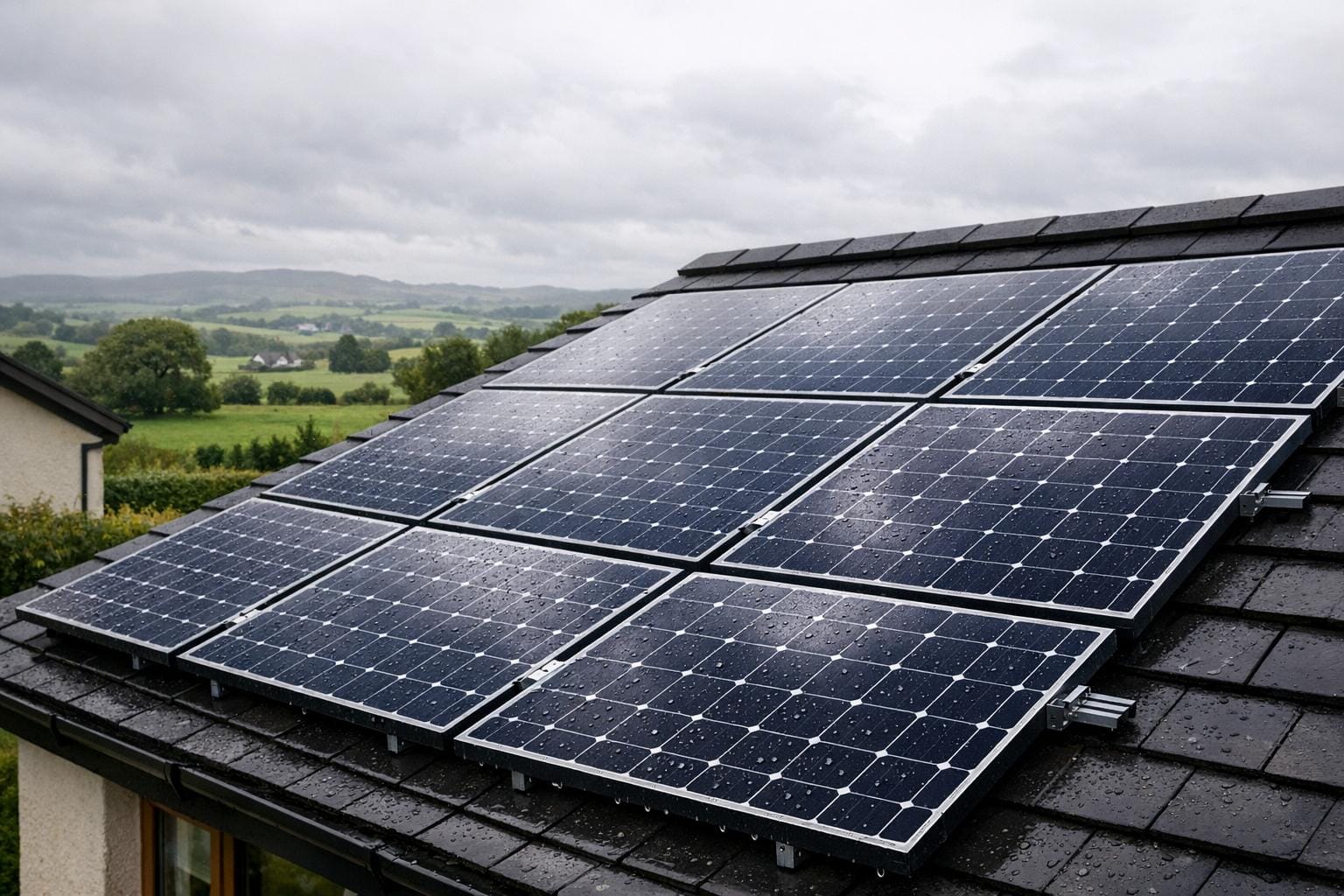
Solar panels work even on cloudy days – because they use daylight, not direct sunlight or heat. Modern monocrystalline panels can generate 10–25% of their capacity during overcast conditions, thanks to their ability to utilise scattered or "diffuse" light. In Northern Ireland, where cloudy skies are common, this means reliable energy production year-round. Cooler temperatures also help panels perform better by reducing heat-related inefficiencies, while frequent rain naturally cleans the panels.
Key facts:
- Cloudy day output: 10–25% of maximum capacity.
- Annual energy generation: A 4kW system produces 3,400–4,200 kWh, covering 40–60% of a typical household’s electricity needs.
- Best panels: Monocrystalline panels are most effective in low-light conditions.
- Additional benefits: Battery storage and smart inverters improve performance and reliability.
Even in Northern Ireland’s unpredictable weather, solar panels remain a practical way to reduce energy bills and carbon footprints.
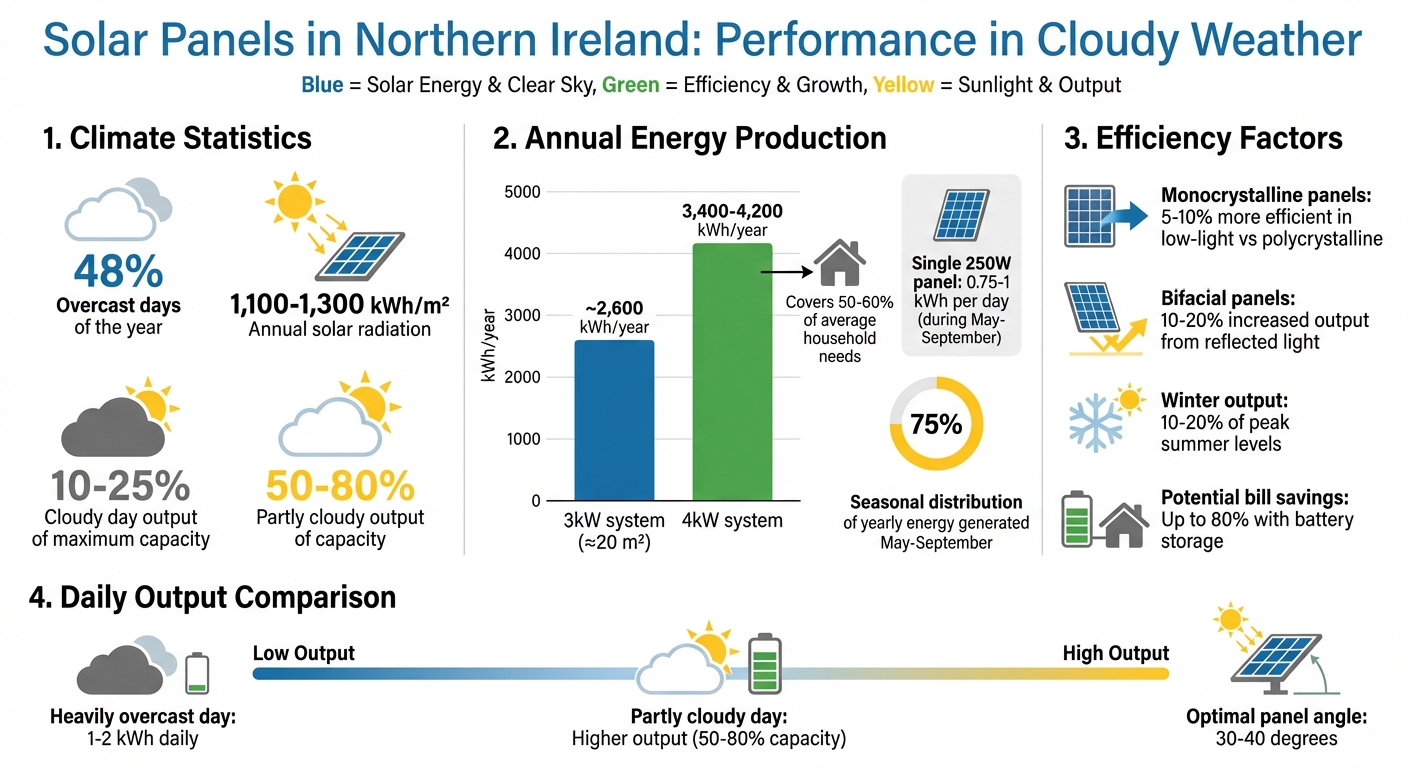
Solar Panel Performance in Northern Ireland: Key Statistics and Output Data
How Solar Panels Work in Cloudy Weather
Northern Ireland’s Climate and Solar Generation
Northern Ireland experiences overcast skies for nearly 48% of the year. Yet, this doesn’t mean solar panels are ineffective. The region receives between 1,100 and 1,300 kWh of solar radiation per square metre annually, which is enough to make solar panels a practical energy solution.
Interestingly, Northern Ireland’s higher latitude comes with an advantage: longer daylight hours during summer. This helps offset the shorter, dimmer days of winter. Additionally, the mild climate ensures that solar panels don’t overheat, keeping their efficiency intact. Frequent rain also works in favour of solar systems, as it naturally cleans the panels, helping them perform optimally.
Understanding how solar panels utilise both direct and scattered light is key to appreciating their performance in such conditions.
Direct vs. Diffuse Light: Energy Production on Cloudy Days
Solar panels harness energy from two types of light: direct and diffuse. Direct sunlight provides maximum power, allowing panels to operate at full capacity. Diffuse light, which is less intense, still contains enough photons to generate electricity even on cloudy days.
Modern photovoltaic cells are designed to work with both types of light. On overcast days, panels primarily rely on diffuse light. Advanced monocrystalline panels, made with high-quality silicon, are particularly effective in low-light conditions. This material allows electrons to flow more freely, improving energy capture. Additionally, the "edge-of-cloud effect" can cause a temporary spike in output when sunlight is concentrated along the edges of clouds.
Seasonal Changes and Solar Output
Seasonal shifts also play a significant role in solar energy production. During the winter months (November to January), solar output typically drops to 10–20% of peak summer levels. This is due to shorter days and the sun’s lower position in the sky. However, in summer, longer daylight hours allow panels to generate electricity well into the evening. A standard 4 kW system in Northern Ireland can produce between 3,400 and 4,200 kWh annually.
This year-round performance demonstrates that while solar panels may produce less energy in winter, they are still a reliable and worthwhile investment. Systems are designed to account for seasonal variations, ensuring consistent energy production throughout the year.
Technical Features That Improve Cloudy-Day Performance
Improving solar energy performance on cloudy days involves a combination of advanced panel materials and smart system technologies, perfectly suited to Northern Ireland’s often overcast weather.
Panel Types and Low-Light Efficiency
Not all solar panels perform equally in low-light conditions. In Northern Ireland, monocrystalline panels have a clear edge. These panels use high-purity single-crystal silicon, which enables more efficient electron flow compared to polycrystalline or thin-film options. This makes them particularly effective in diffused light, such as during overcast days.
"Premium solar PV panels, such as those made from monocrystalline silicon, are particularly efficient at capturing diffused light, making them ideal for Ireland’s climate." – Moy Solar
On average, monocrystalline panels generate about 5% to 10% more energy in low-light conditions than polycrystalline panels. For homeowners in Northern Ireland, this means more reliable energy production throughout the year, even during long stretches of cloudy weather.
But it’s not just the panel material that matters – environmental factors also play a key role.
How Cool Temperatures Improve Panel Efficiency
Cooler temperatures can actually boost solar panel efficiency. While many assume solar panels rely on heat, they actually generate electricity from light. Higher temperatures increase electrical resistance within the cells, which lowers efficiency. Cooler conditions, like those in Northern Ireland, reduce this resistance, allowing panels to convert light into energy more effectively.
"One common misconception is that solar panels rely on heat to generate electricity. In reality, they work with light, not heat, which means they’re perfectly suited to the UK’s cooler climate." – Volt Renewables
Northern Ireland’s moderate climate ensures that panels are less likely to overheat, helping them consistently operate closer to their peak efficiency, even on cloudy days.
To maximise energy production further, modern inverter technology plays a crucial role.
Inverter Technology for Variable Light Conditions
Cloudy skies and shifting light levels make smart inverters with Maximum Power Point Tracking (MPPT) essential. These inverters continuously adjust the electrical load to maximise energy output as light conditions change. When clouds pass and light levels drop, MPPT technology ensures the system adapts quickly to maintain optimal performance.
"Modern inverters optimise energy production by adjusting to varying light conditions, ensuring your system extracts the maximum possible energy, even on dull days." – Moy Solar
For areas with partial shading or inconsistent light, micro-inverters or power optimisers provide an additional advantage. Unlike traditional systems, these technologies allow each panel to operate independently. This means that if one panel is shaded or underperforming, it won’t reduce the output of the entire system. Given Northern Ireland’s frequent broken cloud cover, this feature is particularly valuable for maintaining steady energy production.
Expected Solar Output in Northern Ireland
Solar panels in Northern Ireland can generate substantial energy, even when the skies are overcast.
Annual Energy Production in Cloudy Conditions
Northern Ireland receives between 1,100 and 1,300 kWh/m² of solar radiation annually, which is enough to support efficient energy production for appropriately sized systems. For instance, a 3kW system, covering around 20 m², can produce approximately 2,600 kWh per year. This output can cover a significant portion of a household’s energy needs. A larger 4kW system can generate about 3,400 kWh annually, meeting 50–60% of the average home’s electricity requirements.
Even on heavily overcast days, solar systems typically run at 10%–25% of their capacity, producing 1–2 kWh daily – enough to power essential appliances. On partly cloudy days, efficiency improves significantly, with systems often operating at 50%–80% capacity.
Interestingly, about 75% of the yearly solar energy is generated between May and September. For context, a single 250W panel can produce between 0.75 kWh and 1 kWh of electricity per day during this period, offering a helpful reference for estimating system performance.
To maximise energy production, a well-designed solar setup is essential.
Optimising System Design for Better Output
Smart system design plays a crucial role in maximising performance, especially in areas with less sunlight. Increasing the size of the solar array by 25–35% beyond standard recommendations can help offset lower energy yields during overcast periods.
While south-facing panels provide the highest overall energy output, east-west orientations can be a better choice for capturing sunlight during the morning and evening. This approach aligns energy production more closely with household consumption patterns. Regular maintenance is also vital – while rain helps to clean panels naturally, occasional cleaning is necessary to remove stubborn dirt that reduces efficiency.
Adding battery storage to your system can further enhance energy reliability, especially during periods of low sunlight.
Using Battery Storage for Reliable Energy
Battery storage systems allow you to store excess energy generated during sunny periods, ensuring a steady supply when production dips. This helps you use more of the electricity your panels produce instead of sending it back to the grid. Modern batteries can even be set to charge from the grid during off-peak hours, offering a cost-effective backup during prolonged cloudy weather.
Homeowners in Northern Ireland have reported savings of up to 80% on their electricity bills after installing solar panels and battery storage systems. For those not ready to invest in a full battery setup, a diverter switch offers a simpler solution. This device redirects surplus solar energy to heat water in an immersion tank, providing an economical storage option, particularly during the summer when solar production peaks.
| System Size | Estimated Annual Output | Coverage |
|---|---|---|
| 3kW (≈20 m²) | ~2,600 kWh | Significant portion of a home’s needs |
| 4kW | ~3,400 kWh | ~50–60% of average household demand |
| Single 250W Panel | 0.75–1 kWh per day | Powers small essential appliances |
sbb-itb-d2d975a
Improving Solar Performance in Cloudy Weather
Northern Ireland’s often cloudy skies don’t have to limit your solar power system’s efficiency. By focusing on three key areas – selecting the right equipment, using advanced technology, and maintaining your system – you can significantly boost energy output.
Selecting Panels for Low-Light Performance
When it comes to overcast conditions, monocrystalline panels are an excellent choice. Their single-crystal silicon structure allows electrons to flow more efficiently, giving them a 5% to 10% edge over polycrystalline panels in low-light environments. You can spot monocrystalline panels by their sleek black appearance, while polycrystalline ones have a blueish hue.
For even better results, consider installing bifacial panels. These panels work by capturing light from both the front and back, taking advantage of reflected light from your roof or the ground. If you have light-coloured roofing materials, they can amplify this effect, increasing energy output by 10% to 20% even in cloudy weather.
Additionally, high-quality panels often come with anti-reflective coatings. These coatings reduce light reflection, ensuring that more photons are absorbed, even when sunlight is diffused by clouds.
Pairing these panels with smart inverters can further improve your system’s effectiveness in fluctuating light conditions.
Using Advanced Inverters for Variable Conditions
Modern inverters equipped with Maximum Power Point Tracking (MPPT) technology are designed to handle the unpredictable light levels typical of Northern Ireland. They adjust dynamically to changes in cloud cover, ensuring your system extracts as much energy as possible throughout the day.
"Modern inverters optimise energy production by adjusting to varying light conditions, ensuring your system extracts the maximum possible energy, even on dull days." – Moy Solar
If parts of your roof are shaded by trees, chimneys, or other structures, micro-inverters or power optimisers can make a big difference. These devices ensure that one shaded panel doesn’t reduce the performance of the entire system.
Maintenance for Consistent Performance
To keep your solar system running at its best, regular maintenance is essential. While Northern Ireland’s frequent rain helps keep panels clean, an annual professional cleaning can remove stubborn dirt or grime that rain alone can’t handle. Even small amounts of shading can reduce panel efficiency by over 50%, so it’s crucial to monitor for tree growth or new structures that might cast shadows.
For optimal performance, tilt your panels at an angle of 30–40 degrees. This positioning not only captures more of the low winter sun but also prevents rainwater from pooling on their surface.
Conclusion
Even with Northern Ireland’s often cloudy skies, solar energy proves to be a practical and reliable option. Solar panels don’t rely on direct sunlight – they generate electricity by absorbing photons from daylight. This means they can still produce power on overcast days, albeit at a reduced capacity. On days with patchy clouds, their output improves significantly. For context, a standard 4kW solar system can produce between 3,400 and 4,200 kWh of electricity annually.
Achieving the best performance, however, depends on thoughtful system design and using high-quality components. Monocrystalline panels, known for their efficiency, excel in low-light conditions, while advanced inverters equipped with MPPT technology ensure the system adjusts seamlessly to changing light levels throughout the day. Interestingly, Northern Ireland’s cooler climate works in favour of solar panels, as they function more efficiently without the risk of overheating.
"Even in cloudy conditions, they can generate a significant amount of electricity, making solar power a reliable and practical solution." – Volt Renewables
This combination of adaptability and efficiency highlights how modern solar technology is well-suited to Northern Ireland’s weather patterns.
FAQs
Do solar panels work during cloudy weather?
Yes, solar panels can generate electricity even on cloudy days because they depend on light, not heat, to create power. The photovoltaic (PV) cells in the panels are designed to capture diffuse or ambient light, converting it into electricity, even when the sun isn’t shining brightly.
In typical UK weather, solar panels might produce around 10%–25% of their normal output on overcast days, depending on how thick the cloud cover is. With lighter, patchy clouds, production can reach up to 40%–80% of the panels’ peak capacity. On the other hand, heavy cloud cover may reduce output to as low as 5%–20%. There’s even a phenomenon called the ‘edge-of-cloud effect,’ where sunlight briefly intensifies as it breaks through gaps in the clouds, causing a short-term spike in energy production.
Even in places with frequent cloudy weather, like Northern Ireland, solar panels prove to be a reliable way to generate clean energy year-round, making them a practical option for homes and businesses.
Why are monocrystalline solar panels better suited for low-light conditions?
Monocrystalline solar panels are an excellent choice for areas with low-light conditions due to their impressive efficiency, typically ranging between 19% and 24%. This higher efficiency means they can convert more of the available sunlight, even when it’s diffused, into usable electricity compared to polycrystalline panels.
Thanks to their advanced cell design, which often incorporates PERC (Passivated Emitter and Rear Cell) technology, these panels perform exceptionally well in cloudy or overcast weather. This makes them particularly well-suited for regions with frequent cloud cover, such as Northern Ireland. For anyone aiming to optimise energy production in less-than-ideal light conditions, monocrystalline panels are a dependable solution.
How efficient are solar panels in Northern Ireland’s cloudy weather?
Solar panels in Northern Ireland are surprisingly effective, even on cloudy days. That’s because they rely on diffuse sunlight, not just direct rays. On days with thick cloud cover, panels typically generate about 5–20% of their rated capacity, while lighter or patchy clouds allow them to produce 40–80% of their normal output. Even under fully overcast skies, panels can still achieve 10–30% of their clear-sky efficiency.
One advantage Northern Ireland has is its long summer daylight hours, which help offset the reduced output during the shorter winter days. A standard 4 kW domestic system can generate approximately 3,400–4,200 kWh per year. To get the most from your system, ensure your panels are properly angled and oriented to capture as much diffuse sunlight as possible. Adding a battery to your setup can also store any excess energy, providing a handy reserve for when the skies are darker.